The Most Outdoorsy of Men
Martin Stewart
Peter MacQueen might be associated with Lewis and the Hebrides, but Ayrshire Magazine finds him back where he grew up in Oban. “I’m sitting in my childhood bedroom as we speak!” he says, laughing.
Place is important to MacQueen. Throughout our conversation, the sense of his connection to Scotland, the environment, and to the land itself, comes through again and again.
“Post-industrialisation, we’ve lost – as a nation – our connection to the land. Much of my work is about enabling its rediscovery.”
MacQueen’s work is fascinating, varied, and deeply personal. After studying Gaelic and Scottish History at the University of Aberdeen, he moved into production with the BBC, working on their children’s factual and Gaelic programming, including flagship show Dè a-nis? (What Now?). This led to a period of freelancing with independent production companies in Glasgow and, while it might be hard to picture this most outdoorsy of men in such an urbanised setting, a happy and fulfilling career.
Then came lockdown.
“I started filming a little gardening series myself, with a little camera, in our garden in Glasgow. By the time that was broadcast in January 2021, it was year two of lockdown, and people really seemed to resonate with that connection to our outside spaces. From there, life has changed quite a bit!”
It certainly has. The gardening show led to BBC Alba’s Bothag Phàdruig (Peter’s Hut), and his first book, The Art of Hutting: Living off Grid with the Highland Hutter, written after he’d built an off-grid hut with his father in 2018. If this sounds like a passion project, it absolutely was.
“Hutting is Scotland’s answer to ‘cabin culture’,” he says, enthusiasm bubbling in his voice. “Across Europe, there’s a tradition of small, off-grid spaces: from Scandi sauna huts to dacha in Russia.”
Off grid living goes right to the heart of the connection to the land that’s so important to MacQueen – and sharing that with his readers.
“I’m so thrilled with the process of publishing a book. From receiving your first copies, then watching them make their way out into the world. You hope that they inspire people to take on new challenges.”
Thrillingly, that’s exactly what happened.
“One of the most wonderful things was starting to get emails, a few years after Hutting was published, from people telling me they’d followed the book’s advice and built their own huts! That was just the best feeling.”
Now MacQueen’s passions – for Scotland’s landscape, nature, and history – have taken him in a new direction.
Following on from his BBC Alba series Cù Leis Thu? (Which Dog For You?), his new book, Tails of Scotland: The Story of Scottish Dogs is, according to no less than Alan Cumming, “a love letter to Scotland and its dogs.” A conversation with MacQueen about the breeds within the book’s pages confirms this as a perfect description: his love – for the dogs, their history, and for the people he met along the way – is evident and engaging.
“Making the book was so much fun. We photographed sixty-six dogs in four days, and met thirty-three owners! Susie Lowe – our photographer – did a wonderful job. These Scottish breeds have been with us for centuries: they’re part of the landscape itself. Lochmaddy in North Uist – Loch nam Madadh – means Loch of the Hounds, and there are pictish stones carved with images of coursing dogs. These breeds are part of who we are – and who we’ve been for a long time. So the TV series, and this book, are an invitation to take an interest in both the history and the living breeds.”
Breeds which are under threat.
“There are fourteen native breeds classified as endangered,” he says. “Take the Scottie. It’s an iconic part of Scotland, printed on tea towels and shortbread tins – it’s even a Monopoly piece! But Scotties are on the Kennel Club’s watch list of endangered breeds, with fewer than 450 puppies registered last year.”
And the situation for other Scottish breeds is even more dire.
“Scottish Deer Hounds saw fewer than three hundred registrations: the Dandie Dinmont Terrier fewer than sixty. But the ‘unicorn’ of the Scottish breeds is the smooth collie – think Lassie’s cousin in a wax jacket – with only twenty-nine.”
This decline, he says, is a reflection of Scotland’s increased urbanisation.
“Lots of these working breeds – the herders and the terriers – were part of our way of rural life, which we’ve lost as more of us live in towns and cities. That changed lifestyle is reflected in our choice of dogs, but these are wonderful animals capable of playing a part in all kinds of lifestyles. A wee westie (West Highland terrier) would be perfectly happy trotting round the streets of Shawlands in the southside of Glasgow – but it would be equally keen to run up a couple of Munros in an afternoon! My overall wish for this book is that people will get to know our Scottish heritage breeds – and if a family somewhere choose a Scottish breed for their new pup, my tail will be wagging.”
Cù Leis Thu? saw MacQueen add a Dandie Dinmont, Peigi, to his own domestic pack. He’s so smitten that he’s now the Patron of the Caledonian Dandie Dinmont Terrier Club. “It’s a huge honour to work with the committee to help promote this sparky and delightful breed!”
Meeting the communities around Scotland’s breeds has been a source of constant joy.
“The breeding teams are so passionate about their dogs, and their human packs are just as strong as the animals’!” One pair of enthusiastic breeders were so taken with his support that they even gifted him his own puppy.
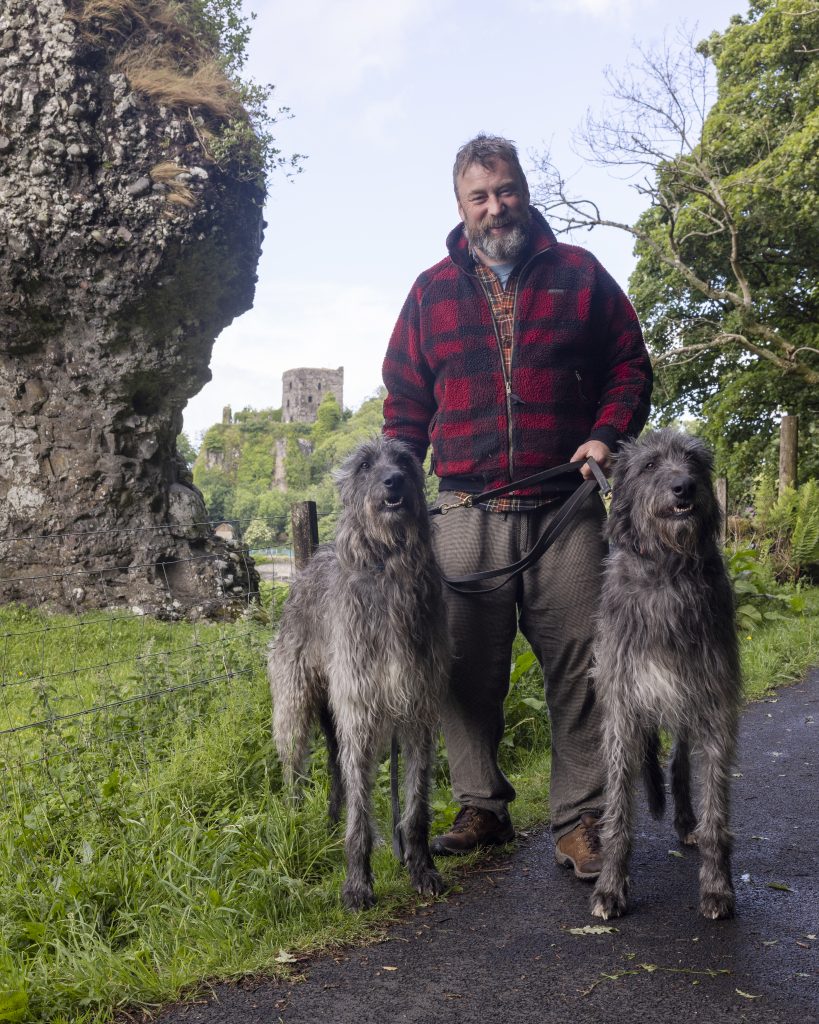
“A Scottish Deerhound,” he chuckles. “I asked my partner what he thought of getting another dog, and he gave me a firm “no”.”
Isn’t arriving home with an unannounced, large breed puppy quite a bold move?
“It was! But he melted pretty quickly when I put Sùla in his lap. Now we’ve got her and Peigi, as well as Flòraidh the westie. It’s a busy house!”
MacQueen’s partner is Coinneach MacLeod – better known as the Hebridean Baker. After such a transformative lockdown for the couple, what’s next?
“My new series, Cruit Phàdruig (Peter’s Croft) starts on the 9th of March on BBC Alba and iPlayer, where I’ll be working with sheep and Highland cattle,” he says, adding, with obvious delight, “Filming for the second series is already scheduled for later this year.”
It sounds quintessentially MacQueen: outdoors, in the landscape he loves, and brimming with enthusiasm.
Peter MacQueen will be appearing at this year’s Boswell Book Festival, 8th – 10th May, Dumfries House. Follow him on Instagram, @highlandhutter.