Industrial Kilmarnock



Dane Love
Kilmarnock has a long and well-deserved reputation as an industrial town, perhaps the most industrious in Ayrshire. There were many notable businesses that thrived over the decades, some making their mark in the world of trade and commerce, but unfortunately changing times and spending habits have meant that most of the heavy industry in the town has either gone, or at best is a shadow of its former self.
The manufacture of shoes is something that Kilmarnock excelled at for many years. Clark & Son was one of the oldest businesses, established in 1820. In 1908 it merged with Abbott’s of England to form the Saxone Shoe Company. A local tradition claims the name came about from a Kilmarnock Football Club score! Saxone had a large factory erected between Titchfield Street and the Kilmarnock Water. Further Saxone shoe factories were erected in Mill Street and West Netherton Street. By 1962 Saxone was part of the British Shoe Corporation but shoe manufacture ceased in Kilmarnock due to cheap imports.
The Glenfield factory was noted for its water valves, used across the world. The Glenfield Iron Company was founded in 1865 to make castings for hydraulic machinery. In 1899 a merger with another Kilmarnock business, Kennedy’s Patent Water Meter Company, resulted in the Glenfield and Kennedy name, one that survives on ironwork across the world. Thousands of ‘pillar fountains’ were located in town and village streets, distinguishable by the Glenfield name and the lion head. In 1951 the firm employed 2,500 people. Various takeovers followed and the company shrunk, but still survives as AVK Glenfield Invicta, making valves and penstocks.
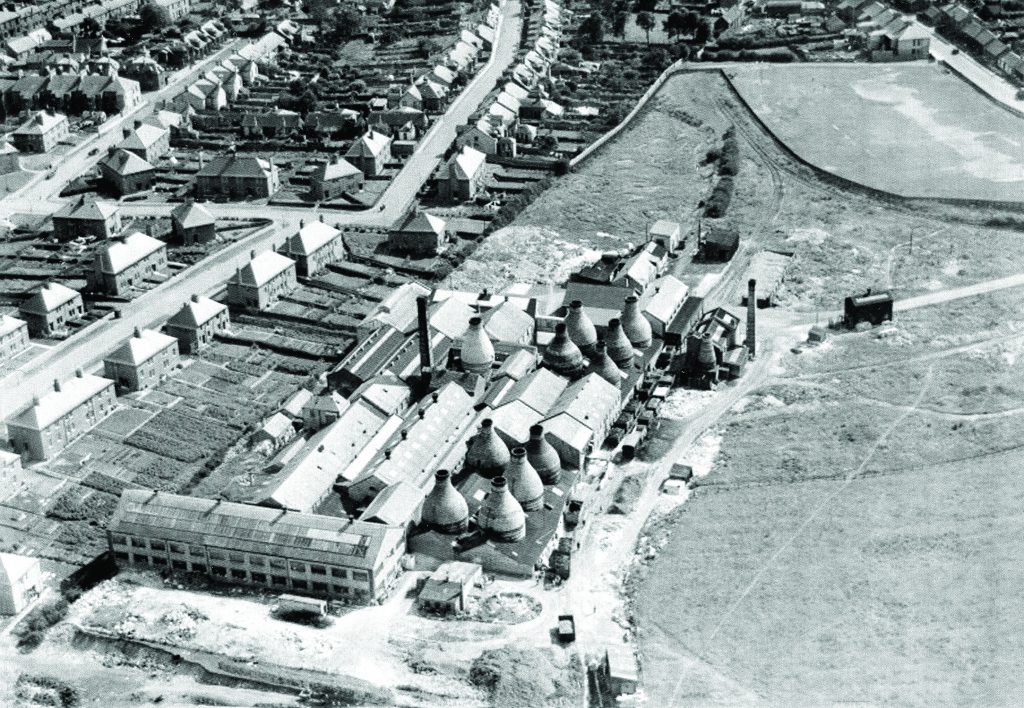
For many years the manufacture of pottery sanitaryware was carried on by J. & M. Craig at the Longpark pottery. This factory was established in 1884 but in 1919 was taken over by Shanks of Barrhead, a name synonymous with toilets. Wash-basins, toilet bowls, urinals and other items were manufactured. Kilmarnock had other potteries – Southhook Potteries Ltd and J. & R. Howie at Hurlford.
The cruise ship Royal Princess, and many other liners, were fitted out with carpets manufactured by B.M.K. in Kilmarnock. The company’s reputation for quality ensured it was specified by many top hotels and even the Emir’s palace in Abu Dhabi. Even the late Queen Elizabeth had a red carpet from Kilmarnock on her wedding day in 1947. The B.M.K. carpet company had a huge factory in Burnside Street which at its peak before the Second World War produced 5,000 carpets and 12,000 rugs every week. Like Glenfield and Kennedy, the company was formed by the merger of two older Kilmarnock companies – Blackwood and Morton, with the ‘K’ indicating Kilmarnock. Gavin Morton was the inventor of a type of carpet power loom. BMK went into receivership in 1981. Older carpet manufacturers in the town included Cuthbertson & Taylor, Gregory, Thomsons & Co and Hugh Wilson.
Kilmarnock was also renowned for the manufacture of steam locomotives for the railway. Andrew Barclay Sons & Company’s Caledonia Works produced an estimated 2,000 engines which were sent all over the world. Established in 1840, the firm specialised in differing kinds of steam locomotives, such as boilers fired by oil, timber and even palm kernels! Since 2020 the works have been home to Brodie Engineering which specialises in locomotive repair and refurbishment.
A more recent engineering firm to settle in the town was Glacier Metal. Originally relocated from London due to air raids, the Kilmarnock factory was established in 1942. Manufacturing of automotive bearings was its speciality. Similarly, Massey Harris, or Massey Ferguson, has come and gone in Kilmarnock. Established at Moorfield in 1949, the company produced over 4,000 tractors and other agricultural vehicles each year but was closed in 1980.
Johnnie Walker’s Kilmarnock blend of whisky became one of the largest selling and instantly recognised whiskies in the world. Johnnie himself, commemorated by a statue in John Dickie Street, was the proprietor of a grocery shop in King Street, but his knack of blending a smoothe whisky soon brought him fame and a huge demand for his product, indeed, at one time it was claimed that there were only three countries in the world where Johnnie Walker whisky could not be bought. At its peak, Johnnie Walker produced three million bottles of whisky each week and employed 700 people. The firm expanded considerably, becoming part of Distillers Company Ltd, but in 2012 its latest owners, Diageo, closed the factory.
There were many other smaller factories in Kilmarnock producing goods that had a solid reputation for quality. There were a number of foundries, producing machinery and components in iron and brass. The Kilmarnock Foundry was one of these, owned by M. Reid & Company. Other manufacturers included the Titchfield, Barclay’s Caledonia, Grange and Holm foundries. The Hillhead and Bonnyton fireclay works produced enamelled bricks, often used for public toilets and kitchens, but uniquely also used for some housebuilding in the town. Bonnet manufacturers abounded and the various woollen mills included the Bishopfield, Craigend, Elmslie, Townhead and Townholm mills.
An almost forgotten industry in Kilmarnock was calico printing, and there were numerous print works across the town, producing patterned shawls and other items of clothing. The trade began in 1770 and Kilmarnock was second only to Paisley and Norwich in the quantity produced. Printworks existed at Burnside, Glenfield, Newton, Welbeck and elsewhere. When fashion changed, these works were usually converted to woollen mills or carpet factories.
Today, Kilmarnock doesn’t have so many heavy industries, but there are still some businesses manufacturing goods, such as Mahle, the current owner of Glacier. There are many service industries, and retail employs many residents of the town.