HARBOUR ARTS CENTRE



AN ASSET TO IRVINE
Martin Stewart
Times are hard for the arts. If things were tough before the COVID-19 pandemic, the acceleration of changing habits brought about by self-isolation and social distancing made things worse, leading even the Royal Shakespeare Company to declare “the biggest threat to our cultural landscape in a generation”. Even now, between fighting for funding, competition from home streaming services and the spiralling costs of maintaining premises, it’s never been harder to put on high quality artistic events.
Thank goodness, then, for the Harbour Arts Centre.
The HAC sits both at the heart of Irvine Harbour and the conversation about the importance of arts to contemporary civic life: questions about the importance of community, participation, and creative ambition in the time of artificial intelligence and social media. At its foundation, sixty years ago, The Irvine Times reported a discussion between the Harbour Arts Centre and the Workers’ Educational Organisation as “a conference being held on ‘The Arts – Who Cares?’”, the aims being “to stimulate discussion about the place of the arts in our society as a whole, and about the particular place of the Harbour Arts Centre in the life of Irvine”.
That the building was founded in 1888 as a seamen’s mission highlights the extent of its connection to Irvine old and new, its prominent position on the harbour a measure of its importance to the community. Originally named after its local benefactors, the Mure Mission Hall became a popular venue almost immediately – but it wasn’t always a place for the arts. An unused emergency mortuary during the Second World War, the building went on to host a knitwear business before falling into disrepair.
Then, in 1965, came the New Town plans.
This process of regeneration led to the establishment of a New Arts Group who – inspired by a visit to Cumbernauld Arts Centre – seized the opportunity to develop a similar programme on the west coast. The Royal Burgh of Irvine purchased the building for just over £3,000, and the HAC’s new life began.
The venue’s first event came in 1966, featuring one of Ayrshire’s finest writers in the poetry of Willie McIlvanney – with folk music. The broad spectrum of this debut is indicative of the ongoing commitment to diverse and varied work, with the emergent HAC having also hosted the drama group, wine making, lecture series, Irvine Camera Club, and the Film Society. There were also barbeques, dances, suppers, and, somewhat unexpectedly, a demonstration from the Irvine Judo Club!
The arts centre was, from the beginning, an important fixture of Irvine’s social fabric, providing education and community. That the venue was run by volunteers until 2003, including during a major renovation in the mid-70s, demonstrates the firm belief of the people of Irvine that participation in the arts is a vital part of living in a happy, successful town.
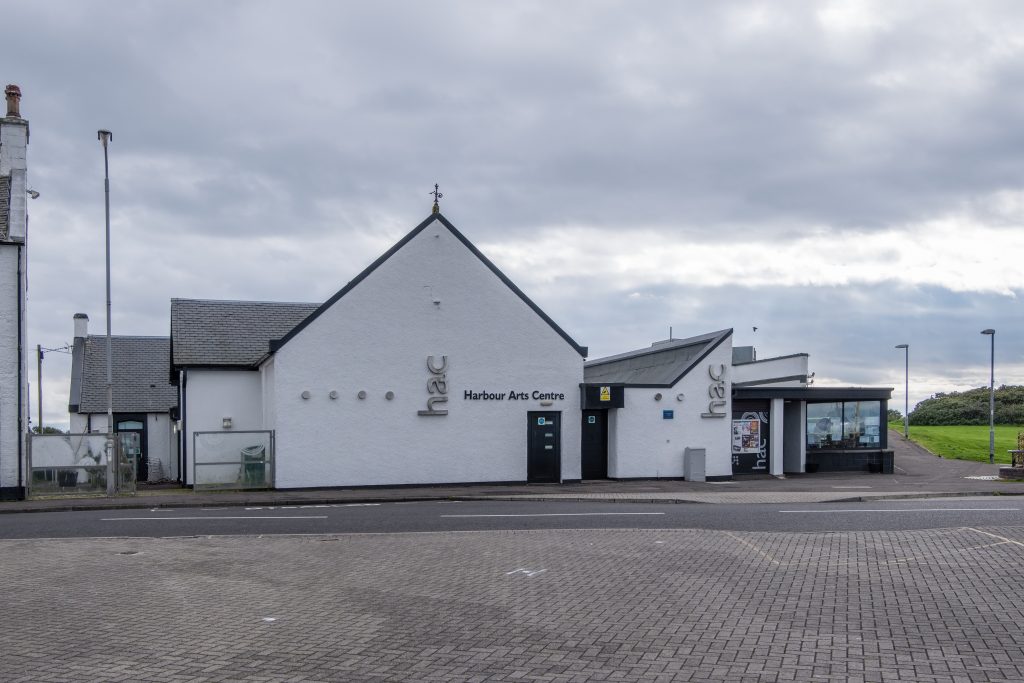
This principle runs through the Harbour Arts Centre to this day. Its commitment to variety endures, with the ever-changing gallery of paintings sitting alongside theatrical performances, arts and crafts sessions for toddlers, stand up comedy, arts workshops, family film clubs, and the ever-popular Tidelines Book Festival.
Tidelines, established in 2013, runs in the HAC every year over a weekend in late September. A major fixture on Scotland’s literary calendar, this community-run programme matches its venue’s principles in bringing the arts to its community through a commitment to affordability, a generous schools programme, and free events designed to combat loneliness and isolation. The festival’s board consider their event to be inextricable from the centre itself, describing it as their “spiritual home, with a great atmosphere, which is highly praised by audiences and authors alike”. More than this, they consider the centre, “an asset to the town”.
It’s hard to disagree.
With many arts organisations facing an “existential threat”, and the Theatres Register maintaining an ‘at risk’ list of the most endangered venues, we should certainly be wary of taking such a precious resource for granted.
The venue’s current staff are as enthusiastic and passionate as you’d expect, describing the HAC as a “special” place where “people can come to meet, enjoy live performances, and participate in arts activity right on their doorstep”. This accessibility is key, meaning the people of Ayrshire aren’t forced into costly trips to Glasgow and Edinburgh to engage with high quality artistic work.
This stress on community is central to the staff’s perspective, with their emphasis firmly on the people involved in the centre’s work. It’s not simply about art, or some dry, abstract notion of creative principle, it’s “the people: the arts team, the artists, musicians, performers and community groups who are so passionate about what they do”.
Even when pressed for a favourite memory, HAC staff won’t be drawn. “There are so many, but it’s just watching audiences engage with our events and exhibitions and hearing them chat about what they’ve seen.” This is especially the case when first-time visitors come to something on the extensive programme. “It’s wonderful hearing that they’re excited to come back, and are planning their next visit!”
What are their hopes for the future?
“To see the HAC continue to thrive as a creative space for Irvine and north Ayrshire, with lots of opportunities for artists, musicians, performers and communities.”
“Thrive” is an interesting choice of language, suggesting vitality, growth, and life. Theirs is a positive vision, going back to the very roots of the centre’s establishment as a place for everyone’s enjoyment.
So, let’s revisit the same question posed by The Irvine Times all those years ago: who cares about the arts? The staff of the Harbour Arts Centre care. The artists who bring their energy and vision to its theatres and halls care. The organisers and volunteers and visitors and guests care. And the people of Irvine, proud to have a cultural gem on their harbourfront, care.
Here’s to another sixty years.