


Chris Palmer
What are your priorities when you are viewing a house? By that, I mean a property that either you, or a friend or relative, are considering buying. Maybe I could rephrase that. Where do you go first when you start to view the house? The kitchen to see if there are enough work surfaces? Will our super king bed fit in any of the bedrooms? Will we need a new bathroom? I can tell you where I go… the garden.
If the garden fails to meet my expectations, which aren’t necessarily that exacting, I will take some persuading to consider the house favourably. My initial thought is, in what direction does the garden face? This might seem obvious, but it can be so easily overlooked or considered a minor matter if the house is ‘just perfect’. Having lived in two houses which were north-facing I would fight tooth and nail to avoid another.
It was surprising to read in a newspaper column recently under the heading ‘19 gardening myths’ that ‘south facing gardens are not always best’. I nearly choked on my porridge! The journalist’s opinion was that with the impact of climate change, the value of shade will shoot up. This could only be written by someone living in the south of England. I’m not a climate-change denier by any means. I do not, however, want to move around the garden in the afternoon to find some sunshine to sit in, whilst the front of the house, by a busy road, is bathed in sunshine.
When I’m scrutinising the garden, I look out for any sign of two plants. One is certainly unusual but it might just be worth being aware of it. Japanese Knotweed is a dangerous invasive shrub. A search on the internet will give you the details. It makes me think of The Day of The Triffids. A reliable surveyor would be looking out for it as it has the capacity to undermine foundations. The other, not worrying to a surveyor but a major headache to a keen gardener is Mare’s Tail. This pernicious plant defies the strongest weedkiller. It is very distinctive, often seen pushing up in pavements. However scrupulous you are in weeding it or applying the strongest weedkiller, it will never be completely eradicated. If it’s in a garden you’re thinking of buying, you know that you will have an annual battle that you can never win.
When I told my mate, Sandy, about my Big Mama, I could see immediately that he was not impressed.
“I gave you three of my Crimson Cherries.”
“I know, and they are doing very well.”
“You’ll never beat them for taste.”
“Possibly, but I wanted a large plum variety and I read that Big Mama is resistant to Blossom End Rot.”
“And I taught you the secret of the bottomless pot.”
“I’m grateful for that as well.”
It’s my first year of growing tomatoes in my greenhouse and it feels like I’ve had to learn a new language. Let me explain to the uninitiated.
Although my greenhouse guru, Sandy, can be a bit tetchy at times, his advice is invaluable. I’ve seen the success in his own greenhouse. Following his method, I cut out the bottom of several 25-centimetre pots and placed them full of good quality compost on top of the soil in the greenhouse. In early May, when the fledging tomato plants were quite small, I planted them into the bottomless pot. You may remember that hot spell back in mid-April that ran into most of May. I was watering them every day and they grew strongly. The principle behind this method, according to Sandy, is that it encourages stronger root systems and can help prevent root diseases.
I’m pleased to say that both Sandy’s Crimson Cherries and my Big Mama are doing well, so far. There is no sign of Blossom End Rot. It is one of the many potential disorders of greenhouse tomatoes. I read in a catalogue that some varieties are more resistant than others. I have also learned that it is important in very hot weather to keep the greenhouse well ventilated, leaving both the door and side vents fully open. Fungal diseases thrive in humid air. I keep the path damp as this helps to keep the temperature lower. Applying the correct amount of liquid feed is critical. Don’t overdo it!
“There is a lot to think about. I sometimes wake up in the middle of the night worrying that I might have forgotten to do something.”
Did I over-water yesterday? Have I left the vents open? Have I pinched out the side-shoots? Will I see the first signs of blight in the morning? At least I’m not stressing about Japanese Knotweed. That would be a nightmare. The taste of the first home-grown tomato of the season makes it all worthwhile.
For inspiration and encouragement, mid-summer is a good time to visit specialist gardens and there are a significant number in Ayrshire. Last July, on a warm sunny morning, we had a family outing to Dumfries House, on the outskirts of Cumnock. An uncle and two cousins drove down from Glasgow. There is a great deal to see, but I really enjoy in particular the walled garden. It is a labour of love for the many volunteers who work there. In the fruit and vegetable garden area I compared the progress of my own plants to all the varieties growing there. I also make a note of anything new that I have not seen before.
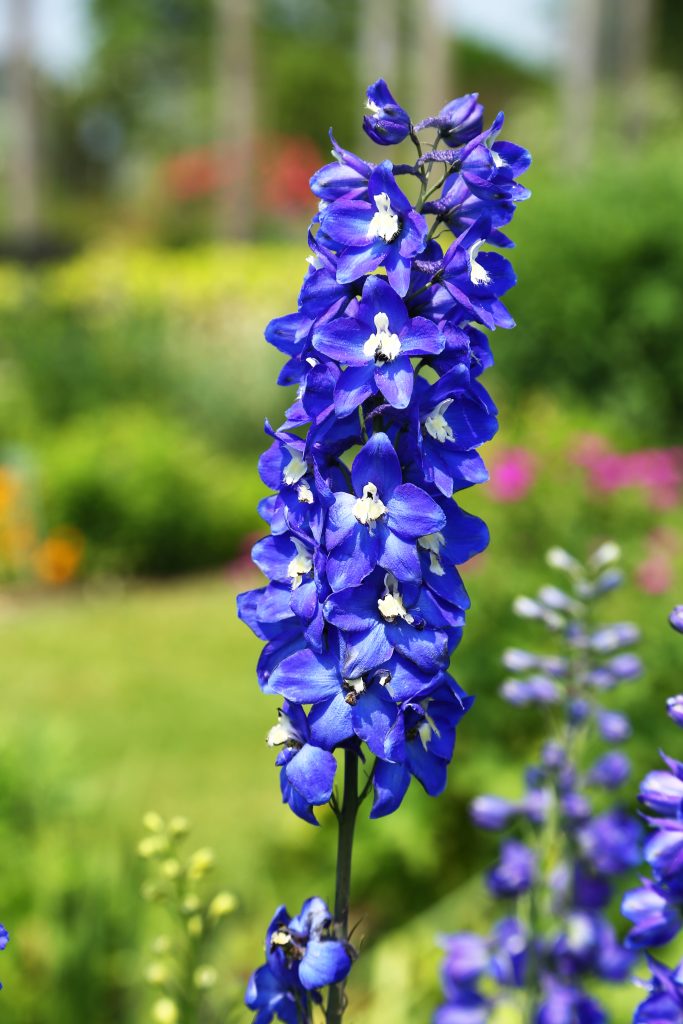
The highlight, however, was a particular flower border which was full of delphiniums just in bloom. I knew very little about this plant, but I now find it irresistible. The grand, stately purple blooms towered over us, swaying slightly in the gentle breeze. They proved to be the perfect backdrop for a family group portrait. I wish that I had taken a note of the variety. I’ll remember to look when I return this year.
Early this spring, I was examining the plants outside a popular discount supermarket (I’m always looking out for a bargain). They had delphiniums for sale at £1.99 each. Remembering the Dumfries House border, I couldn’t resist them and bought three plants, even though I had nowhere to put them. Yes, I know it doesn’t make sense, but I could always pass them on to someone with more space, couldn’t I?
As it happened, the variety Dark Blue White Bee proved to be much more compact, growing only to 75-centimetres. I potted them on for a couple of months, and they ended up in a large pot with a strong stake and were a delight for several weeks. They are already a favourite, and should continue to flower for a good number of seasons to come.
It is high summer. There is still so much to do in the garden. You will, however, slowly start to notice that the days are already getting shorter. Summer can slip away before you know it. Don’t forget to enjoy your garden, whatever size it is, while you can.