A TALE OF THREE POST BOXES


Chris Palmer
One day when I was still a nipper, I was entrusted with posting the Christmas cards for the family. Over half a century ago, for those unfamiliar with those times, stamps were relatively inexpensive, and it would not be unusual for families to send out 30 or 40 cards each Christmas, maybe even more. It was a useful means of keeping in touch with distant family or friends. You could touch base with relatives you didn’t particularly want to see, but did not want to completely cut adrift. We all have a few of those, don’t we?
As I recall, I had to go to the main post office in town because I had to buy the stamps first. It was next door to the library which was the main purpose of my journey.
“You will be careful, won’t you, Christopher?”
“Yes, Mum.”
“Are you listening?”
“Yes, Mum.”
“Do the Christmas cards before the library.”
“Yes, Mum.”
I cycled into town, locked my bike, walked to the post office and posted the cards in the post box outside.
I then queued for the stamps.
I’m sure you’ve spotted my awful error, my catastrophic clanger, which only came to me as I went to fix the stamps to the cards. Don’t ask me what happened when I arrived back at home to face my parents. I’m still having therapy for it!
I can testify to the quantity of cards that used to be sent. In the mid-1970s, during one Christmas vacation from Chester College, I signed up to help with the Christmas post. It was common then for students looking to bolster their student grants. It was casual labour, reasonably well paid, with no tax. I can’t remember if I used my own or a GPO bike, but the bag was swollen with post, very heavy and the day was long. And that year in Chester it snowed before Christmas. By some bizarre coincidence, considering the population of the city, my round included delivering to my girlfriend’s flat.
So, you might say that I have a history involving the Christmas post, and in recent times, purely by chance, a passing interest in post boxes. And, yes, I’m not afraid of admitting it. More accurately, though, it is three post boxes that have attracted my attention as we approach a time when some folk may well use them for the only time in twelve months.
Can you name a listed building in Ayrshire that is only five feet high, cylindrical and mainly red? Well, I have signposted it, haven’t I? There are two – one in Kilmarnock, and the other in Seafield, Ayr. How come, you might well ask?
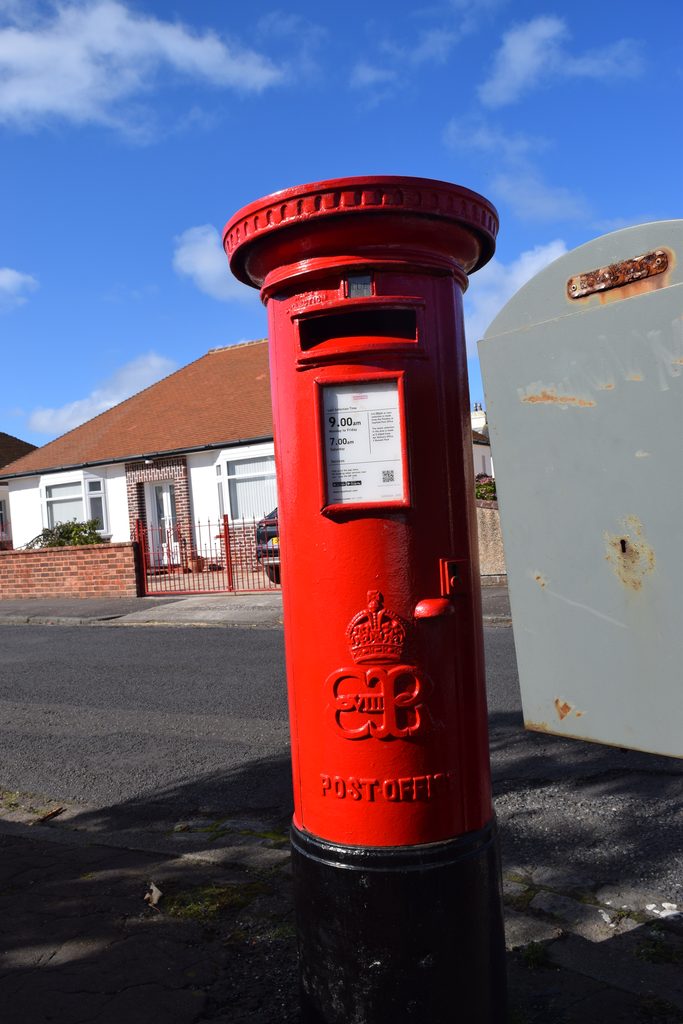
Edward VIII had an unusually short reign of less than a year before he abdicated in December 1936 to enable him to marry the woman he loved, the divorced American, Wallis Simpson. Post boxes and wall boxes were erected in the normal way and had on the lower part of the door the cipher EVIIIR in raised gothic letters. When his reign came suddenly to an end, all wall boxes were updated, but doors on pillar boxes were left unchanged. So rare are these that they are all designated as listed buildings.
When this information was first imparted to me, I felt compelled to go and see the one in Seafield, hence the photograph. I must admit I received a funny look from the house owner across the road as I got out my camera. I also, now, look at post boxes in general with greater interest, and in particular the royal initials displayed on them. This leads me neatly to a post box, in contrast to the last, that is the subject of many postcards and holiday photographs.
We have to cross the Firth of Clyde to Arran. On arriving in Brodick, we take the String Road across the north of the island and stop at the junction with Machrie Moor. There sits the unique stone pillar box which was built as far back as 1859.
It was first built of wood and painted a bright white. The post was collected by a horse-drawn mail brake running between Shiskine and Brodick. In the 1870s, the exact date seemingly uncertain, a horse was spooked by the bright, white construction and threw its rider. On hearing of this, a guest of The Earl of Arran paid a local stonemason a generous amount of money to construct an improved Permian sandstone post box decorated with mason’s marks, hence the unique appearance. It is one of the landmarks on the island, with many cars pausing at the junction to have a look and ponder its history.
Back to the mainland for post box number three. We are now in Alloway where the post box is situated outside the post office, virtually opposite Burns Cottage. Alloway village attracts many tourists and in the past the post box has been ‘yarn bombed’ with knitted or crocheted coverings to celebrate Burns Night and other festivities.
It had a different look last November and has enjoyed a chequered year. For several months it was wrapped up in cling film like leftovers in the fridge. It looked unwanted and was certainly unused. Eventually it became one of a number of new solar-powered digital post boxes that can handle parcels as well as letters.
It appears that the change was not wholly popular. Change rarely finds unanimous approval. Some months into its new life, the local critics of the change found an unlikely champion. An unlucky motorist made an error of judgment, mounting the pavement and knocking the relatively new post box over. Royal Mail, as if sensing some form of judgment on its innovation, when it restored the post box, reverted to the old style, and the status quo has been returned.
I’m not sure if there is a word for post box enthusiasts. If there is one, I’m not a member. Honestly! However, like many social history aspects of our lives, they can tell a story.
Will my granddaughter, aged just over four and a half years, ever get the thrill of opening an exciting pile of Christmas cards that have landed with a thud on the mat? Will she ever both write and post one? I suspect not, but predictions of this nature can prove to be wrong. The jury is out. Happy Christmas!