

In Dreghorn
Dane Love
According to archaeologists, Dreghorn is perhaps the longest continually inhabited village in Britain. Excavations off Station Brae discovered the remains of ancient houses, dating from the Neolithic period (around 3500 BC), and it is reckoned that the village has been morphing on the same site ever since. Although it became part of the wider Irvine New Town in 1966, residents always claimed their independence from its larger neighbour and are fiercely proud of their village.
MORNING
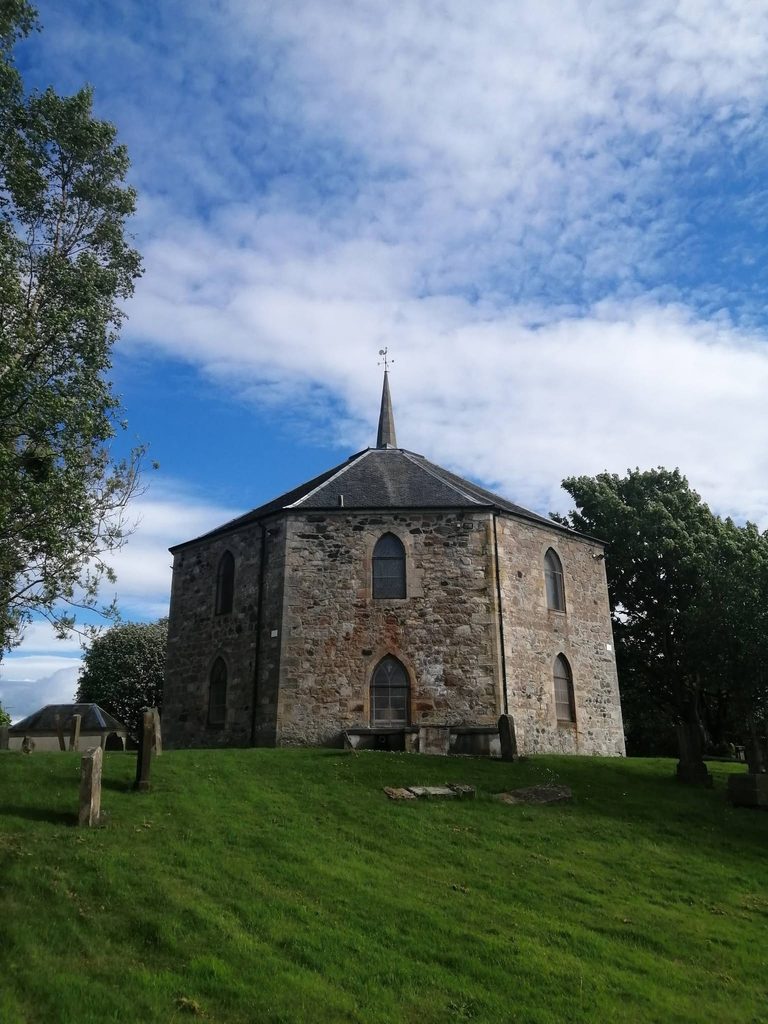
Dreghorn’s most historical surviving landmark must be the parish church. To locals it is the ‘Thruppeny Bit Kirk’, so called from its plan. The church takes an unusual eight-sided shape, one that is almost unique, with a pyramidal slate roof. The only addition to this octagonal sanctuary is the spire, a simple but slender tower.
The church owes its existence to the 11th Earl of Eglinton, the major landowner hereabouts. He funded the present building in 1780, replacing an older church that occupied the same site. A similar church was erected at his Eaglesham village in 1788. At the corner of the interesting old graveyard, where a number of eighteenth-century carved stones can be found, is the former village school of 1774, later converted into the Session House.
A wander along Dreghorn’s Main Street to the east will reveal a few places where you can enjoy a coffee, cake or carry-out snack. The library sits at the opposite corner of the Cross from the church, and there a memorial to John Boyd Dunlop can be seen. He was to develop the rubberised pneumatic tyre which revolutionised road transport. Inside the Dunlop Memorial Hall is a mural in Dunlop’s memory.
AFTERNOON
Having browsed the centre of the old village’s principal street, it’s perhaps time to stretch your legs a bit more. Despite being in a fairly urban setting, there are plenty of rural walks around the village. As we are wandering up the Main Street, keep walking past the last houses into the open countryside. There are woodlands on your left and open fields to your right. Within a few hundred yards you’ll arrive at a block of large villas on your right, including Kidron House. This was erected on the site of an old church building. The church was disused and put on the market but, unlike many church conversions, this one was bought, dismantled stone by stone, and packed into crates. It was then transported halfway round the world to Hiratsuka in Japan, where it was faithfully rebuilt adjoining a large hotel in 1997.
Apparently the Japanese wanted a wedding chapel that looked like western films!
Opposite Kidron House a footpath heads north into the woods, and you should follow this. The surface is tarmacadam, so its an easy and clean walk, suitable for prams, wheelchairs or kids on small bikes. After a few hundred yards a branch strikes to the left, and this should be followed alongside the Capringstone Burn. A foot bridge crosses the Annick Water and then the path follows the line of an old railway, again the surface finished for easy walking. The woodlands that are passed through could be in the middle of nowhere, and you get a feeling of isolation.
If a shorter walk is all you need, then you can return up Station Brae back to the Parish Church, or if you want a little more, the path can be followed westwards through slightly more open countryside to a former railway bridge across the Annick Water once more. After crossing it turn left and a path brings you back through the houses of Dunlop Crescent to the village centre.
EVENING
If you’ve built up an appetite you’ll be wanting something to eat. As you make your way back to the Thruppeny Bit Kirk you’ll pass The Brae on your left-hand side. This is a traditional village inn, family owned and operated, located in converted single-storey former weavers’ houses, for which Dreghorn was once famous. The Brae offers lunches, dinners and once a month does special Sunday carveries. The inn has won numerous awards, and it’s dog-friendly and offers special deals on different days.
I’m sorry to drag you from the comfort of the bar with its selection of cocktails, ales and whiskies, but if it’s a nice evening then it’s worth popping up to the war memorial on an elevated mound at the east end of the village. In addition to seeing the monument to the sons of the parish who gave their lives in two world wars, the view over Dreghorn and to the west is worth seeing as the sun sets over Arran. The vista includes much of the Firth of Clyde, and on a clear day one can see Ailsa Craig to the south-west, the mountains of Arran to the west, and the hills of West Kilbride and Argyll to the north-west.
Dane Love has written extensively on the history and heritage of Ayrshire. Find out more at www.dane-love.co.uk