Historical Prestwick



Dane Love
Prestwick is one of Scotland’s oldest burghs, the charter of renewal issued by King James VI in 1600 stating that the burgh had by then been in existence for at least 617 years. Despite its longevity as a burgh, initially the community did not thrive, being little more than a few thatched cottages alongside the roadway to the ancient St Nicholas Church.
The ruins of this church survive in its ancient kirkyard at the end of Kirk Street. Four walls and gables are perched on the low knoll, abandoned since the end of the sixteenth century when the parish was united with that of Monkton, Monkton Church being used as the place of worship. In this old kirkyard are many interesting gravestones, and it is said that some Covenanters were buried there.
The burgh of Prestwick was controlled by 36 Freemen, and they remained in charge until 1850 when their rights were abolished. Each freeman held strips of land around the village for a period of nineteen years, after which they could be reallocated. Prestwick was more enlightened than many other burghs in that females could succeed as a freeman on equal terms to their male counterparts.
Prestwick grew slowly – the population as recently as 1880 being around 1,000. The railway arrived in 1846 making it more accessible to travellers who found the beach a pleasant place to walk. Soon the dunes were recognised as having potential for playing golf, with Prestwick Golf Club being instituted in 1851. In 1860 they invited players from all over the world to what became the first Open Championship, won by Tom Morris. A memorial cairn at the golf course commemorates the event’s origins, which was played at Prestwick on 24 occasions, the last time being in 1925. Unfortunately, the Old Course at Prestwick is not deemed suitable for the present international event.
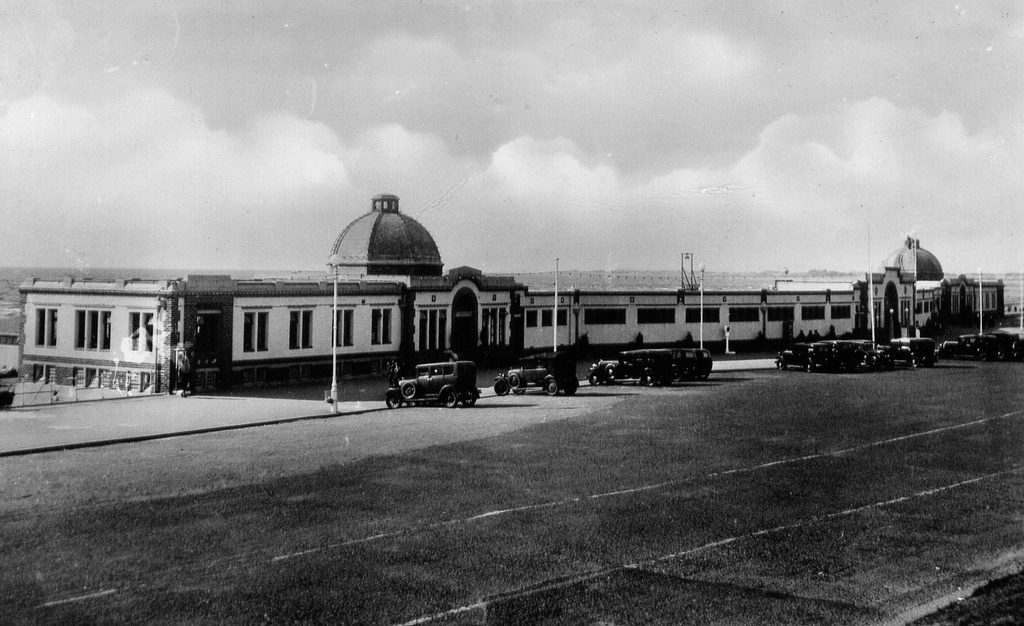
A growing town resulted in Prestwick becoming a Police Burgh in 1903, and the new town council commenced developments to cater for residents and visitors alike. A large bathing pool was created at the shore, the annual galas and beauty pageants attracting thousands of visitors. The pool survived from 1931 until 1972, its cold water being less attractive than more modern indoor heated lagoons.
To cater for the needs of the influx of visitors and golfers, numerous hotels and boarding houses were established, such as the Towans Hotel, Links Hotel, Parkstone Hotel, and Queen’s Hotel.
The flat fields north of Prestwick were identified as being a suitable site for an aerodrome, and this was established in 1933 by the Scottish College of Aviation. The former Orangefield House was adapted as the first terminal building, an aircraft control tower being built over the roof. This was subsequently replaced by the present terminal, opened in 1964. Prestwick has its unique place in pop history as being the only place on British soil where Elvis Presley landed, on 3rd March 1960, whilst serving in the United States Air Force.
Few people now associate Prestwick with the coal industry, but at the northern end of the burgh the Glenburn Colliery was opened in 1911, officially Auchincruive Numbers 4-7. A mining community was established at the Glenburn Rows. The pit closed in 1973.
Prestwick’s Main Street is a popular shopping area to this day. Just beyond the northern end is the former North Parish Church, dating from 1874. On the other side of the road is the Freemen’s Hall, built in 1844 as a meeting room and later converted into a school and jail. The Red Lion Inn dates from the eighteenth century, a major posting establishment before the arrival of the iron horse.
At Prestwick Cross the ancient Mercat Cross survives, rebuilt in 1777. The lawns and flower beds of Boydfield Gardens form a welcome open space in the town centre where the war memorial was placed. Prestwick Town Council demolished buildings here with the intention of erecting a large civic centre, but this never materialised and the Links Hotel was adapted instead. On the opposite side of the street is the Town Hall, originally the Unionist Club, erected in 1899, which was often used for meetings.
The former South Parish Church stands on the west side of Main Street, erected in 1884. The street’s buildings seem to become smaller the further away they are from the town centre, many being old weavers’ cottages. St Nicholas Church is the exception, a massive Mauchline sandstone building with a tall steeple, the work of the noted ecclesiastical architect, Peter MacGregor Chalmers, and erected in 1908.
Just off Maryborough Road is Bruce’s Well, an ancient watering place where King Robert the Bruce is said to have used the water to wash. He is known to have suffered from a skin complaint, some say it was leprosy, and the waters appear to have soothed the pain. To reward the hospitallers he endowed the site and granted them extensive lands, but this was ultimately acquired by the Burgh of Ayr in 1786.
Dane Love is the author of the recently published A Look Back at Prestwick, available from Carn Publishing. Find out more at www.dane-love.co.uk/lookbackprestwick.