Stewarton and District Historical Societyand Museum


Chris Palmer
Arriving early in Stewarton on a damp morning in November I found sanctuary in the Renew Wellbeing Café in The John Knox Church. Over coffee and an angel cake I confessed to a kind and perceptive host that my knowledge of their town was woefully limited. As I was helpfully shown the way to the museum, I was assured it would demonstrate that Stewarton is more than just bonnets.
Stewarton and District Museum is housed in the Stewarton Area Centre, a multi-purpose community centre in the heart of this vibrant town. As well as the museum the centre houses the library and a main hall that can seat 220 people. The museum is compact and packed with a diverse collection of artefacts. There is no waste of space. It was warm and welcoming.
I made two visits, initially meeting Matthew and Megan, two charming and informative guides who gave me a preliminary view of the museum. A week later I met the top brass (I know they will chuckle at that description) Sheila and Sandy Plant, curator of the museum and secretary of the Society respectively. They explained that the Society started as a group of enthusiastic local people from the community with an interest in local history and a mission to preserve and assemble items of interest that might otherwise be lost for future generations. Initially they acquired a modest-sized room in the town centre. As the years passed this became overcrowded. Their persistent representations to the local council were eventually rewarded by a room in the Centre.
The Society has a membership of between 25 and 30, paying a subscription of £18 per year. Between September and May there are monthly talks on a wide range of topics. This season they include The Covenantors of Ayrshire, The Life of Andrew Carnegie, and Paisley Witch Trials. The museum received a modest grant from Stewarton Initiative (funded By East Ayrshire Council) four years ago. The Society is in the throes of a potentially game-changing application for Museum Accreditation. If successful, the museum would be ‘put on the map’ alongside museums such as The Dick Institute in Kilmarnock.
The aim of both the Society and the museum itself is to bring to life the social history of Dunlop, Fenwick, Kilmaurs and Stewarton. Local history is a powerful tool in the construction of identity. Sheila emphasised to me several times how important they feel it is to involve ‘tots to teens’ in the museum. School visits are encouraged and there are facilities such as art carts, drawing paper and quiz items.
With such a wealth of artefacts to discover I invited Sheila and Sandy to nominate the top four or five which I should consider and include in my report. Naturally there is an abundance of practical exhibits and reference books relating to the bonnet industry. It has been, after all, the main industry of the town. There are working machines and examples of bonnets through the ages, including those worn by Scottish regiments serving in many parts of the world.
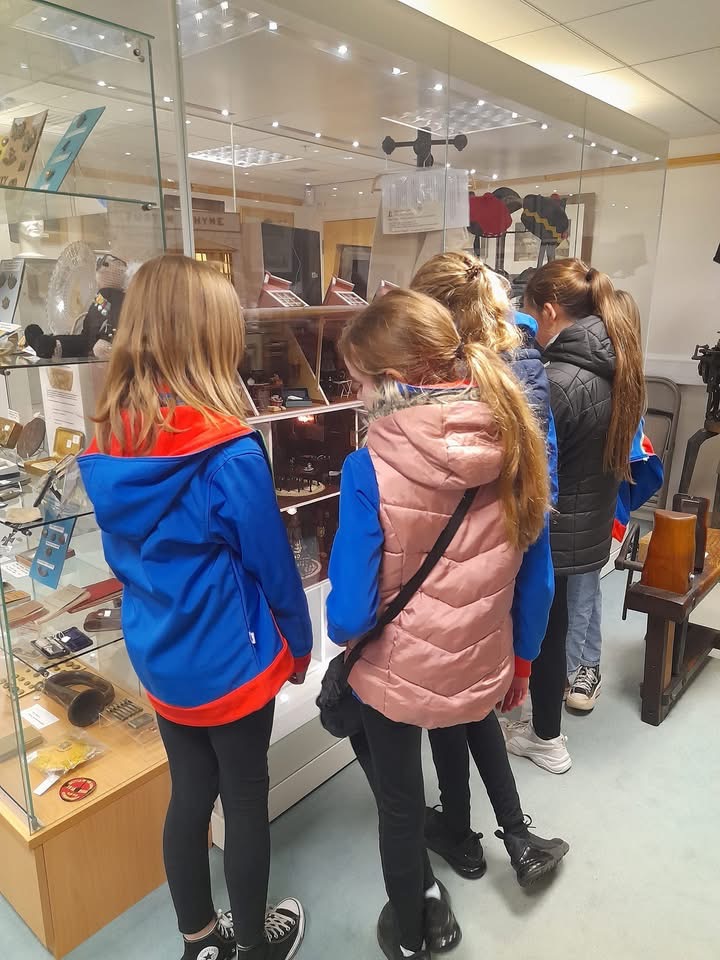
The museum is very proud of the extensive display of medals for gallantry from both world wars. These have been donated by local families and are lovingly set out with details of each individual. The museum also houses a comprehensive Roll of Honour listing all local servicemen and women who fell in both wars.
In contrast to the above, there is a fine collection of paintings by a distinguished local artist, James Taylor Brown, who was born in Kilmarnock in 1868 and moved to Stewarton in !870. Brown had a shop in the town and an artist’s studio at the rear. He had the guidance of, and took lessons from, a famous group of artists known as ‘The Glasgow Boys’. He had many national exhibitions including one at the Royal Scottish Academy.
The museum is keen to be ‘hands on’ so there are opportunities to hold on to and examine objects of local historical importance, assisted by experienced guides such as Matthew and Megan.
Quoiting was very popular in Stewarton. Very much a ‘men-only’ sport, it involved throwing very heavy iron rings at a target such as an iron pin that was driven into the ground. Sandy painted a picture of farmers enjoying the game after market once a week. I lifted a hundred-year-old quoit weighing 22lbs and tried to imagine throwing it any distance at all. It was more likely to end on my toes. I’ll stick to golf.
I also had an opportunity to examine a belt. This is a solid piece of leather with one or two slits at the end. This belt (or tawse) was used to physically discipline pupils in one of the Stewarton schools. Holding it, and imagining it being used on children as young as six or seven years fills me with horror.
In our conversation Sheila emphasised more than once that the museum recognises the need to include histories of local people who have excelled at sport, as this can capture the imagination of the younger visitors. There are press cuttings and memorabilia of sports such as archery, curling, football and taekwondo. Rose Reilly, for example, is a truly inspirational figure from women’s football.
Born in Kilmarnock in 1955 but brought up in Stewarton, where she now lives after a globe-trotting football career, Rose Reilly can be safely described as a true trailblazer for women’s football. The exhibits trace her extraordinary life from a start with the local boys’ club, Stewarton United (as long as she cut her hair and called herself ‘Ross’) to playing for both Scotland and Italy – the only Scot to get her hands on a World Cup.
Visitors to the museum have access to a comprehensive collection of articles, books, photographs, paintings, maps and computer records. The society holds records for school registrations, church and burial records and land registration. Visitors looking for help with genealogical research will find a wealth of information. I noticed in the Visitors’ Book that in recent months the museum has had folk from New Zealand, Seattle, Winnipeg and Redhill, Australia. There is also on the society’s website, a contact form to enable e-mail enquiries to be sent about family history.
I was so intrigued by the museum’s collection that I missed my train. As I left, I offered to take a photograph of the Secretary of the Club and the museum’s curator, but they were too modest. I’ll not forget their warm welcome. Opening times are on the website. If you are in North Ayrshire, call in and see that this area is not just about bonnets.
www.stewartonhistoricalsociety.com