


A Walk Through Cessnock Wood
Linda Brown
Clusters of bonnie snowdrops, lantern-like heads bobbing in the sharp January breeze, have popped up along the grass verges. Their presence brings me hope that winter’s grip is loosening and spring is waiting around the corner, although, who am I kidding? We all know February, even March, can still bring snow, ice and strong winds. Yet these resilient little flowers battle through, brightening our winter-bare hedgerows and skeletal woodlands through dreich days still to come.
I’ve set off just after first light, and I’m on one of the farm roads on the south side of Newmilns in the Irvine Valley. It is a steady uphill trudge, testing my legs and lungs, but I know my waistline will thank me for it.
Pausing at a gate to admire the view – most definitely not to take a breather! – I watch a consolation of fieldfares (I love kooky collective nouns) patrol the field, foraging for snails, earthworms and insects. These Scandinavian and Eastern European winter visitors, members of the thrush family, are handsome birds with blueish grey heads, chestnut backs and mottled breasts. Listen out for their harsh tsak task calls carrying across farmland from October to April.
One fieldfare, a wriggling worm dangling from its beak, cranes its neck, keeping a watchful eye out for any danger. Halfway along the field, beneath the tangled roots of a hawthorn hedge, a flicker of movement catches my attention. Shhhhh… I haud ma wheesht (as my granny would’ve said), and my breath, then raise my camera –my timing perfect – as a brown hare slips into the open. His ebony-tipped ears twitch, alert to every sound. For a moment, his wide, golden-brown eyes survey the landscape, then he takes off; powerful hind legs propelling him in bounding leaps as he zig-zags across the field. Startled, the fieldfares rise in a chaotic flurry of wings. Abandoning their feeding ground, they fly noisily over my head, in search of another spot to plunder for breakfast. The hare reaches the hedgerow on the far side of the field, and the last I see of him is a flash of black and white tail before he is swallowed by undergrowth. I plod on, along a mucky tractor track, then onto a quiet road, to finally reach the entrance to Cessnock Wood.
Situated outside Galston, Cessnock Wood, one of the Irvine Valley Walking Trails, is popular all year-round with dog walkers, ramblers and families. This morning, I’m no sooner through the kissing-gate, and up the muddy steps to the path, when I’m met by a jubilant black Labrador. The dog jogs with a determined air, hauling a thick moss-covered branch, much longer than herself, clenched between her jaws. I chuckle at her optimism.
“Daisy loves a big stick,” the lab’s exasperated owner explains, as she passes. “But this one takes the biscuit.”
Daisy drops her ‘big stick’ and looks doe-eyed at her owner, perhaps hopeful for assistance. But before the branch can be confiscated, she snatches it back up and trots on. I wonder who will end up carrying Daisy’s treasure home?
Heading deeper into the woods, following the recently upgraded gravel path, I listen for birds. In Cessnock Wood, it’s not unusual to hear great spotted woodpeckers and nuthatches alongside my old pals: the great tits, blue tits and robins, who always appreciate the birdseed I carry in my pocket.
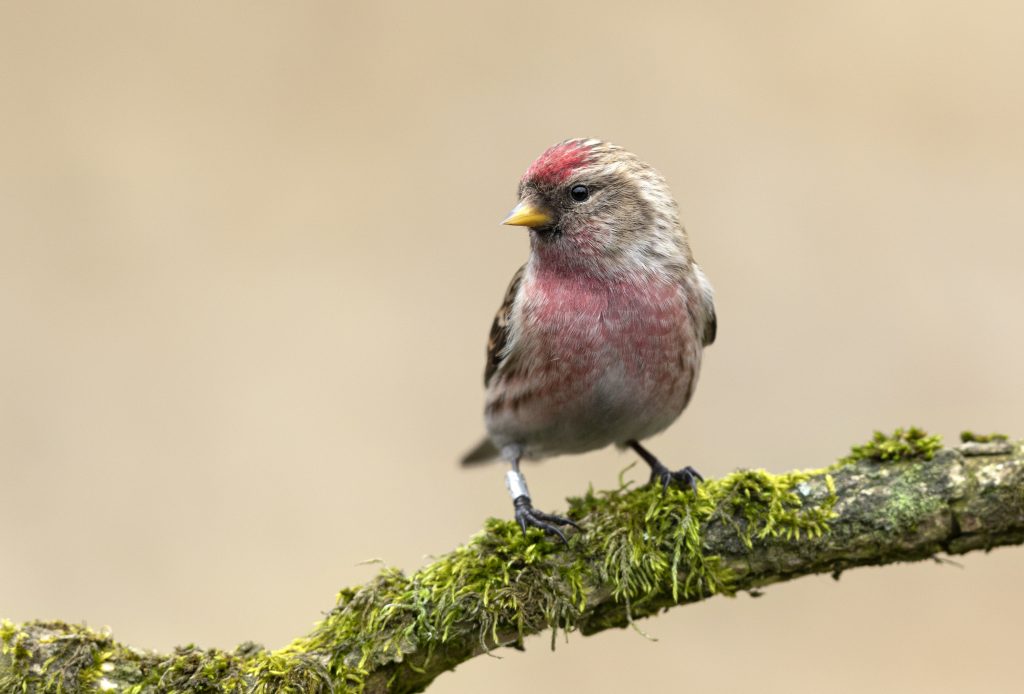
I’ve just crossed the narrow wooden footbridge spanning the Burnawn (or Burn Anne), which meanders through the woodland, when, from somewhere up ahead, I hear a familiar, high-pitched trilling noise – chich chich chich. Lesser redpolls? All through winter, I’ve been aware of their fast machine-gun-like chatter when I’ve been out walking along the River Irvine, or near to Loudoun Kirk, identifying their calls on my phone’s bird sound app. However, the birds themselves remain annoyingly elusive – I have yet to clap eyes on even one. You would think redpolls would be fairly easy to spot. After all, there is a clue in their name – both males and females have a distinctive ruby-red patch on their forehead and crown. The birds enjoy birch, alder and conifer seeds, and often dangle at precarious angles from the cones high in these trees, while teasing them out with their sharp little beaks. Knowing that redpolls usually travel in groups, (in case you’re wondering, a collective term is a restfulness of redpolls), I start scanning the bare branches of nearby trees. But today the light quality is poor. Leaden skies block the sun and threaten rain, making it difficult to make out any movement, especially among the treetops. The redpolls’ chattering shifts location, and I follow the sound through the trees. Scrunching my eyes, I peer up at an alder tree, and finally catch a glimpse of a tiny bird performing a daring acrobatic display, hanging upside down, manoeuvring from cone to cone. Success! Or is it? I focus my camera’s zoom lens, trying to capture a clear image of the solitary diner, only to discover it has yellow-green plumage. A siskin? Then I see another… and then two more… all siskins. Close cousins to redpolls, the two sociable species sometimes congregate together, flitting from tree to tree and feeding. So, I’m certain redpolls are among this guzzle of siskins (I made that one up!). A large raindrop sploshes on my cheek, then another hits my nose. The heavens open and rain batters down. Reluctantly, I lower my camera and give up the search. The redpolls have won. It seems they are destined to join the River Irvine’s ‘mythical’ otters – the ones every man and his dug claim to have spotted along the riverbank – on my ‘Wildlife I’ve Yet To See’ list.
Pulling up my jacket hood, I quicken my step through Cessnock Wood. More of my granny’s wise words echo in my ears – ‘Whit’s for ye, will no go by ye, Linda.’
There will be another time. I’ll be back!
Now, who said that? I don’t think it was my granny?