Largs Museum



Nigel Ward
Shrieks and screams told of seafront fairground rides providing adrenalin fixes. The smell of fish and chips mingled with salt and candy floss while seagulls craa’d at the sudden clang of the Cumbrae ferry. Children slurped ice creams before they melted in the August sun.
This was the Largs I thought I knew.
However, retreating into the Largs Museum from the bustling promenade I discovered how wrong I was. Invited by Anne Cowgill and George Newlands, trustees and volunteers from the Largs & District Historical Society (LDHS), I spent the afternoon exploring historic treasures in Manse Court.
Stepping into two converted weavers’ cottages I knew where my article should start. George was unwrapping a donation brought in that morning. Echoing transport from another era, they had been given some old destination boards from the former St Enoch Station in Glasgow. Long before the clickety-clack of scrolling information displays, or today’s illuminated panels, these wooden slats would have been slotted into place by hand when a new service was announced.
Typical of other items in their collection, these pieces of wood might be seen as commonplace, everyday artefacts found anywhere in the country. However, they boldly declared their relevance to Largs. Local museums can fall into the trap of receiving and retaining objects with no relevance to unique aspects of the locality’s history. There is no danger of that happening here.
The museum’s origins date back to the 1960s. Alexander Simpson, a successful and prominent local businessman left his extensive collection of artefacts, paintings and photographs to the town.
“A bit like The Burrell in Glasgow, but on a smaller scale,” I joked, only to discover that Burrell himself could feature in the collection.
“Sir William had a holiday home on Nelson Street in Largs,” I was told. “And he’s buried in the cemetery here, alongside their family memorial.”
My learning points for the day were just starting.
While Burrell’s collecting was eclectic and international, Simpson’s was purely local. As stationers, printers and owners of the Largs and Millport Weekly News they amassed thousands of photographs and postcards, each meticulously catalogued. Now being digitised, they will become a hugely valuable resource for researchers and residents.
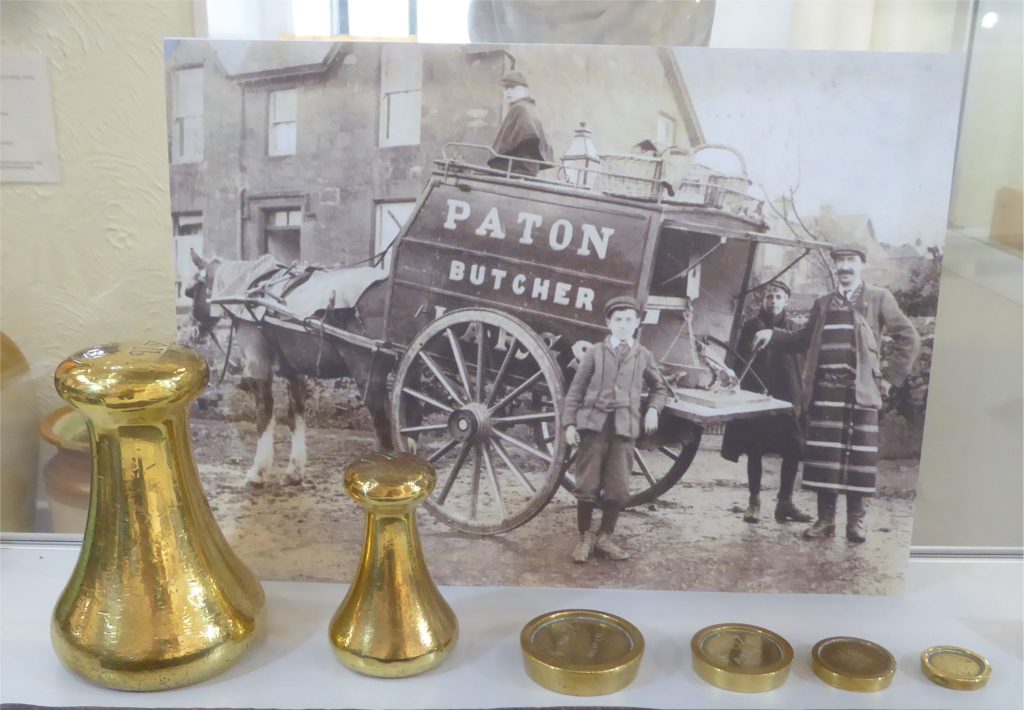
Scales and weights, cleavers and scoups feature in cabinets relating to local businesses. Photographs of the local baker, butcher and dairyman form a backdrop to the display, while an immaculately handwritten Post Office day-book describes arrangements for annual leave and even washing towels. With a selection of their original art deco café’s crockery from the 1930s, the famous Nardini family business inevitably features too.
The museum is run by volunteers, all members of the LDHS, which Simpson was keen to see established. His aspiration was achieved when the museum opened in 1967. Acting as guides, supervisors and trustees, a growing band has ensured its promotion and development, especially over the last few years.
Applications have successfully funded training, IT equipment, refurbishment and displays, all of which have enhanced the museum. Expertise has been shared by other heritage venues in the county and they are taking the onerous step of applying for accreditation with Museums and Galleries Scotland. This small museum intends to keep growing and developing.
In June, I marked D-Day’s 80th anniversary by visiting Normandy. I was therefore surprised to learn about the role played by Largs in the build-up to that momentous event. Some displays draw on the interests of single volunteers. It was fascinating to understand from one how, in 1943, the location for Operation Overlord was finally decided at a military conference in The Hollywood Hotel, temporarily named HMS Warren.
Then, I asked George to play the Desert Islands Discs game: what would you rush to save should the need arise? Immediately pointing to a well-worn flag hanging from one wall, more learning points were gleaned.
“The White Ensign,” he said. “From HMS Largs, the command ship at Sword Beach on D-Day.”
We then leapt to the other side of the world, while remaining connected to Largs. Born here in 1773, Thomas Makdougall Brisbane became Governor of New South Wales in 1821, subsequently giving his name to a fledgling community that became one of Australia’s largest cities. A small, sturdy cannon squats in one corner. This relic of HMS Arethusa’s exploits during the Napoleonic Wars once graced Brisbane House, his birthplace and the family home in Noddsdale.
By now I’d lost count of my learning points.
However, before leaving, I was keen to visit the Skelmorlie Aisle. I’d been told this hidden gem should not be missed.
An expert volunteer led me through gates behind the museum into the old graveyard. On behalf of Historic Environment Scotland, LDHS members play a critical role in ensuring visitors can enjoy a further glimpse into history.
The Aisle stands as a remnant of the original church, surviving its demolition in the early 1800s. Within, in 1636, Sir Robert Montgomerie created a private place of worship and subsequent resting place for himself and his wife, Margaret. Painted oak ceiling panels depict aspects of life in Largs through the seasons, while stonework displays symbolic family imagery, humour and the macabre.
Museum visits shouldn’t end without some nostalgia. In one corner of a display of entertainment venues was a commemorative brochure from 2010. Not too old, you might say. Here, learning points and nostalgia combined. I learned that singers Gallagher and Lyle hailed from Largs. I’d bought their records in my university days of the 1970s. Sadly, I recently shed my vinyl, their album covers a fading memory, until I visited Largs Museum.
Now, I know Largs is more than defeating rampaging Norsemen, Italian ice cream and the Millport ferry. These still tempt visitors to this north Ayrshire resort but there’s a richer history too. Escape from the sea and sand to discover for yourself.
The museum, in Manse Court, is open Thursday to Sunday, 1.30pm – 4.30pm, between April and September, although groups may arrange access outside these times. However, work goes on all year round.
Members and volunteers don’t just welcome visitors. They interpret and explain the collections, work together on projects, and undertake with enthusiasm all the essential behind-the-scenes tasks. With more members and volunteers to sustain the work…
If you’re interested, contact the LDHS through their website:
www.largsmuseum.org. Or, if you are on the north Ayrshire coast, call in and discover your own learning points.