


Linda Brown
Backpack strapped to my back and camera slung over my shoulder, I tramp uphill along The Five Mile, one of the Irvine Valley Trails, which winds through the countryside behind Darvel. With fantastic rural views, it’s an invigorating walk on a September morning. But beware, one thing you need to know before tackling The Five Mile is that it feels more like ten miles, thanks to those muscle-challenging hills.
Today, I’m on the lookout for skylarks.
Last spring, on a grey day, while exploring this route, I spotted Eurasian skylarks (their ‘Sunday’ name) in the fields. These ground nesting birds, with their streaked beige and brown plumage, were well hidden among the long grass and tussocks. However, every now and then, the males would soar vertically into the air, whistling their melodic song and performing graceful aerobatic dances high in the sky. Sadly the light was so poor and the birds moved so quickly that any photographs I took were colourless and blurry.
This morning, despite a couple of black clouds skulking in the distance, the sky is brighter and clearer. Just when I stop for a well-deserved breather, my ears detect a familiar sound – distinctive high-pitched trills and chirps. A skylark? Where? Then I clock him, swooping and diving overhead. I can scarcely believe my good luck when he lands on a nearby fence post and eyes me as curiously as I eye him. Taking care not to make any sudden movements that might scare him off, I snap a few shots from different angles of this obliging wee chap before he scarpers.
In times past, skylarks were a fairly common sight in our fields, but modern farming practices have, unfortunately, resulted in a reduction in their numbers. This has placed the skylark on the RSPB’s ‘Red List’ due to conservation concerns, making it always a joy to see one.
I walk onwards, the wind whipping my hair. Ahead, the road levels out revealing open and exposed farmland – a patchwork of golden and green fields, with toy-sized farms and white wind turbines dotting the horizon.
Further on, a sign points to the track leading to Lochfield Farm, birthplace of Darvel’s most famous son, Sir Alexander Fleming (born 1881). It was in this isolated location that the scientist, who discovered penicillin in 1928, spent his childhood. Every Valley wean was taught this at school when I was wee lassie.
As I stride down the steep brae at Laigh Braidley, I take a moment to stop and savour the view below of the small glen with its burn, the aptly named Glen Water, snaking through it. Rounding The Five Mile’s infamous (in the Valley at least) hairpin bend, I recall my first ever spin as a teenage pillion passenger on a pal’s motorbike, a beat-up old Honda, on this very road, when we were lucky not to take off and end up with a dookin in the burn.
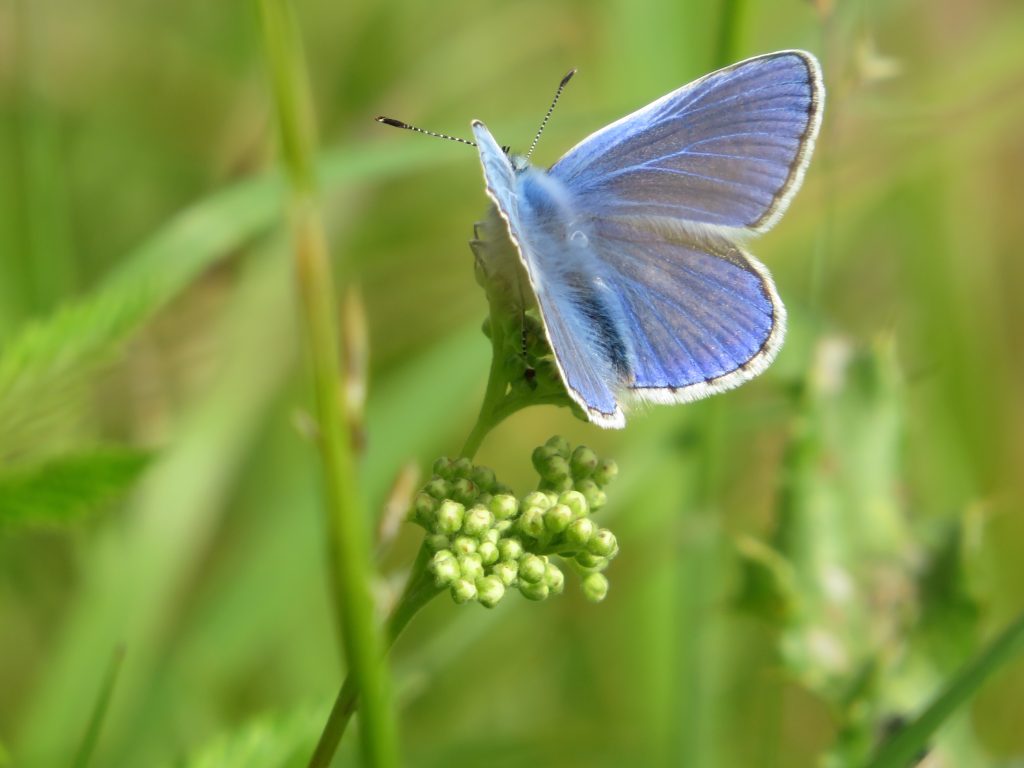
After crossing the recently upgraded Braidley Bridge, a flutter of colour alongside the water’s edge – vibrant lilac-blue – catches my eye. A Common Blue butterfly flits among dandelions and grasses. It’s a welcome sight. This year, whether due to low temperatures or the ever-present rain, I’ve hardly seen any butterflies, which is worrying as they play a crucial role in pollination.
The road leading out from the glen rises before me, and I steel myself for yet another uphill slog. Then I hear voices, loud and laughing. A barrage of bikes hurtles around a bend and heads towards me; The Five Mile is popular with cyclists. I skip onto the grass verge and the group whizzes past me. Easy-peasy on the descent but must be a thigh-burning test of pedal power on the ascent. Minutes later, a solo cyclist travelling in the opposite direction, pants and puffs behind me before managing to overtake on the incline. His face is crimson, his cycling top damp with sweat. He makes eye contact with me and groans, “It disnae get any easier.” My knees creak in solidarity.
Around the Five Mile’s halfway point, a side road branches northwards. This is the beginning of a historic right of way – The Weavers’ Trail – dating back to the 18th and 19th centuries. During those times, the Irvine Valley’s handloom weavers would trek across this moorland route, transporting their lace and cloth by packhorse to Eaglesham. From there, their goods were taken to Glasgow and Paisley to be sold.
The Weavers’ Trail is still walked today by serious hikers. By all accounts, the sixteen-mile-long trail, which passes through Whitelee Windfarm, comprises extremely challenging and boggy terrain. Maybe not for me then!
Sticking with the Five Mile road, I pass a cottage which was, once upon a time, Loudoun Moor School (now a private home). In the 1880s, this tiny schoolhouse, staffed by a single teacher and with a school roll of around a dozen pupils, was where young Alexander Fleming received his early education. Fleming would walk a mile in all weathers from Lochfield Farm over moorland, crossing a makeshift plank bridge over the burn to reach it. Just astonishing that a lad from such a humble little school went on the make one the most impactful scientific discoveries of the 20th century.
Up ahead there’s a commotion along the grass verge. Wisps of thistledown, float and spiral like pirouetting fairies in the breeze across the road. A charm of partying goldfinches, their high-pitched chirps sounding like squeaky supermarket trolley wheels, are having a blast, shredding thistles. They move from plant to plant, balancing on the flower heads or dangling at precarious angles from stems to tease out thistle seeds. These tiny seeds, rich in fats and oils, are an essential part of a goldfinch’s diet. The birds are engrossed in their feast and I grasp the opportunity to capture their antics on my camera.
Moving on, I cross the Muck Brig, and brace myself to climb the last steep section of the Five Mile road. Head down, I grit my teeth and force weary legs to keep trudging. I’m so focused on getting this hill far behind me that, I must admit, if a giant dodo were to pop out from the undergrowth and dance the macarena, I would not even be tempted to stop and snap its photo
Meanwhile the goldfinches zip ahead, acting as my cheerleaders, their excited chatter willing me onwards. It’s a tough plod until, eventually, the road levels out again. The good news is, it is downhill all the way back to Darvel.
Two cyclists zoom past me. “They hills were nae bother,” one shouts to the other.Really? Who are they kidding?
www.eastayrshireleisure.com/countryside-outdoor/routes-in-east-ayrshire/irvine-valley-trails