Largs and World War 2



The People And The Places
David Milloy
Scotland was a hive of activity during World War II. It had a vitally important role in the defence of the United Kingdom and the later offensive operations conducted by the Allies. And Largs played its part.
As German U-boats preyed on merchant shipping and threatened to starve this country into submission, weapons capable of countering them had to be found. The long-range seaplane was one of those weapons. Armed and capable of flying significant distances, they hunted down and attacked U-boats and reported their locations to the Admiralty.
An RAF seaplane base was established at Battery Park in Greenock in 1940, on the site of a pre-war civilian seaplane facility. More capacity was needed, however, and so an overflow base was set up at Largs in 1942. Staffed by a combination of civilians employed by Scottish Aviation Limited and RAF personnel, the base was situated at Greenock Road. Barrfields Pavilion was pressed into service as the base’s workshops and administration area and the putting greens at the front of the building were used as a staging area.
A slipway was built on the shore in front of Barrfields. It has continued to be used by both the public and RNLI but temporarily closed this year to allow a new slipway to be constructed for the RNLI. Additional slipways were built on Great Cumbrae, one of which is now used by the Caledonian MacBrayne ferry. A Catalina seaplane sank close to this slipway in 1943, and its wreckage is now a popular site for recreational divers to visit.
Readers of a certain age might recall the talent show programme, Opportunity Knocks, which was broadcast on ITV for many years. It was hosted by Hughie Green, who as a pilot with the Royal Canadian Air Force flew aircraft across the Atlantic from North America for the RAF’s Ferry Command. Green became a familiar sight in Largs, eventually becoming the seaplane base’s Commanding Officer. His log book from the period can be seen at the Largs Heritage Centre hosted within St. Columba’s Parish Church.
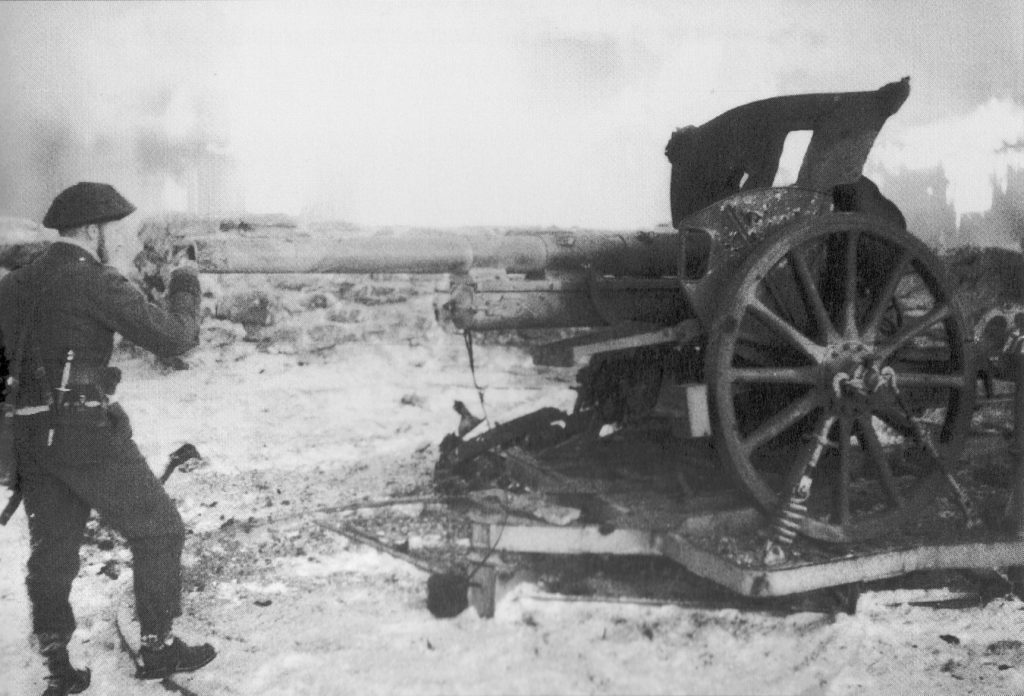
Another noted character with wartime connections to Largs was John Churchill, a British Army officer who became known as ‘Mad Jack’. Having fought in France in 1940 and been evacuated from Dunkirk with the remnants of the British Expeditionary Force, Mad Jack volunteered to join the newly formed Commandos.
Number 3 Commando, to which Mad Jack had been assigned, did much of its training in the hills around Largs, and it was while Mad Jack was at Largs that he met the woman, Rosamund Denny, whom he would marry at Dumbarton in the spring of 1941.
Mad Jack was a proficient piper and an expert archer, and he became known for carrying not only his bagpipes and a bow and arrows into battle but also a Scottish broadsword known as a claybeg. So equipped, he led two Troops of 3 Commando on a raid at Vågsøy, Norway, on 27th December, 1941. As his landing craft approached the shore, he took up his bagpipes and waded ashore playing ‘The March of the Cameron Men’. The raid was a success.
Some of his exploits became legendary, including the time that he and a corporal infiltrated German positions in an Italian village and took 42 prisoners between them. On a later occasion, Mad Jack and a handful of wounded Commandos were trapped on a hill by German forces during a Commando operation on a Yugoslavian island. With the situation hopeless, Mad Jack picked up his bagpipes and played ‘Will ye no come back again’ as the Germans advanced on his position.
After retiring from the army in 1959, Mad Jack continued to follow his own path. Every night on his commuter train home from central London, he would open the window of his carriage and throw his briefcase from the train, to the bemusement of fellow passengers and railway employees alike. It turned out, however, that there was method to his madness: the garden of his house backed onto the railway line and throwing his briefcase into it saved him from having to carry it home from the station!
Very much a one-off, he had a long and happy marriage and lived to the age of 89.
It has been suggested that Mad Jack’s namesake, Winston Churchill, also spent time in Largs during World War II. The story goes that both he and General Eisenhower attended a conference hosted in the town in late June/early July 1943, and that both stayed at St. Phillans, just outside the town on the road to Skelmorlie. Unfortunately, there is no evidence to support this.
The conference, codenamed ‘Rattle’, did take place, though. It was chaired by Admiral Lord Louis Mountbatten and brought together a multitude of high-ranking Allied officers – so many, in fact, that it became known in some quarters as ‘The Field of the Cloth of Gold’, a name originally applied to a summit between Henry VIII of England and François I of France in 1520.
Hosted at the town’s Hollywood and Vanduara Hotels, both of which had been commandeered by the military and were respectively known as HMS Warren and HMS Monck, the conference dealt largely with plans for the invasion of France in 1944. One of a series of conferences on the matter, it played an important role in helping to firm-up plans for what would be the most important military operation of the war. In particular, key decisions were made regarding planning, training, equipment, and the ‘Mulberry’ artificial harbours. There was also much discussion about Operation Fortitude, the purpose of which was to mislead the Germans as to where the main Allied landings would take place.
The Hollywood Hotel became a convalescent home after the war and was demolished in the 1980s. Its name is remembered by the flats built where it once stood. The Vanduara Hotel still stands, however, although it has long since been converted into apartments.
Largs certainly played its part in the struggle against Nazi Germany, and the same is true of towns and villages throughout the country. There’s a world of interesting history out there, and it’s just waiting to be discovered.