Knit Weel

Stewarton’s Bonnet Toun History
Linda Brown
Stewarton – 1841.
Picture the scene – it’s a dreich February afternoon and, despite fading light, the Gibson household at Kirkford is hard at work.
Inside their humble cottage, eight members of the family – from father James, down to wee Jean, only eight years old – are knitting. Their needles click steadily. Candles are lit, or perhaps the family work beneath the flicker of new-fangled gas lights, the town’s gasworks having opened in 1832. Like so many in Stewarton, the Gibsons earn their living as bonnet makers.
Bonnets were knitted in the round using three needles. Skin wool, rather than fleece wool, was used because it produced a heavier, denser and more weather-resistant fabric that held its shape. To support the weight of the work-in-progress, one needle was anchored into a leather belt fastened around the knitter’s waist. Stitches were formed as the two free needles worked in tandem with the fixed one. As the bonnet grew in size, additional needles, held in place by the belt, could be pulled out and used when required. Once complete, the knitted cap was steeped in urine to help waterproof it, then stretched out on a stool, before being combed out with a carding brush.
Only a short walk away on Avenue Street, nine-year-old Robert Forbes also labours knitting bonnets. His earnings supplement his widowed mother’s meagre income. Young Robert and Jean Gibson are just two of around forty children under fourteen years of age, engaged in bonnet making in Stewarton at the time.
Meanwhile, across town on Dean Street, Thomas Mackie and his older sons run a dyeing business, colouring the wool the bonnet makers depend on. Just four years from now, in 1845, Thomas’s forward-thinking son, Robert, will usher the Industrial Revolution into Stewarton when he establishes one of its first bonnet-making mills.
By 1851, Robert Mackie – at still only twenty-eight – employs seven men, forty-three women and ten boys at Holm Mill. His contemporary and competitor, Robert Sim, has around forty workers at Robertland Mill. Both enterprising manufacturers transformed what had once been a cottage industry into profitable, mechanised factories. Business booms. A decade later, there are around ten bonnet manufacturers in the town offering employment to hundreds of folk.
But Stewarton’s bonnet-making heritage stretches further back than the 19th century. Records prove the industry was in existence by 1650, although, it’s believed bonnets were being made there as early as the 15th century. No wonder Stewarton became known as The Bonnet Toun.
Originally, the headwear produced would be simple, rough flat caps, knitted from locally sourced wool and dyed blue using woad, a natural plant-based dye. These sturdy bonnets, resembling toorie-less Tam O’Shanters, were commonly worn by both men and women across Scotland, gaining popularity due to their warmth and durability.
In those early years, the cottage industry was dominated by male knitters, mainly farmers and labourers who lifted up their needles during winter months. Knitting provided a necessary and reliable way of earning a few shillings when bad weather prevented field work.
The Glasgow markets insisted Stewarton bonnets be both heavyweight and of a consistently high standard. To maintain the town’s reputation, the Bonnet Court of Corsehill was formed. This ancient body was responsible for overseeing and regulating the work of local makers, ensuring the excellent quality of their products and controlling prices. Inspectors, known as sichers, were appointed to inspect the headwear and verify they were of the correct weight. Occasionally, traders complained that unscrupulous craftsmen had soaked inferior caps in water to make them heavier – the illegal practice of creating ‘wet caps’. Such accusations were taken seriously and investigated by the sichers, who wielded their considerable power, imposing fines on the culprits and destroying underweight goods. At times, to prevent the market being flooded with a surplus of hats, and to safeguard high prices, the Court would order all bonnet production ceased – a practice known as idlesett. Hefty fines were inflicted on those who disregarded this ruling.
By the 18th century, changes were afoot. Imported indigo began to reach Scotland through European trade. Initially rare and costly, indigo, producing a deeper, longer-lasting blue than woad, soon supplanted the older dye. New styles of bonnets followed. Toories (pompoms) became fashionable on Tam O’Shanters, and there was a growing demand for military headwear. Stewarton’s bonnet makers embraced these developments, producing Glengarries – long, boat-shaped caps decorated with a toorie on top, a rosette on the left side, ribbons down the back and a checkered band, known as dicing, around the base – and Balmorals – a soft cap, usually dark blue, black or Lovat green also adorned with a pompom, rosette and ribbons. These hats, worn by civilians and soldiers, were in all likelihood the styles Robert Mackie and Robert Sim’s mill workers created during the 1850s and beyond. Both bonnets, integral components of Highland dress, worn by the Royal Regiment of Scotland, historic Highland regiments and pipe bands, symbolising our nation’s long military tradition and history, were produced in the town for many years.
Sadly, the 20th century brought a sharp decline to the bonnet industry. Fashion trends shifted and global competition became a challenge. During the Second World War, military contracts kept Stewarton’s factories busy while civilian demand for caps slumped. Inevitably, post-war mills shut down. Robertland Mill finally closed its doors in 1987, more than eighty years after its founder, Robert Sim’s death.
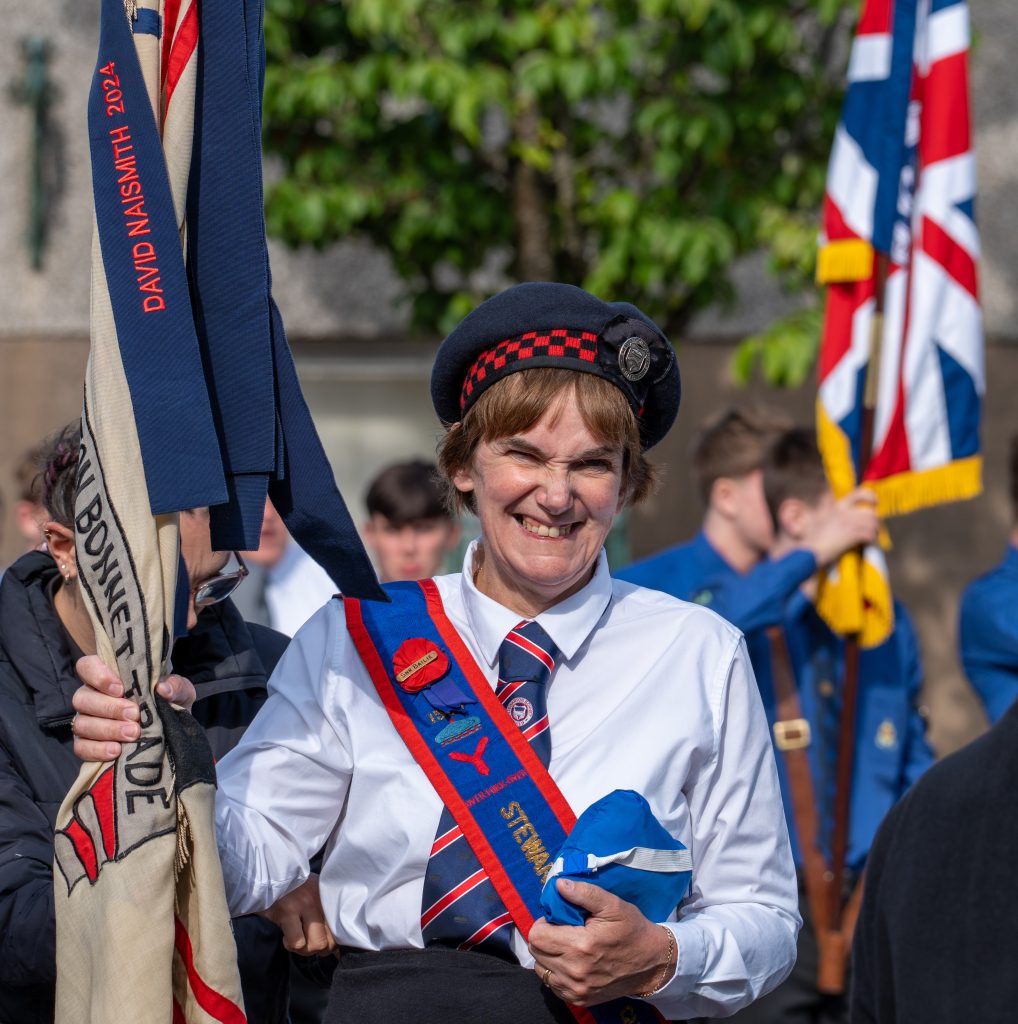
However, Stewarton’s Bonnet Guild, formed in the 1933, keeps the town’s heritage alive. Each year it holds Bonnet Guild Week; a celebration with family events including sports days, treasure hunts, kids discos and culminates with a Gala Day – a parade, floats, stalls, amusements and the crowning of the Corsehill Queen.
As for the health of Stewarton’s bonnet-making industry today? Military caps are no longer made in the town. Yet, remarkably, one hundred and eighty years after its foundation, Robert Mackie of Scotland Ltd, at Holm Mill is still going strong, manufacturing knitted hats and accessories – living up to Stewarton’s proud motto: Knit Weel.