Culzean Castle



Dane Love
Perched on its cliff on the Carrick shore, Culzean Castle is without doubt one of the finest country houses in Scotland. Who cannot be inspired when passing through the ruined arch, walking along the viaduct to the great gateway and the courtyard in front of the castle itself? And then, on entering the building and wandering through the parade of exquisite rooms, ascend the magnificent oval stair and enter the circular Saloon, situated on the cliff-top, with its views of the Firth of Clyde and Arran’s mountains.
Culzean Castle was ostensibly built in 1777 to plans by the greatest architect of the period, Robert Adam, for David Kennedy, 10th Earl of Cassillis (pronounced ‘castles’). When the earl invited Adam to visit the estate before he commenced his designs, he found that there was an ancient castle on the same site, one that had been owned by the Kennedy family for generations. Some sketches he made of this grand old tower house survive.
The eighteenth century was a time of improvement across Scotland, and landowners no longer required castles for defence. This also applied to Ayrshire, where the Kennedy clan were infamous for their part in local feuds – various murders and torturing were carried out by them against warring neighbours. The classical country house had arrived, but many ancient landed families still hankered after the traditional feudal system, and in many case new mansions were built in a baronial or castellated style.
It was thus with Culzean. In fact, one cannot imagine a Palladian country house replacing the old castle on the same site. Robert Adam had designed some ‘modern’ castles before, such as Douglas Castle, but it was at Culzean that his castellated style came to full fruition. And full fruition it was indeed.
To ensure the continuation of the ancient family seat, the original tower house was incorporated in the new structure, the centre of the garden front actually being a recast tower of the sixteenth century. The ground floor would originally have been vaulted, and the great hall of the old tower now forms the Long Drawing Room. Adam clamped two wings to either side of the old tower, adding eight of his distinctive corner turrets, and recasting the old tower with stone to match the new work.
The earl must have been pleased with the results, for only two years after the initial phase was complete, he commissioned Adam to double the size of the castle, adding new rooms on the cliff-side of the tower. This included the Round Drawing Room and State Bedroom. Further additions included the Porch and the large West Wing, all designed by Wardrop & Reid and added in 1877.
Visitors to the castle enter the Vestibule on the east façade, reached from the Forecourt, where one of the gun batteries is located. On entering the castle, one discovers the magnificent collection of arms, arranged decoratively across the walls. It forms the second largest collection in Britain after those in Windsor Castle. Most of the guns and swords belonged to British Army, the 12th Earl buying them from the Tower of London. Among the many antique furnishings one can spot some unusual items, such as a propellor from an aeroplane flown at Turnberry aerodrome in 1919.
The Library follows on the tour of the house, located in what was the ground floor of the original castle. Here the Adam plaster ceiling is one of the first to be admired on the tour, with painted roundels. Continuing to the Oval Staircase, the columns rise through the two upper storeys (the ground floor has archways) to support an irregular conical roof with glass skylight, illuminating the centre of the castle.
“This is a place I can relax.” – Former US President Dwight D. Eisenhower
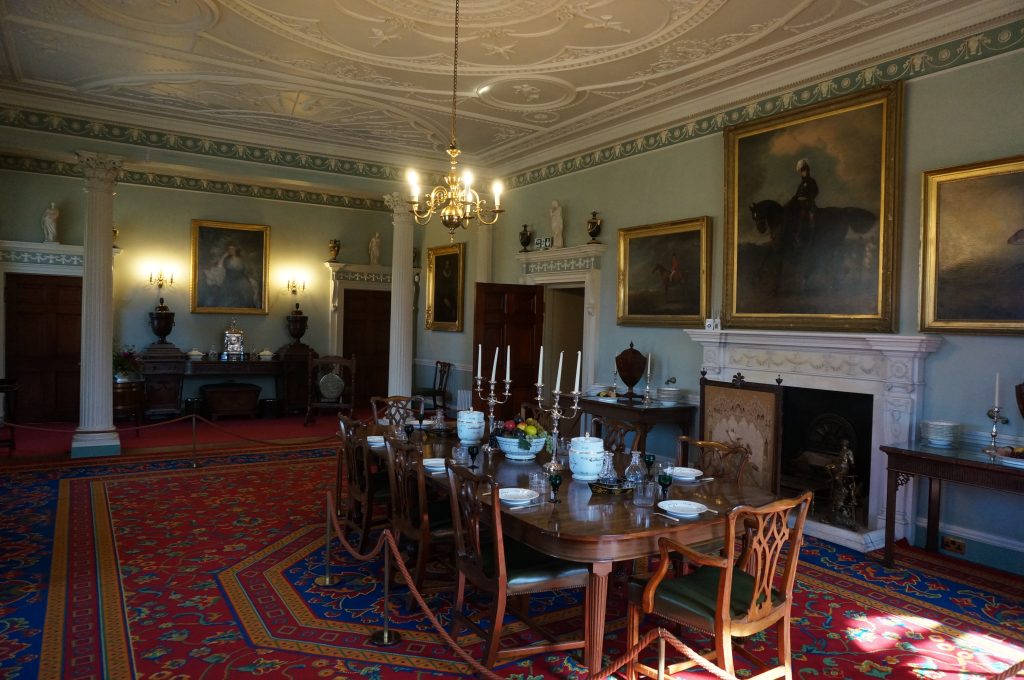
All of Culzean’s public rooms are sumptuously furnished with antique objects, from bookcases and beds to pier glasses and dining tables. Among the more unusual items of furniture is a cradle in the shape of a wooden boat. Maritime associations abound at Culzean, from model ships to trophies won in yacht-sailing events. The 3rd Marquis established a boat-building yard on the shore below the castle, gradually evolving into Ailsa Shipbuilders of Troon.
The Kennedys are one of the most important landowners in southern Ayrshire – indeed the old poem claimed that they ran Carrick, from ‘Wigtown to the town of Ayr’. There were many branches of the family, and most of the old castles in the area at one time belonged to branches of the family. What is now Culzean was in fact originally known as Coiff, or Cove, Castle. The name was changed when the Kennedy’s of the original Culzean (which was located near Kirkoswald) acquired Coiff Castle in the 1600s.
Over the centuries the family’s fortunes have waxed and waned. They were involved in many local feuds, and some of the family fortune is said to have been made in the illicit smuggling trade, the caves beneath the castle being an important aspect of this. One of the Kennedys was created Lord Kennedy in 1458. In 1510 David Kennedy became the 1st Earl of Cassillis, the title coming from another castle of theirs. The 12th Earl of Cassillis was raised in the peerage to become the Marquis of Ailsa in 1831.
The 4th, 5th and 6th Marquises were three brothers who inherited the estate in turn. They didn’t really live at Culzean, and it was decided that the castle and the policies, extending to 650 acres, should be presented to the National Trust for Scotland, so that they would be preserved and available for visitors to enjoy. The transfer took place in 1945.
In addition to the castle, the wider policies contain many places of interest, including the Gas House, where coal gas was created to heat the castle, the Camelia House, Swan Cottage, Dolphin House, Home Farm, various attractive gatehouses, the Pagoda, Viaduct, Stable Block and Powder House. The walled garden is extensive, with its grotto, and the Deer Park contains different types of deer.
There is too much at Culzean to fit into this article, and readers are encouraged to make a visit, either for the first time or else a return visit, to find out more about Adam’s Scottish masterpiece.