


A Midsummer Maidens Beach Walk
Linda Brown
Oh, I do like to be beside the seaside. Especially on a dazzlingly sunny and hot July day – which is why I’ve dragged myself from bed at the crack of sparrows and left my Irvine Valley home to journey south to one of my favourite Ayrshire coastal spots, the village of Maidens.
Now I’m standing on the harbourside, watching people pottering about on their cruisers and yachts, getting things shipshape for a day on the water – perhaps a leisurely sail along the Clyde coast, a trip to Arran, or just a jaunt around Ailsa Craig. Crab and lobster creels are stacked like building bricks along the pier wall, their sun-bleached ropes giving off a salty, fishy tang that mingles in the air with the sweet scent of suntan lotion and the irresistible aroma of cooked bacon – (some lucky sailors are clearly having a fry-up before they cast off.)
A common eider drake bobs around the moored boats, diving now and then before resurfacing triumphant with a crab clamped in his beak. Meanwhile a cheeky and very vocal rock pipit struts along the pier’s high wall, stealing my attention. He takes flight and homes in on one of the older boats tied at the quayside, landing on its winch wheel where he poses obligingly while I take some photos. Maybe the pipit fancies a wee sail doon the coast? The potential stowaway is still onboard, perched like a tiny figurehead on the prow, when I move on to explore the beach and foreshore.
But first, I pause at an information board which tells me that Maidens has been visited by none other than two Scots legends – Robert the Bruce and Robert Burns. Bruce landed here in 1307 on his return from Ireland to ignite the next stage of the War of Independence, and Burns, centuries later, frequented a local hostelry where he undoubtedly enjoyed a brandy or two. Perhaps in the boozy company of the real Tam O’Shanter, I wonder?
Walking on, I marvel at the thought of those two Roberts – warrior king and ploughman poet – gazing out across the same shoreline as me.
Overhead, a pair of oystercatchers skim the curve of the bay, their insistent peep-peep-peep cries as shrill as my digital alarm clock. The tide is in retreat. A lone kayaker glides past the craggy line of rocks known as the Maidens of Turnberry, while a commotion of herring gulls squabble along the water’s edge as they look for molluscs and crabs. Tap-tapping their webbed feet on wet sand, the canny gulls try to coax hidden marine worms to the surface for breakfast.
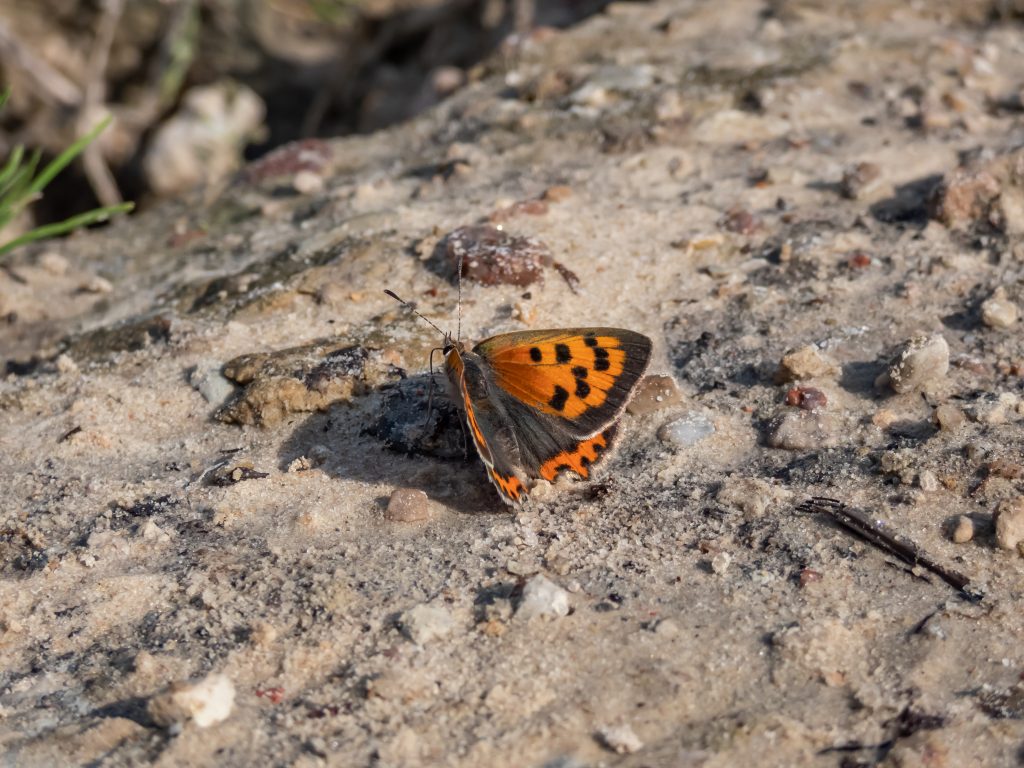
I trace a path along the grassy foreshore, following a little butterfly with vibrant amber and black wings – a Small Copper. I’m determined to capture a few images; it’s not a species I often see on my home turf. But the tiny butterfly outwits me, vanishing into the dense foliage of a beach-rose bush heavy with big, showy magenta-pink blooms. Fingers crossed I can snap another one later.
When I last visited Maidens in May, the gorse along the dunes blazed yellow and exuded an almost tropical coconut scent. Today, in the midsummer heat, those same bushes are burnt brown, their flowers crisped to husks, with only an odd stubborn bloom hinting at the riot of colour they once displayed.
A flurry of activity in a nearby mound of earth and sand catches my eye. Something’s scuttling around. Is it a mouse – or worse still, a rat? What a relief – it’s just a scruffy house sparrow, having the birdie equivalent of a spa treatment, as he revels in the simple pleasure of a dust bath. Wings fluttering, he shimmies, wriggles and rolls, flinging sand over his ruffled feathers. It might seem an odd thing to do, but dust bathing helps birds keep their plumage clean and healthy, dislodging unwelcome parasites or mites and absorbing excess natural waterproofing oils. Once finished, he gives himself a few vigorous shakes, then completes his grooming with a brisk preen before hopping off, looking far more respectable than when I first spotted him.
Back on the beach, day-tripping families and sunseekers have staked their territory with deckchairs, tartan rugs, cool-boxes and pop-up sun shelters for the weans. The morning sun is cranking up a gear – it’s going to be a scorcher – and some folks are already enjoying a refreshing ‘dook’.
I make my way to the sea’s edge. Slipping off my walking shoes, I pad barefoot along the smooth, damp sand uncovered by the ebbing tide, feeling that oddly satisfying Robinson-Crusoe-like thrill of leaving the first footprints on its virgin surface. Or is it just me? Over my shoulder, Ailsa Craig – set against a cerulean sky, a halo of white cloud floating above its dome – seems to have edged closer to the shore, and to the south the top of Turnberry Lighthouse peeps over the rocky landscape. A lazy heat haze shimmers across the beach.
Crossing the Hogston Burn, now just a trickle across the beach thanks to a long dry spell, I weigh up my options. Part of me is tempted to turn inland and follow the path up to Culzean Castle, with the promise of the country park’s cool woodland shade. But then again, should I aim for the steep steps that climb to the coastal path? Or simply retrace my steps back to the village?
Up ahead the Barwhin headland rises from the sand – a rocky, weathered, whin-covered outcrop curving down from the hillside. Maybe it’s my writer’s imagination or perhaps I’m hallucinating in the rising temperature, but it strikes me that the feature looks remarkably like a dragon, frozen in stone, bending down, long snout in the sea for a briny drink.
Jeez-oh, dragon or no dragon, it’s high time I headed back for a seat in the shade and an iced coffee – before the heat has me spotting selkies as well.