When Scotland ruled the tracks


David Milloy
There was a time when Scottish racing drivers ruled the world; a time when they won the F1 World Drivers’ Championship five times in 11 years (with at least four other championship wins being lost due to bad fortune), along with the Indianapolis 500 and a host of other races and championships.
It was an era which began with Ireland. Innes Ireland.
A colourful character, Ireland was born in Yorkshire to Scottish parents. His family returned to Scotland when he was two years old, and it was there that the young Ireland became interested in both motor racing and engineering, at the expense of his academic career. On leaving school, he joined Rolls Royce as a trainee aero engineer and took his first tentative steps into motor racing.
The requirement to perform national service intervened, however, and he soon found himself in the Parachute Regiment, having volunteered to join it whilst under the influence of alcohol. He resumed his motor racing career once free of the military’s clutches. Fast and brave – perhaps a little too brave – he soon began to make something of a name for himself. His successes in sports car racing attracted the attention of Team Lotus, resulting in him joining the team for the 1959 F1 season.
Ireland had a good start to his F1 career, finishing fourth in his first Grand Prix. He thereafter notched two second places in the 1960 World Championship season en route to fourth place in the World Drivers’ Championship. The next year was, however, more difficult and included an accident in practice for the Monaco Grand Prix which resulted in serious leg injuries. As he later put it, he exited the circuit’s famous tunnel but his car didn’t!
In the year’s final Grand Prix, at Watkins Glen in the USA, a strong recovery drive after an early spin was rewarded with victory. It was not only his first Grand Prix win but also that of Team Lotus. It turned out, however, to be his last Grand Prix for Lotus, as he was unceremoniously dropped by them soon after the season ended.
Ireland continued to drive in Grands Prix for other teams but further Grand Prix victories eluded him. He did, however, win three non-championship F1 races during that time to add to the five he had won for Team Lotus. But as his career as a racing driver faded, a new one as a motorsport writer emerged. Indeed, his talents as a writer might even have been greater than his gift as a driver.
The reason that Innes Ireland was jettisoned by Team Lotus was that the team’s owner, Colin Chapman, felt that Lotus’s other driver was a better bet to bring success to the team. That driver was another Scotsman, Jim Clark. Chapman’s decision, though harsh on Ireland, was soon vindicated, as Clark’s speed and uncannily smooth driving style rapidly marked him out as the greatest racing driver of his time – and perhaps even of all time.
He should have won the World Championship in 1962 but lost out when his car’s engine failed with just 20 laps left to run of the season’s final Grand Prix. He was not to be denied, though, and romped to the World Championship in 1963, winning seven of the ten Grands Prix which constituted the championship. He looked set to win the title again in 1964, winning three of the first five Grands Prix, but a series of mechanical failures meant he was lying only third in the championship standings prior to the final Grand Prix of the season. Not intending to lose his title without a fight, Clark took pole position and scampered away from the rest of the field, looking set to retain the championship until his engine seized with one lap to go. He did, however, win the British Saloon Car Championship that season at the wheel of a Lotus Cortina.
1965 saw Clark regain the World Drivers’ Championship, winning another six Grands Prix. And just for good measure, he also won the coveted Indianapolis 500 for Lotus. Rule changes for the 1966 season were, however, to be the undoing of several teams, including Lotus. With the maximum engine capacity of an F1 car having doubled from 1.5 litres to 3.0 litres, Lotus needed to find a new engine supplier. They placed their hopes in a new 16 cylinder engine from BRM. Known as the H16, this complex engine was overweight, underpowered, and unreliable. Used by both Lotus and by the works BRM team, it yielded but a single victory. Typically, it fell to Clark.
It was clear that Team Lotus needed a new engine for the 1967 season. A deal was struck with Ford for exclusive use (for that season) of their new, Cosworth-developed DFV engine. It wouldn’t be ready until the third round of the season, though, and Lotus would meantime have to make do with the troublesome BRM engine and underpowered 2.0 litre Climax unit. Clark failed to finish either of the first two Grands Prix but returned to the top of the podium on the DFV’s debut at the Dutch Grand Prix. He won three further Grands Prix during the season, missing out on further victories due to mechanical issues. His performance in the Italian Grand Prix typified his luck: having suffered a puncture whilst leading the race, the resultant pit stop meant that he emerged from the pits a lap behind the leaders. Remarkably, he made up the deficit and re-took the lead late in the race, only to be cheated out of victory due to a lack of fuel. Had he enjoyed better reliability, there’s little doubt he would have become World Champion again that year.
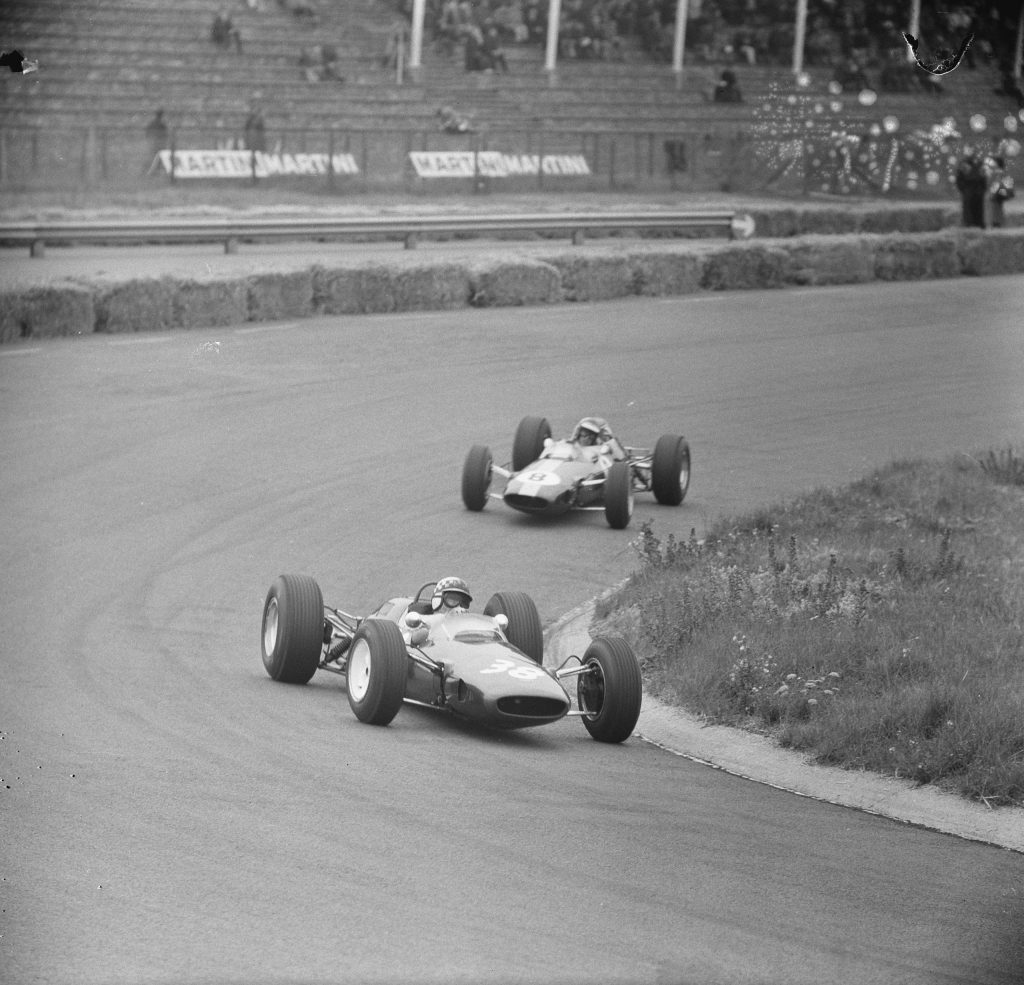
The start of the 1968 season saw Clark stroll to victory in the season-opening South African Grand Prix. It turned out to be his final Grand Prix start and his 25th and last win. Three months later, on 7th April, he was driving a Formula 2 Lotus in a relatively unimportant race in Germany when his car left the track and struck a tree, most likely as the result of a punctured tyre. He was fatally injured and the whole world of motorsport grieved for its brightest star.
Had he lived, he would have almost certainly won the World Drivers’ Championship again in 1968 and quite probably in 1969 and 1970 too, based on the performance of other Team Lotus drivers in those seasons. Indeed, it’s quite conceivable that he would have raced on until the mid-1970s, most likely winning more Grands Prix and World Championships.
His incredible natural ability as a driver shone through no matter what he was driving. In addition to the Indianapolis 500 and the British Saloon Car Championship, he also won the Tasman Series in three of the four years in which he contested it. He also drove in the RAC Rally in 1966, wowing the rallying world with his speed. Indeed, such was his prowess behind the wheel that Juan Manuel Fangio, himself a five-time World Drivers’ Champion, said in 1967 that Clark was outstandingly the greatest Grand Prix driver of all time.
Jim Clark was not, however, the only Scottish driver to win the World Drivers’ Championship in the 1960s; his great friend Jackie Stewart won the first of his three World Championships in 1969. Stewart had made his F1 debut in 1965, partnering Graham Hill at the BRM team. It says much of the calibre of the men who raced in that era that Clark, Stewart and Hill became close friends, often spending time together when not competing.
Stewart took his first Grand Prix victory in 1965 before experiencing two lean years with BRM in 1966 and 1967, a consequence of the team having gone down a blind alley with the H16 engine. He moved to the Matra International team (run by Ken Tyrrell) for 1968. Armed with the French-built Matra car and the powerful Ford DFV engine, Stewart battled former teammate Graham Hill, now with Lotus, for the World Championship. Unfortunately, a fractured wrist sustained in an accident during a Formula 2 race resulted in Stewart missing two rounds of the championship, putting him at a significant – and decisive – points disadvantage to Hill.
It was a different story in 1969, with Stewart winning six Grands Prix and taking his first World Drivers’ Championship by a comfortable margin. Stewart and Tyrrell parted ways with Matra at the end of that season; Matra wanted to use their own F1 engine henceforth whereas Stewart and Tyrrell wished to continue with the Ford DFV unit. The result was that Tyrrell founded his own F1 team, initially using chassis supplied by March, with Stewart as its lead driver.
The move blunted Stewart’s defence of the World Drivers’ Championship in 1970 but he regained the title the following season, winning six Grands Prix. He finished second in the championship in 1972, winning four Grands Prix in spite of being hindered by health issues. As the 1973 season dawned, Stewart had decided that it would be his last. He told very few people of his decision and did not publicly announce it until the end of the season. He won his third World Drivers’ Championship that year, winning five Grands Prix. The final Grand Prix of the season would have been his 100th but he withdrew from it after his teammate and close friend Francois Cevert was killed during a qualifying session.
Although he did not possess quite the same freakishly high level of natural talent as Jim Clark, Stewart’s combination of considerable natural ability, superb hand-eye coordination (he was a world-class shot), meticulous attention to detail, and fierce intelligence made him one of the finest racing drivers in the history of the sport.
More than that, he became an outspoken campaigner for safety. Back in the 1960s, F1 was a deadly sport, with several drivers perishing each year. To give an example of this, of the 40 drivers who started at least one Grand Prix in 1966, no fewer than 15 would ultimately lose their lives in racing accidents. Stewart’s persistence in campaigning for the sport to be made safer, which made him unpopular in certain circles, resulted in significant safety improvements being made. It is no exaggeration to say that many racing drivers owe him their lives.
Innes Ireland died in 1993, a much beloved figure whose passing was greatly mourned throughout the world of motorsport. He may not have achieved all that his driving talent was capable of delivering but he made his mark. He is remembered not just for his speed but for his devil-may-care character and ebullient approach to life, with many stories still told about his exploits, including the time he scaled the outside of a clock tower in an Austrian village after celebrating a race win with several drinks!
Jim Clark’s life and career is the focus of the Jim Clark Motorsport Museum in Duns. It hosts not only cars driven by him but also an array of trophies, racing suits, photographs, films, and memorabilia. Indeed, it pays homage to not only Scotland’s first F1 World Drivers’ Champion but also to a lost world and the characters who inhabited it. It’s a must-visit for anyone with even the slightest interest in motorsport.
Jackie Stewart went on to become an acclaimed commentator. Together with his son Paul, he formed his own F1 team, which won a Grand Prix before being sold to Ford. Knighted in 2001, he still appears regularly at Grands Prix and other motorsport events. If you ever get the chance to hear him speak about his days as a driver, then grab it with both hands – you’ll be in for a treat.
www.liveborders.org.uk/culture/museums/our-museums/jim-clark-motorsport-museum