Doonfoot’s Great Escape



The biggest breakout of POWs in the UK
David Milloy
A classic film that has just entered its seventh decade, The Great Escape is a fictionalised version of the mass escape from Stalag Luft III in March 1944, when 76 allied prisoners of war (‘POWs’) escaped through a tunnel. It’s a thrilling story with a tragic end, with 50 of the escapees being murdered by the Gestapo and SS on the orders of Hitler.
Getting 76 men out of a POW camp in one fell swoop was an impressive feat, but did you know that Doonfoot was once the site of a POW camp where an even greater number of POWs (Italian in this case) made a successful bid for freedom?
In July 1943, Benito Mussolini, the fascist dictator of Italy, was deposed and imprisoned. Within weeks, an armistice was agreed between the new government of Italy and the allied powers. This did not, however, result in a cessation of hostilities in Italy, with most of the country now under the control of a puppet regime headed by Mussolini, who had been rescued from captivity by German forces.
With most of the 100,000-plus Italian POWs in the UK thought to have little or no loyalty towards Mussolini, it was decided to offer them the opportunity to undertake paid work. Those who accepted this offer were henceforth regarded as co-operators and were housed in camps in which they enjoyed a considerable amount of freedom, to the extent that they were able to mix with local people, forming bonds that would result in a considerable number of them going on to make their homes in the UK after the war finally ended.
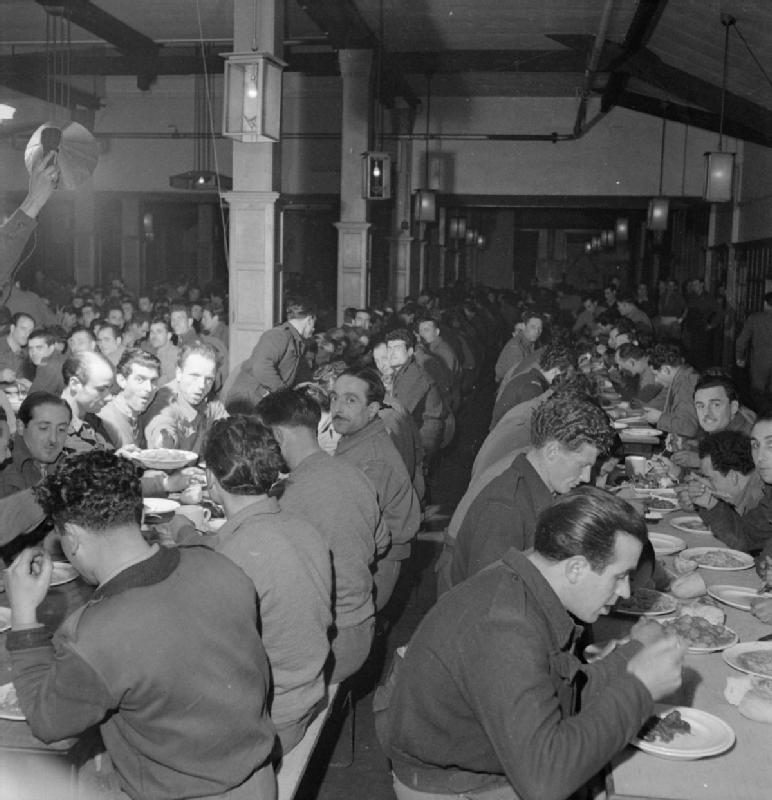
A smaller number of Italian POWs, including those who remained ardent supporters of Mussolini and fascism, declined to became co-operators. They were housed in more secure camps, such as Bun camp at Doonfoot, which accomodated around 1600 POWs.
On the night of 15th December, 1944, 97 prisoners escaped from Bun camp via a tunnel. Like the Stalag Luft III tunnel, it led from an accommodation hut to a point clear of the camp. The escape was not detected until the following day, with the remaining POWs doing their best to interrupt the guards’ attempts to carry out an accurate headcount.
In his book Hitler’s Hangmen, author Brian Lett puts forward the suggestion that the escape from Bun camp was part of a larger plan in which a series of mass breakouts from German POW camps (there being over 400,000 German POWs in the UK) was intended to coincide with a surprise attack by German forces in the Ardennes. The idea behind the plan was that the escaped German POWs, numbering in the thousands, would endeavour to acquire arms and transport and, aided by British fascists, initiate a military uprising that would, at the very least, cause mass disruption on the home front. Although Doonfoot housed Italian POWs, their loyalty to Mussolini meant that they could be relied upon to participate in this uprising.
In the event, the plan for a mass breakout of German POWs was thwarted before it could be carried out. The escape from Bun camp did, however, proceed. But although it took place at the same time as the German offensive in the Ardennes began, it seems unlikely that it formed part of any serious plot to cause mayhem through a mass breakout of POWs. There was no support network waiting to help the 97 escapees, who remained unarmed, unorganised, cold, and largely unfed during their brief time at large. Almost half of them were recaptured within a day, most managed to travel little more than a handful of miles before being returned to captivity. Four made it as far as Newton Mearns and two hid out for several days in a railway wagon at Dalrymple station. There were no reports of violence being committed by the escapees, and unlike the mass escape from Stalag Luft III all of the escapees survived.
Assuming that the escape wasn’t part of a larger plan, why did it happen? Based on the reported accounts of escaped prisoners, it seems that it was intended as a protest against overcrowding, lack of recreational facilities, and the confiscation of a radio. In any event, the escape made the newspapers in both the UK and the USA and was the subject of questions in the House of Commons. But with the successful and peaceful recovery of the escapees, it rapidly became little more than a forgotten footnote in both national and local history.
No trace remains of Bun camp, its site having been redeveloped for housing some decades ago, and there are no signs or markers to mark its former presence or narrate that it was the locus of the greatest of great escapes in the UK. The same fate has befallen most of the other POW camps in the UK, including the other Ayrshire POW camps near Mauchline and Cumnock.
One former POW camp in Scotland has, however, survived. Situated near Comrie in Perthshire, it is home to a museum that’s open to visitors between April and October. It’s well worth visiting.
www.brianlettauthor.com/books.html#hangmen
www.cultybraggancamp.uk