MORE, MORE, AVIEMORE!



Gill Sherry
Ask a travel agent for a holiday incorporating both beach and wildlife and they’ll probably recommend a long-haul trip to South Africa. But there’s a destination much closer to home that ticks both of these things (and much more) off your wish list – Aviemore.
Yes, you read that correctly. Despite being 30 miles from the coast and 30 metres above sea level, Aviemore – or Glenmore, to be precise – is blessed with a beautiful arc of sand that stretches along the shore of Loch Morlich at the foot of the Cairngorms.
If you’re unaware of its existence, the beach takes you by surprise as you emerge from the surrounding forest; the glistening, freshwater loch and mountainous backdrop momentarily forgotten as you step onto the coarse, amber sand.
You would, no doubt, be just as surprised to learn that the sand once contained a large amount of glass. Sightings of large fragments are still sometimes reported so caution is required before kicking off your shoes and sinking your toes into the sand’s therapeutic embrace.
The glass dates back to World War II when Loch Morlich was used by British Special Operatives to train members of the Norwegian Independent Army Company. There’s even a memorial to these fighters – a stone of remembrance unveiled in 1973 – to honour those who lived and trained in the surrounding mountains whilst they prepared for operations in their occupied homeland.
Nowadays, the beach is used as a base for all kinds of activities. The wooden boathouse, which wouldn’t look out of place in a Swiss ski resort, thanks to its pitched roof and elongated balcony, hires equipment for kayaking, canoeing, windsurfing, sailing and paddleboarding. There are also bikes for those wishing to venture away from the water, as well as a café boasting stunning loch and mountain views.
But, as we all know, the best things in life are free, so many visitors to Aviemore and its surrounding villages choose simply to swim. Which is exactly what I did on a beautiful (but very cold) day in December. Open water swimming is becoming increasing popular – regardless of the time of year, or indeed the temperature of the water – thanks to the benefits to both body and mind.
Loch Morlich has to be one of the most beautiful open water swimming locations in Scotland. Time it right and the splendid view will be mirrored in the flat surface of the loch, doubling its breathtaking impact. You might also be joined by a raft of ducks, as was I, the family of mallards apparently curious of my woolly hat!
Sharing the same space as the ducks allowed a wonderful sense of freedom. In fact, floating on the water and seeing nothing but blue sky and mountaintops brought, not just a sense of calm, but a feeling of absolute belonging.
Back on dry land, there are numerous scenic walks, some of which hug the loch. Mostly circular, they vary in length and difficulty and are easy to navigate thanks to the well-positioned marker posts. The Loch Morlich Circuit is especially popular. At three and a half miles it boasts spectacular views of the Cairngorm peaks, as well as Loch Morlich itself, and is fringed by the magnificent Scots Pines that dominate Glenmore Forest.
Which leads nicely to the wildlife aspect…
Red squirrels are often seen scampering through the trees at Glenmore or nibbling on pine cones on the woodland floor. My very first sighting of this cute bushy-tailed creature was, in fact, right outside Glenmore Visitor Centre, although, I’m not sure every visitor gets such an exclusive welcome.
The forest is also a haven for birds, with golden eagles and ospreys favouring Loch Morlich as a hunting ground. Imagine witnessing those giant talons emerging from the water with a wriggling fish, its mighty wings lifting it up, up and away with its prize.
Merlins and peregrine falcons have also been known to breed at Glenmore and, if you’re lucky, you might spot the brown-and-black streaked plumage of a dotterel, or even a capercaillie (otherwise known as a woodland grouse). If you’ve only ever seen one of these on the label of a whisky bottle, you’re in for a treat. That said, the capercaillie is a protected species and only 1,000 remain in the UK. Sightings are rare but not unheard of, particularly as almost all the surviving birds reside in the Cairngorms National Park.
The rivers and lochs of Glenmore are home to otters and are also an important spawning area for Atlantic salmon. Seeing these determined fish swimming against the current and leaping waterfalls in their desperate and instinctive return to their spawning ground is quite the spectacle and usually occurs in November or December in this part of the country, depending on weather patterns.
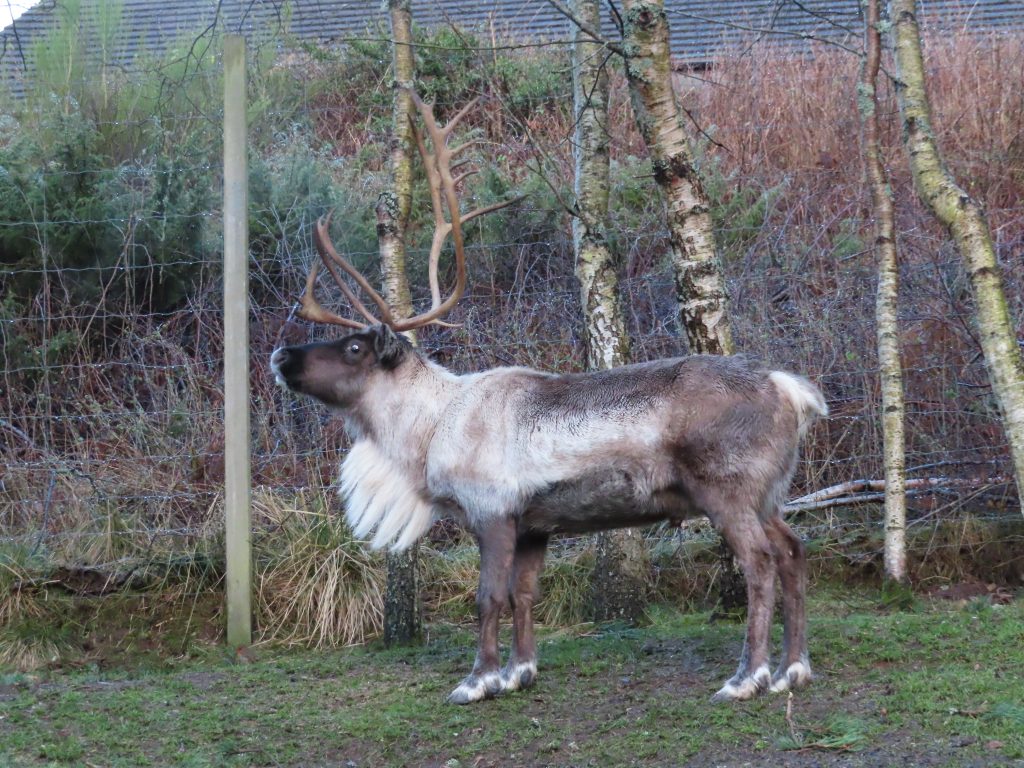
I have, however, saved the best until last. For where else can you find a free-ranging herd of reindeer? Well, you can’t, not in Great Britain anyway, as the Cairngorm Reindeer Herd is the only one in the UK.
There are currently around 150 reindeer in the herd and it’s possible to see these awkward but beautiful animals up close, either on a guided hill trip or a paddock visit. For those who believe reindeers are only for Christmas, this really is a thrill; even more so if you get to hear their peculiar clicking back feet.
Hill trips consist of a guided walk up to the herd, which can take up to 40 minutes. There is no path so this can be tricky, and appropriate footwear is essential. Seeing the reindeer in their natural habitat is a privilege indeed. They are, however, surprisingly tame and exceptionally good-natured, the result, no doubt, of their constant contact with human beings.
The hill trips afford the opportunity to feed the animals and take photographs, and your guide will provide plenty of information and answer your reindeer-related questions.
In total, the trip can last up to two hours, depending on the weather and how long it takes to locate the herd. It’s worth it, though. The sensation of a reindeer nuzzling the palm of your hand is not something you’re likely to forget, particularly when you realise that their noses, rather than being wet and shiny like other deer species, are soft and hairy instead. Some even have beards!
For less mobile visitors, or those not willing to expose themselves to the elements, a paddock visit is ideal. The paddock is situated in the glen, just behind the main ticket office and shop, and is wheelchair and pushchair friendly. Information boards provide details of the reindeer and there are quizzes for children (did you know both male and female reindeer grow antlers?). But although a close view of the animals is guaranteed, there are no opportunities to feed them and no direct contact – unless one happens to poke its nose through the fence!
Usually, there are four reindeer in the paddock. These are rotated on a regular basis from the herd, so the animals are not confined for too long at a time.
Once you’ve fallen in love with these charming creatures, you’ll no doubt be looking for a reindeer souvenir. Thankfully, the shop sells everything from cuddly toys to T-shirts and from notebooks to necklaces. Not forgetting those unique, ethically sourced, reindeer pelts, which actually come from the indigenous Sámi people of Finland and not from the Cairngorm herd. So, not only will your new hide remind you of a wonderful time in the Highlands, you will also have helped to sustain this traditional Nordic farming culture that has existed for thousands of years.
Naturally, reindeers will always be associated with the festive season. As a result, visiting the herd was recently announced ‘best Christmas activity’ by Time Out. But don’t let that put you off visiting at a different time of year. Bear in mind, though, that the centre is closed from January to early February and at other times, pre-booking is recommended.
Aviemore, and neighbouring Glenmore, a mere seven miles away, are year-round holiday destinations. In the winter months, unsurprisingly, the hills attract large numbers of skiers, as do the cafés restaurants and bars. Aviemore is what you would call a ‘happening’ little town, with a predictable parade of outdoor shops and a definite winter sports vibe: think rosy-cheeked, athletic types with brightly-coloured beanies and fur-lined boots. Glenmore, in comparison, is a quirky wee village which comes alive with après ski. The local bar is standing-room-only as more and more skiers descend from the slopes. Initially, coffee and hot chocolate are the drinks of choice, as cold, stiff fingers seek a hug from a hand-warming mug. But it’s not long until the sigh of beer pumps and the click of optics add their own unique percussion to the crescendo of tales from the pistes. If only the atmosphere could be bottled and taken home. I suspect, though, that the magical feeling captured within the pine walls, steamy windows and ceiling of skis would be impossible to replicate elsewhere.
This little corner of the Highlands really does have something for everyone: an award-winning beach, ample rambles, wonderful wildlife and a seemingly endless array of activities. And I haven’t even mentioned the locally distilled whisky and gin! That is, perhaps, a subject for another day.