Park Life



A Visit to Belleisle and Rozelle
Linda Brown
It is a bright but very frosty morning. Shaking off the temptation to hibernate on the sofa with a good book, I de-ice our car then press-gang my other half, Scott, to be my chauffeur and expedition companion. We set off from the Irvine Valley and travel southwest to Ayr, with plans to enjoy a brisk walk around the town’s two popular parks: Belleisle and Rozelle.
First stop is Belleisle Park, well known for its excellent golf course and gardens. Correction – first stop is Belleisle’s Stables café for a much-needed caffeine hit before we get started! Two Americanos and a fruit scone later, we pull on bobble hats and thermal gloves. Leaving the cheery atmosphere and warmth of the café behind, we head out to explore the park.
Earlier, when we arrived, I’d heard the familiar calls of nuthatches – their rapid and high-pitched ‘tuit-tuit-tuits’ came from the wooded area next to the car park. The birds are still very vocal, so we decide to cut through the trees, and I have my camera ready, hoping for a good shot of at least one of my favourite birds. It doesn’t take long until I spot them. I count five. The nuthatches zip from branch to branch before landing on the icy ground and scurrying across the grass, their pencil-sharp beaks probing the frosted earth for hidden insects. Under our boots, the frozen leaves and twigs carpeting the path crackle and snap, making it impossible to sneak up on the birds to capture some decent images. Ever cautious, the nuthatches take flight and hide high in the trees. As always, I’m carrying a bag of bird food in my pocket. I scatter peanuts and sunflower seeds around the base of some trees and hope the little ‘family’ returns later for a feast. It strikes me I’ve no idea what the collective noun for a group of nuthatches is? I whip my out my phone and ask Google. The answer is, apparently, a booby of nuthatches. Who knew?
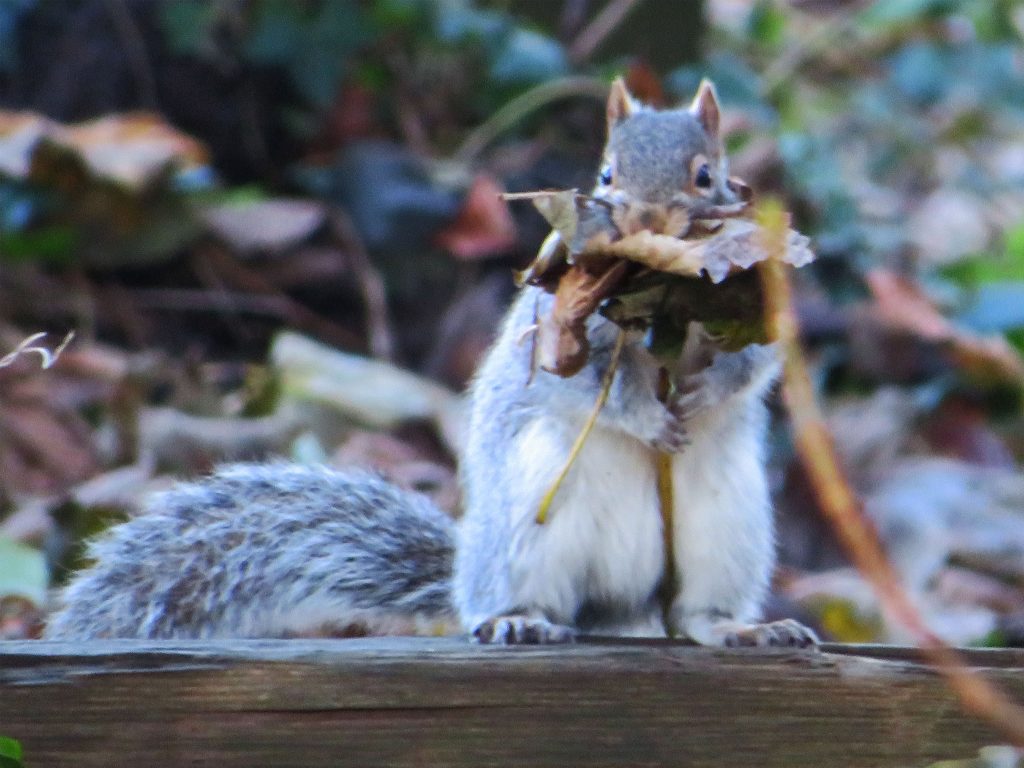
Nearby, and unperturbed by our crunching footsteps, a determined blackbird struts alongside the path, tossing up leaves with his sleek black head. His beady orange eyes scan for worms and other tasty treats under the debris. He really should work in tandem with one of the industrious grey squirrels who are rampaging around the woodland floor, gathering up bundles of leaves then stuffing them in their mouths. Cheeks bulging, they scamper up tree trunks, taking their booty to add to their dreys, ensuring their homes are comfortable and well-insulated for the even colder days ahead.
We bypass the children’s playground and find ourselves at the viewpoint overlooking the park’s deer enclosure. Some distance away a small herd of fallow deer and a few shaggy sheep are busy munching on icy grass. One deer pauses and raises her head. With eyes tightly closed, she savours the rays of winter sunshine on her face, as if soaking in every precious moment of warmth and light.
It’s a short walk from the deer park to the walled garden. Passing through the stone doorway, we realise we have the garden to ourselves. During summer its formal flower beds, planted and maintained by South Ayrshire Council gardeners, are a bonny burst of blooms. Naturally, in mid-winter, the beds lie bare, waiting for spring planting. However, the neat topiary sculpted trees add an artistic touch to the empty garden, giving it a simple, stark beauty and creating a serene atmosphere. This morning, the garden’s centrepiece – a sundial – wears a dusting of ice crystals. We take a moment to appreciate it and I snap a few photographs. But it is too chilly to hang about for long, so we take the path that leads out the garden to Belleisle’s Conservatory. Time for a wee bit of warmth.
Stepping inside the glasshouse, a wall of humid heat hits us… and my glasses immediately fog up, as does my camera’s lens.
The Conservatory is home to exotic plants, tropical flowers and cacti. We wander around the narrow passageways admiring species of lilies and orchids. I try to take a photograph of my favourite, the stunning glossy red Flamingo Flower (Anthurium) but my steamed-up lens refuses to focus. Scott draws my attention to the Conservatory’s observation bee hive, installed at one of the windows. A sluggish mass of bees wriggle under the glass panels. I try to pinpoint the queen bee (the queen apparently has a white dot on her back) but eventually give up – I never was any good at ‘Where’s Wally?’
One of the Conservatory’s dedicated volunteers stops me for a chat – she tells me that normally the Conservatory holds activities and community events throughout the year and that Ayr Phoenix Folk Club meet there on the third Sunday of every month. However, this year the Conservatory is due to close its doors from February until May to allow essential refurbishment work to take place. Hmmm… checking out the ‘refreshed’ Conservatory gives me a good reason to make a return visit to Belleisle this summer.
The morning is fast disappearing, we need to move on. Originally, we’d planned to take the path across the golf course to reach Rozelle, however, with the temperature continuing to hover around zero and remembering we would need to walk back later, we decide to go by car. Returning to our vehicle, we skirt the boarded-off shell of Belleisle House Hotel, devastated by fire in 2019. Once the ‘in’ place for posh dinner-dances and stylish weddings, it’s a shame to see this iconic old building in such a sorry state. Belleisle Park has much to offer locals and tourists alike – wouldn’t it be amazing if this derelict hotel site could have a positive ending soon?
Our second stop, Rozelle Park, is a fantastic place for a family day out, featuring mature woodland with paths to explore, an interesting museum and art gallery and much more.
As we drive into the park, a joyful Rupert the Bear, with outstretched arms held high in a gesture of welcome, greets us. Rupert is one of several fabulous willow sculptures of iconic children’s film and literary characters, including Peter Pan, Captain Hook and Hogwarts Sorting Hat, that were installed around the park in 2022. Somewhere, I believe, there is a Long John Silver (the pirate from Treasure Island), but on my previous visits to the park, I’ve somehow managed to miss him. Maybe today I’ll be lucky?
After parking, we head towards Rozelle’s pond, normally a haven for ducks, moorhens, swans and other waterfowl. But today the water is completely frozen over – the poor ducks are relegated to the sidelines; they waddle along the pond’s edges, quacking plaintively, waiting for a thaw. The usual suspects of chaffinches, great tits, blue tits, and robins scrabble about the undergrowth and dart around the foliage of nearby rhododendron bushes, foraging for food. Not easy in these icy conditions. Just as well I have my bag of bird food with me. Scott cups his hand and I tip some seeds into it. Sensing a feed is available, the clever birds immediately move closer. A robin flutters inches from his face. Scott holds out his arm – the small heap of sunflower seeds, maize and peanuts nestles tantalisingly in his palm. “Do you think they will eat from my hand?” The words have hardly passed his lips when a great tit swoops across from a low hanging branch, lands lightly on his hand, pinches a seed then zooms off. Wow. The crafty bird carries its prize back to a tree where it cracks the seed open and deftly extracts the kernel from inside, while a cautious coal tit watches with envy. Just as I focus my camera lens on my husband’s hand another daring little great tit, perched on the pond’s fence, makes a move. It takes off, hovering momentarily in mid-air before gently landing on Scott’s fingertips and looking at him with an almost quizzical expression. I snap a perfect image then the great tit helps itself to a nut. Amazing. I’ve always considered robins to be the boldest of wee birds but it seems the cheeky great tits can give them a run for their money (or bird seed).
We scatter the rest of the food around a wooden bench for the birds to help themselves. Of course, the grey squirrels want in on the action. Four of them are skulking in the background – ducking and diving around tree trunks, standing up on their hind legs, necks craned and poised to pounce on the nutty picnic the minute we walk away to join the woodland path.
Meandering along the well-trodden tree-lined track, I’m on the look-out for lesser redpolls (members of the finch family) – these are birds I’ve never seen on my home turf. I’ve heard
there have been recent sightings of the tiny finches in the park. Lesser redpolls have streaky brown plumage with red patches on their foreheads and chests and they dangle upside down like gymnasts while feeding from trees – so I’m hoping they will be easy to spot. But, I’m not in luck. All I catch are fleeting glimpses of cute long-tailed tits, nuthatches and the red, white and black flash of a great spotted woodpecker manoeuvring around the highest branches.
Eventually, we give up and double back to pay our respects at Rozelle’s Remembrance Woodland – a special area of the park created as part of 2014-18’s WWI centenary commemorations. Planted with rowan, birch, alder and oak trees, the Remembrance Woodland features a striking contemporary willow and steel installation ‘Flighted’ and a fine collection of wood-carved sculptures depicting trench-life and warfare – including a seated soldier writing a letter, a German soldier peering through field glasses, a crashed plane and a machine-gunner. I pause for a moment of reflection at the memorial to the unknown soldier. The fast-fading winter light, the sky now pale grey with a jaundiced tinge, and the still heavy frost add to the poignancy of the scenes and an eerie aura settles over the woodland. There is scarcely a bird about – only a lonely and silent robin sits, all puffed up against the chill, on a frosted branch – his vibrant orange-red breast the sole splash of colour against his monochrome surroundings.
The temperature is dropping – my feet feel like two lumps of lead and my cherry-red nose could rival Rudloph’s – so we decide to take a shortcut back to Rozelle House and seek refuge and lattes (and maybe even a slice of Victoria sponge?) at its tearoom. En route, we stumble across my favourite ogre, Shrek, (another of the story-book willow sculptures) lumbering through the trees. He is so photogenic. A dog-walker tries to pass by, her West Highland terrier straining on its lead and barking with gusto.
“Quiet, Angus…” The Westie’s owner retrieves a doggie treat from her pocket and smiles at us. “No matter how often we walk here, he always gets a bit freaked by Shrek,” she explains.
Angus accepts his treat then, casting Shek an evil glare, and with a low growl rumbling at the back of his throat, jogs on past with his owner.
We emerge from the trees and cross the large expanse of grass in front of Rozelle House and its old stables. I stop to admire an impressive carved tree and fumble for my camera. Ever impatient, especially when coffee and cake is involved, Scott offers to go on ahead to the tearoom and bag a table, while I snap some pictures. Minutes later, I follow him indoors, heading downstairs to the basement where the tearoom is located.
Time for a confession – we have a special, personal connection to Rozelle House’s basement. Or at least my husband Scott has. Over ten years ago, he was the subject of a mural painted on one of the basement’s colourful, graffiti artwork walls. So look out for the guy wearing the welding goggles and creating sparks – that’s my man!
The artist’s model is ensconced in the cosy tearoom with a mug of coffee and waiting for a toasted sandwich. I join him and study the menu. It’s only then it occurs to me that I have yet to find the sculpture of Long John Silver. Where is that pesky pirate ? Does he still exist? Could he be hiding in a quiet corner of the park with the redpolls instead of his parrot? Oh well… never mind… going on a pirate hunt is a great excuse to come back to Rozelle Park very soon.