


All the Colours of a Winter Walk at Greenan Beach
Linda Brown
Cabin fever has set in. My husband is on a week’s holiday from work and the weather has been grim – heavy rain and blustery winds. For days we’ve been chilling; bingeing on crisps and chocolate, lazing like two slugs on the sofa and mainlining Netflix. But now we’re getting antsy for a change of scenery and some fresh air to blow away the cobwebs. Fortunately, the forecast is improving. So, on a chilly but bright morning, we rise early, throw together some cheese and ham pieces, fill a flask with coffee and head off in the car – destination, Greenan Beach at Ayr.
We park near the Millennium Bridge, tramp down the grassy slope and stand at the foot of the River Doon. The tide is out. A few gulls wade aimlessly in the shallows. Looking north along the curve of the bay, other hardy walkers, all wrapped up against the crisp bite of the icy day, stride across the sands. The air smells raw with a hint of brine.
We follow the well-trodden track skirting the side of the feature I’ve always known as Doonfoot Lagoon. Except there is no lagoon. At most there’s a muddy puddle, surrounded by bare sand and patches of blackened, withered vegetation. I’ve not visited this area since summertime, when I’d hoped to catch sight of the kingfisher that sometimes fished here. So, what has happened? I suspect the answer is our Ayrshire autumn weather – wild winds and stormy high tides have shifted the sand dunes, filling in the channel which once held the water, changing the shape of the foreshore. Sadly, there’s no chance of kingfisher-spotting here today.
Moving on, past the tall bulrushes, known also as great reedmace, we watch a pair of stonechats flit between their velvety brown spikes, while above our heads excited sparrows swoop and twitter. Then we trace our way along the sandy path that cuts through the grassy dunes towards the beach. In the distance, to the south, the ruins of Greenan Castle gleam in the sunshine. Perched on the cliff’s edge and set against a cornflower blue sky, the castle makes a striking subject for a photograph.
Up ahead, just off the path, a whirl of activity among the burnished golden grass stops us in our tracks. A feeding frenzy is underway. A blaze of ravenous yellowhammers mingles amicably with a small group of reed buntings. They all cling to the long, dry stalks as they search for seeds or grains to munch on.
Yellowhammers were once a common sight across our rural areas, but changes to agricultural practices over the past couple of decades have impacted their numbers. The yellowhammer population is in decline. These days, I rarely see one on my Irvine Valley home turf, so it’s always a real treat to spot them on my coastal walks.
I manage to snap several good images of the feeding birds, but it’s too nippy to hang about for long.
Mr B wanders down onto the beach and beckons me to follow him to where a bonny rock pipit poses on a heap of lightly frosted seaweed. Its thick winter plumage is a warm olive green in the bright morning light. The pipit stabs its beak among the seaweed and stones, foraging for the tiny invertebrates that make up its diet.
We trek briskly along the shoreline towards the castle before doubling back across the dunes. Over the skirls of herring gulls, an insistent shrill call pierces the air. What bird is that? It’s a sound I can’t quite identify.
“Do you hear that strange bird?” I ask Mr B.
He shakes his head. “Only hear gulls.”
“Really? Can’t you hear its high-pitched calls?”
I whip out my phone, open my trusty bird-sound identification app. But it refuses to co-operate and won’t acknowledge the sound. The piercing trills grow closer. Holding my phone high to capture the noise, I look around for the mystery bird – but only see a young woman trying to rein in two exuberant springer spaniels, ears swinging wildly, bouncing through the long grass.
Mr B laughs. “I think you’ve heard the greater spotted dog whistle.”
Oops. No wonder Merlin didn’t work its usual magic.
On the way back, we retrace our footsteps along the edge of the sand-filled lagoon. Despite my thick gloves, my hands are cold and I’m certain my nose must be glowing scarlet. A hot drink and a sandwich will sort me out, and Mr B powers ahead to organise our lunch. However, sharp whistles make me hesitate. Definitely not a dog whistle this time. Instead, I hear the nasally, rising trills and rattles of a bird I’ve been trying, and failing, to find all year – the elusive redpoll. Surely not? The sounds continue, growing louder. A redpoll must be close by. But where?
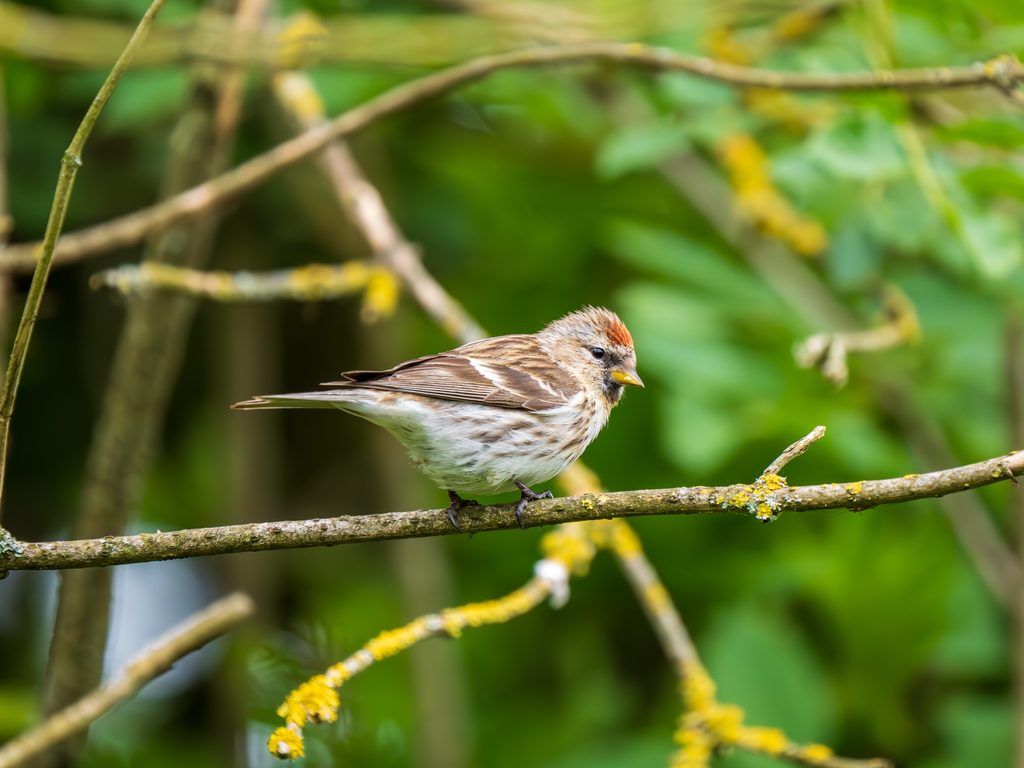
A flicker of movement among the undergrowth catches my eye. A little puffed-up ball of ivory-and-tan-streaked feathers balances on a dried stalk of mugwort, teasing out seeds. The rust-red patch on his forehead, directly above his beak, clinches his identity. I freeze. Can I possibly take some photos of him? I’m wary of making any movement, scared I’ll frighten him away. Then I realise he’s not alone. A second bird wobbles on the brittle stem of a nearby plant, nibbling on the seed heads.
Redpolls love mugwort – its small seed heads are packed with nutritious high energy food, much-needed fuel for these wee birds to help supplement their diet during harsh winter conditions. Completely unfazed by my presence, the pair hop from plant to plant, their antics captured on my camera. I’m reluctant to move on, but my stomach is rumbling, and I swear the scent of coffee is drifting over the grass banking from the car park. But, my very first redpolls – what a way to finish my winter walk!
I return to our car with a contented spring in my step.