

“I hope Ayrshire reclaims these two lost sons and celebrates them and their talent.”
Gill Sherry
“Growing up, I thought that to write, you had to be dead.”
I can’t help but laugh at Damian Barr’s opening line but he’s actually serious.
“I always wanted to be a writer, but I didn’t know any living writers. Then I met Liz Lochhead, who I’d studied at school, and realised that you can be a living writer. Liz is a great writer and from the same village as me, Newarthill.”
Damian went on to study Sociology and English Literature at Lancaster University, graduating in 1998.
“My first job after university was at The Times. When I was there, I started my Literary Salon where I’d interview other writers about their books. I ran that for 15 years. It was while I was doing my Literary Salon that I started working on my memoir, Maggie & Me.”
That memoir, which was all about growing up in Lanarkshire in Thatcher’s era was published in 2013 and was followed in 2016 by his debut novel, You Will Be Safe Here. Prior to that, in 2006, he’d published a non-fiction book called Get It Together: How to Survive Your Quarterlife Crisis.
“I always forget about that book!” he admits. “That was based on a column that I wrote in The Times about life in your 20s.”
Now, though, it’s all about his new book, The Two Roberts, a beautifully written story about two Ayrshire artists which came about following a Tweet from the Dick Institute.
“The Tweet was about a picture by Robert MacBryde called Two Women Sewing. I was captivated by this bright, intense image. I thought it was by George Braque or some other European painter, then I realised it was by this guy called Robert MacBryde from Maybole and I thought, who’s he? And of course, as soon as you meet Robert MacBryde you meet Robert Colquhoun.”
Realising the two Roberts were a couple, he became fascinated by their story.
“Like them, I’m gay, working class and Scottish and had gone south to find myself and make my fortune. I haven’t made my fortune, but I have found myself!”
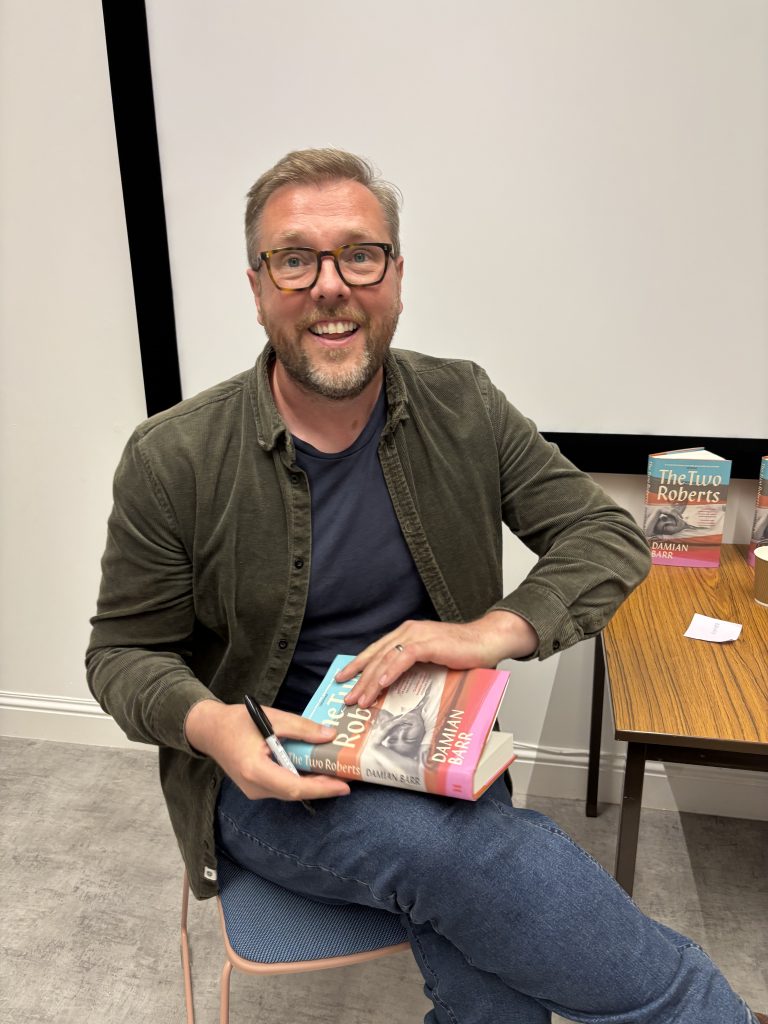
Determined to discover more about these two talented artists from Ayrshire, he contacted Davy Brown.
“Davy Brown is a brilliant artist from Kilmarnock, which is where Robert Colquhoun was from. Davy has done more than any other living person to protect and restore the reputations of the two Roberts. He was really generous and helped me with finding out about them and driving me around Ayrshire to places that they spent time so I could understand more about their work.”
Having attended a Meet the Author event at Girvan library, I’d heard Damian talk about his research and how he’d been able to tread in the footsteps of the two artists. I ask him now if there was one moment which was particularly special.
“I very much enjoyed doing that research on the ground with Davy. I remember going to Craigie Hill… and I remember going to Maybole Library, which is an important scene in the novel. I’ve also been supported by the Colquhoun and the MacBryde families. I find it incredibly sad and a real wasted opportunity that there is nothing in Maybole and nothing in Kilmarnock to highlight the achievements of these incredible sons in these places. They were huge talents. They are the most famous Scottish artists in the world, and you can’t find anything about them.”
The hope is that Damian’s book will raise awareness of their art, although, it’s important to remember that it’s a work of fiction.
“There’s so much we can’t know about the two Roberts. Because they were gay and Scottish working class so many of the facts of their lives have been hidden or erased. They literally had to burn letters! So the book is a blend of fact and fiction but the fiction is built on the fact.”
He compares it to Maggie O’Farrell’s Hamnet and to the works of Walter Scott who is considered the pioneer of historical fiction with novels such as Waverley and Ivanhoe.
Of course, it’s one thing writing a story, but it’s quite another bringing it to life. Damian does this brilliantly.
“I like to try and situate the characters in a world that responds to all the senses, and I like the reader to be in that world too. I’m doing it consciously. I’m helping the reader to understand the story. What’s going on? What can Bobby and Robert hear? What’s it like to be in their world?”
I enjoyed every page of The Two Roberts. It offers nostalgia, local history, and a story of love and art. Like Damian, I’m sad that these two artists remain relatively unknown and unappreciated. I’m also extremely grateful that he’s brought their story to life.
“It’s only when they went to Glasgow School of Art that they realised that Turner came to Ayrshire and painted Ayrshire. They then began to see it differently. Ayrshire gave them the colours and textures that they drew on for the rest of their lives and I hope Ayrshire reclaims these two lost sons and celebrates them and their talent.”
I hope so too.
You can see some of their work at the McKechnie Institute in Girvan. Damian has also curated an exhibition in Sussex (where the two men once lived) which he hopes will go on to tour the UK. The exhibition features paintings, drawings, lithographs, monoprints and archival objects, including school records and photographs. In the meantime, if you haven’t already read The Two Roberts, you’re in for a treat!
www.damianbarr.com