Newmilns Murals



Celebrating the Town’s Lace Industry
Linda Brown
If you’ve visited Newmilns in East Ayrshire recently, chances are you’ve been blown away by the town’s striking new additions along Main Street – two fabulous murals honouring its proud lace-making heritage.
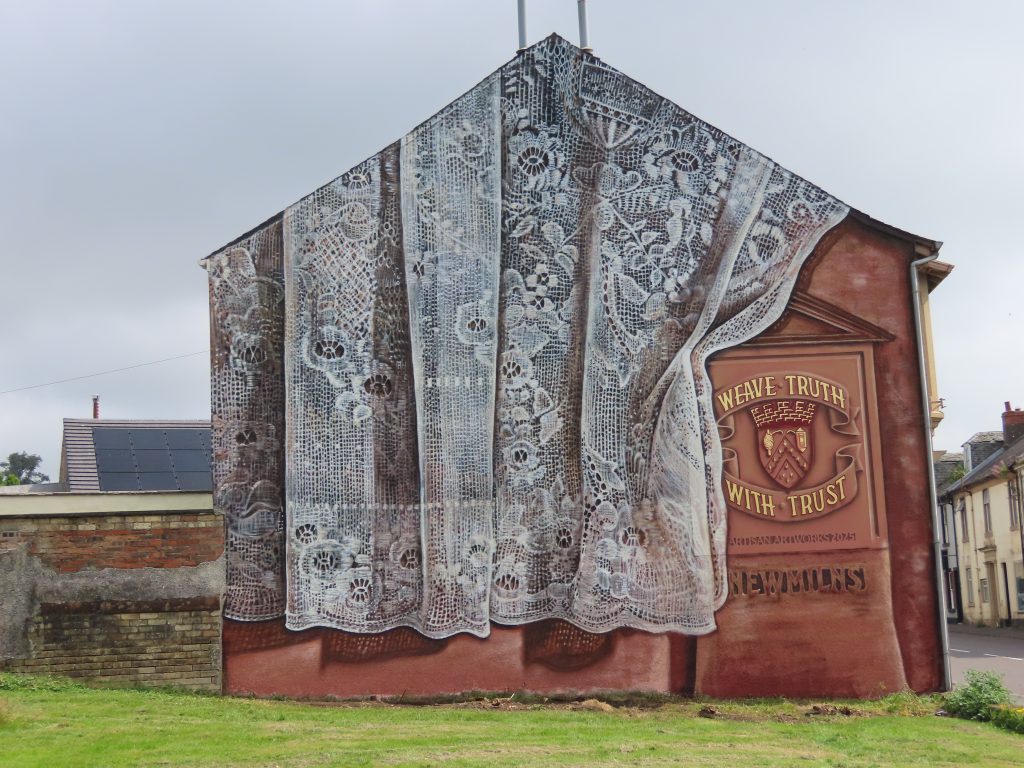
The first mural, near Lady Flora’s, features a 3D-style lace curtain delicately draped over the side of a building and pulled aside to reveal the town’s crest and motto: Weave Truth with Trust. The second, on the gable end of the old Loudoun Arms pub, depicts a hand darner at work, skilfully repairing lacework. Both were created by Artisan Artworks and are the result of a community project led by the Newmilns Regeneration Association (NRA), made possible by funding from The National Lottery Heritage Fund.
Weaving has flourished in Newmilns for centuries, its roots tracing back to the late 1500s when Flemish Huguenot refugees, fleeing religious persecution, settled in the area. They brought with them the craft of handloom weaving, a skill that helped shape the town’s identity for generations.
The introduction of the first power loom to the town in 1877, coupled with the import of cotton from the USA, transformed the industry. Handlooms quickly became obsolete as mills were built to house the newfangled technology. Lace and madras manufacturing boomed in the late 19th century with over thirty mills operating locally during the industry’s peak.
Today, only two mills remain – Haddow, Aird and Crerar Ltd and MYB Textiles. Remarkably, MYB is believed to be the only mill left in the world producing patterned lace on traditional Nottingham lace looms.
MYB Textiles played a key role in the NRA murals’ project. The patterned lace featured in the artwork is based on their design, Lydia. I popped into the company’s office to chat with designer Margo Graham about MYB’s involvement.
“The NRA and Artisan Artworks came to visit us and took some photographs around the mill,” she tells me. “Lydia lace happened to be on the loom that day, and one of our darners was also repairing a piece of Lydia lace. Samples of the fabric was taken away by the artist, and it was later decided to use the Lydia pattern in the murals.”
A photograph of darner, Janey Gray (recently retired) sitting on a low stool, head bowed, eyes focused on repairing a flaw on the lace fabric, just as generations of darners have done before her, inspired the second mural.
Lydia has been one of MYB’s most popular lace designs since its launch in 1936. It is believed to be named in honour of Lydia Mitchell, the local banker’s wife from Lamlash House and daughter of Joseph Hood, the innovative loom engineer who set the pattern cards on the first lace loom in Newmilns.
Margo tells me that Lydia lace is still woven today on one of MYB’s original Nottingham looms dating from 1916. “That particular loom has been adapted to be electronic. It is networked to the design computer in this office,” she explains. “These days, designs are sent to the loom via an ethernet cable.”
It’s astonishing to think that a 110-year-old loom now uses 21st century technology, but this upgrade demonstrates how the industry is evolving once again.
Before I leave the mill, designer Sherry Campbell, takes me on a quick tour of the factory floor, showing me tall rails of pattern cards, madras looms and, of course, that original 1916 Nottingham loom.
Next, intrigued to learn more about the murals’ creation, I catch up with Frank Carty, of Artisan Artworks. A Newmilns resident and one of Scotland’s top mural artists, Frank designed and painted both artworks along with his wife and business partner, Mandy.
“We’ve always been interested in 3D painting,” he tells me. “I wanted to capture the intricacy of the lace and chose the simple idea of draping it across a building over a stone monument bearing the town crest and motto. We wanted to show that the lace industry is something for the town to be proud of and that it is still very much active – that’s why we chose a current employee as the model for the ‘Darner’ mural.”
Was it difficult to create the appearance of lace with paint?
“It was definitely challenging,” Frank laughs, “but I’ve always tried to push myself with the detail of the murals we paint. We’d been given samples of the Lydia lace to study and had a good understanding of the material before painting. We draped lace over a scale cardboard model of the building and photographed it, that gave us the image to copy for the mural. Once I’d drawn out the basic framework of the lace pattern on the wall, it was a case of painting all the detail in ‘stitch by stitch’. The 3D effects are created by carefully drawing out all the folds in the design then choosing the right tones and colours for the shadows of the threads. Very little of the finished mural is actually white.”
It took Artisan Artworks six days to complete the ‘Newmilns Lace’ mural, and three days to work on the ‘Darner’. Both murals have received glowing feedback from the local community and Frank has heard images of his works have popped up on social media posts as far away as Australia.
“Lots of people stopped to chat while we worked,” he adds. “So many people have personal or family ties with the lace industry. It meant a lot to us to hear we had represented it properly. Our favourite visitor was Bert Faulds, a 90-year-old lace designer from the era when all designs were hand drawn. Hearing him say we’d got every stitch right – that is the ultimate seal of approval.”
As a Newmilns girl (albeit an auld one) born and bred, with family connections to the lace industry, I couldn’t agree more – the murals are stunning and are a perfect tribute to my town’s manufacturing history.
So, why not come to Newmilns and see their beauty for yourself?
www.mybtextiles.com Instagram: @artisanartworks