The Loch Doon Spitfire



Is there a more beautiful memorial anywhere?
David Milloy
Graceful, fast, and agile, the Supermarine Spitfire is arguably the most iconic fighter aircraft of them all. It served throughout the Second World War and into the post-war years, most famously in the summer of 1940 when it, together with the Hawker Hurricane, bore the burden of defending Britain from the Luftwaffe following the fall of France and the Low Countries.
Over 22,000 Spitfires and Seafires were built, of which perhaps a little over 200 remain. None are to be found in Ayrshire but a short trip down the A76 to Dumfries leads to one which will be forever linked to both Ayrshire and the Czech Republic.
That Spitfire is, to use its serial number, P7540, a mark IIa Spitfire built at Castle Bromwich in the West Midlands. It left the factory in October, 1940 and was delivered along with a number of other mark IIa Spitfires to 66 Squadron, then based at West Malling in Kent, on 29th October, 1940. It flew its first combat patrol on 30th October, with Flight Lieutenant Robert ‘Bobby’ Oxspring at the controls. As the Battle of Britain was somewhat arbitrarily deemed to have ended on 31st October, 1940 (although no-one seems to have consulted the Luftwaffe about this at the time), this makes P7540 a genuine Battle of Britain veteran.
Oxspring, who would later command 72 Squadron when the unit was briefly based at Ayr Racecourse, was not the only pilot who flew P7540 during its time with 66 Squadron – several other of the squadron’s pilots, including Pilot Officer Hubert ‘Dizzy’ Allen and Flight Sergeant Jimmy Corbin, also took to the air in it. Oxspring, Allen, and Corbin all survived the war and went on to write books about their wartime experiences. Allen was the most prolific of the trio, writing several books including the controversial (at the time) Who Won the Battle of Britain?
66 Squadron was transferred to Exeter in February, 1941, at which time its Spitfires, including P7540, were swapped with the older Spitfires of 609 (West Riding) Squadron. Whilst with 609, P7540 was flown by a number of pilots, including two Belgians (Pilot Officers Willi van Lierde and Francis de Spirlet) who, having flown for the Belgian Air Force during the Battle for the Low Countries in 1940, thereafter made their way to Britain and joined the RAF.
One of the 609 Squadron pilots who spent the most time at the controls of P7540s was Pilot Officer Keith ‘Skeets’ Ogilvie from Ottawa, Canada. He was later shot down over France, sustaining injuries which led him to spend several months in French hospitals before being transferred to the infamous Stalag Luft III POW camp in Poland, where he became a leading member of the Escape Committee. He was one of the 76 men who escaped from the camp in March, 1944, an event which would go down in history as The Great Escape. He was recaptured after two days and – unlike 50 of his fellow escapees, who were murdered by the SS and Gestapo – was subsequently returned to the camp. He survived the war and lived to the age of 82.
As for P7540, it and 609 Squadron’s other mark IIa Spitfires were handed over to 266 Squadron in June, 1940. P7540 spent very little time with 266, for it sustained combat damage on 3rd July, 1941, which required repair work to be effected at one of the RAF’s numerous maintenance units. Its next port of call would be its last in RAF service. Now repaired but said to be in poor overall condition, it was one of six mark II Spitfires handed over to 312 (Czech) Squadron in August, 1941.
Based at RAF Ayr (situated at Heathfield and not to be confused with the nearby RAF Prestwick), 312 was equipped with Hawker Hurricanes. It was intended that 312’s pilots should use the mark II Spitfires to gain experience of the type before the squadron was issued with new mark V Spitfires at the end of the year. One such pilot was 26 year-old Flying Officer František Hekl from Nemojany in what was then Czechoslovakia (now the Czech Republic).
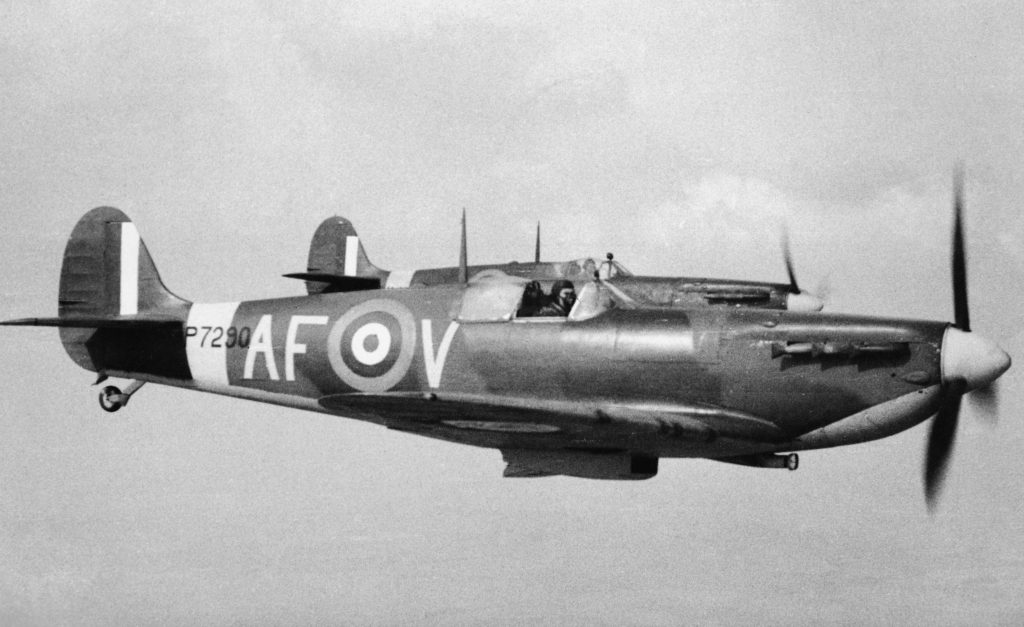
A pilot in the Czech Air Force when Germany annexed the Sudetenland in 1938 and subsequently occupied the remainder of the country in March, 1939, Hekl joined many other Czech pilots in fleeing to Poland and joining the Polish Air Force, with whom he was serving when the Germans invaded Poland on 1st September, 1939. The Poles fought hard but had little chance against the combined might of Germany and the Soviet Union, whose forces invaded Poland on 17th September. The last Polish troops surrendered on 6th October, 1939, and the country was thereafter partitioned by Germany and the Soviet Union.
Hekl and his fellow pilots had been ordered to make their way to Romania. Some succeeded but Hekl was captured by the Red Army and interred in Russia. He managed to escape from Russia in July, 1940, and over the next few weeks he made his way to Britain via Turkey, Egypt, and India.
Having arrived safely in Britain, Hekl joined the RAF Volunteer Reserve in November, 1940. He was assigned to 312 (Czech) Squadron on 28th August, 1941. He flew Hurricanes during his first few weeks with the squadron before making his first training flight in a Spitfire on 24th October. The following morning found him at the controls of P7540 for another training flight. Tragically, it was to be his last.
After taking off from Ayr at around 10.25 am, Hekl headed inland and made his way to Loch Doon. Flying at very low altitude, he put the Spitfire into a banked turn, whereupon the Spitfire’s starboard wing dug into the water and the aircraft disappeared below the surface in a cloud of spray. Although the crash was reported to the authorities by witnesses, a seven day search by an army team failed to locate the wreckage of the Spitfire. There was likewise no sign of František Hekl.
It is believed that no further attempts were made to locate the Spitfire until 1977, when a group of aviation enthusiasts based in Dumfries & Galloway decided to try to find and recover it, with the intention of putting it on display at the Dumfries & Galloway Aviation Museum. Having obtained permission from the Ministry of Defence and the backing of Dumfries & Galloway Sub Aqua Club, they began to search the area in which the crash was believed to have occurred. The searches, which later also involved members of the The Northern Federation of the British Sub Aqua Club and the use of both sonar and metal detectors, yielded neither the Spitfire nor any clues as to its whereabouts.
The search area was widened but a continuing lack of success, and a growing belief that the Spitfire’s wreckage might have been entombed by the silt which made visibility such a problem for divers, led to a waning of enthusiasm for the project. It was therefore decided that 1982 would be the final year in which searches took place.
On 15th May, 1982, one of the divers searching for the Spitfire literally bumped into its wreckage on the loch bed. An underwater inspection showed that it had sustained significant damage when it struck the water in 1941: the cockpit, the engine, and both wings were gone. Moreover, there was no trace of František Hekl’s body.
The Ministry of Defence duly granted permission to recover the wreckage, and further searches led to the discovery of the engine, wings and numerous other parts of P7540. Although preserved to some degree by the fresh water and silt of Loch Doon, P7540 was in a poor state but not beyond salvation. Its Rolls-Royce Merlin XII engine was, however, in surprisingly good condition. At some point the Merlin was sent off to Rolls-Royce, who subsequently reported that it still turned over by hand and was probably capable of running again in spite of having spent over four decades in the loch.
Restoration work proceeded slowly over the years, hindered by a lack of funds and the need to buy parts to replace those which couldn’t be salvaged. The wings were too badly damaged to restore, and although the museum possessed a pair of Spitfire wings, these were from a later model. In the end, the museum purchased a pair of glassfibre replica wings, this being deemed to be an acceptable (and affordable) compromise given that P7540 was not being restored to flying condition.
As P7540 neared readiness, a new building was erected at the museum for the specific purpose of housing the aircraft and its engine. That work was completed in 2017, and P7540 was installed in its new home. The museum then began the task of locating the families of some of the pilots known to have flown P7540. Their first success was in making contact with Bobby Oxspring’s granddaughter, who journeyed to the museum with her two children to see – and sit in – P7540. Further successes followed, with Dizzy Allen’s grandson, Jimmy Corbin’s son, and František Hekl’s nephew all visiting the museum.
A visit by a student from the Czech Republic in 2023 resulted in contact being made with the Czech Ministry of Defence. The story of P7540 and her last pilot struck a chord with the Czech authorities and it was decided to create a memorial to him at Loch Doon, where his remains still lie. This memorial will be unveiled at a special event in September of this year, a fitting tribute to a very brave and determined young man whose life was cut brutally short by war. He and the other young men who flew P7540 may be gone but they should never be forgotten.
Dumfries & Galloway Aviation Museum is situated at Heathhall Industrial Estate, Dumfries, where it occupies part of the site of the former RAF Dumfries. It is home to a varied collection of aircraft, vehicles, and aero engines. Displays focused on airborne forces, the WW2 bomber offensive, and the home front are each located in dedicated buildings. There’s also a shop and cafe, and visitors (and their dogs) are warmly welcomed. A number of events are held at the museum every year, including the Wings and Wheels event (which will take place on September 28th this year) at which classic, veteran and vintage vehicles vie for attention with the museum’s aeronautical exhibits.
For more information on the Dumfries & Galloway Aviation Museum please call (01387) 251623 or visit the website
www.dumfriesaviationmuseum.com