Harry Doy


From Monty Python to Rob Roy on a vintage BSA
David Milloy
It’s fair to say that motorbikes haven’t graced the pages of Ayrshire Magazine as often as we’d have liked, so we thought we had better do something about that, such as by talking to a man who not only rides old motorbikes but restores them too.
So without further ado, let’s meet Harry Doy.
Harry’s love affair with motorbikes started when he was a child. His parents were not, however, keen on him having a motorbike, so when he bought his first motorbike he decided to avert any problems at home by simply not telling his mum and dad about his new purchase, as he explains: “I kept my first bike at a friend’s house for a while, but I was rumbled when my mum found a motorbike engine that I’d hidden under my bed. She wasn’t overly happy but accepted that it was up to me to make my own decisions. My dad was a different story. He remained unhappy about me having a motorbike until I got into riding and restoring old motorbikes. I suspect his change of heart was due to him being interested in antiques – I suppose he saw old motorbikes as being antiques with engines!”
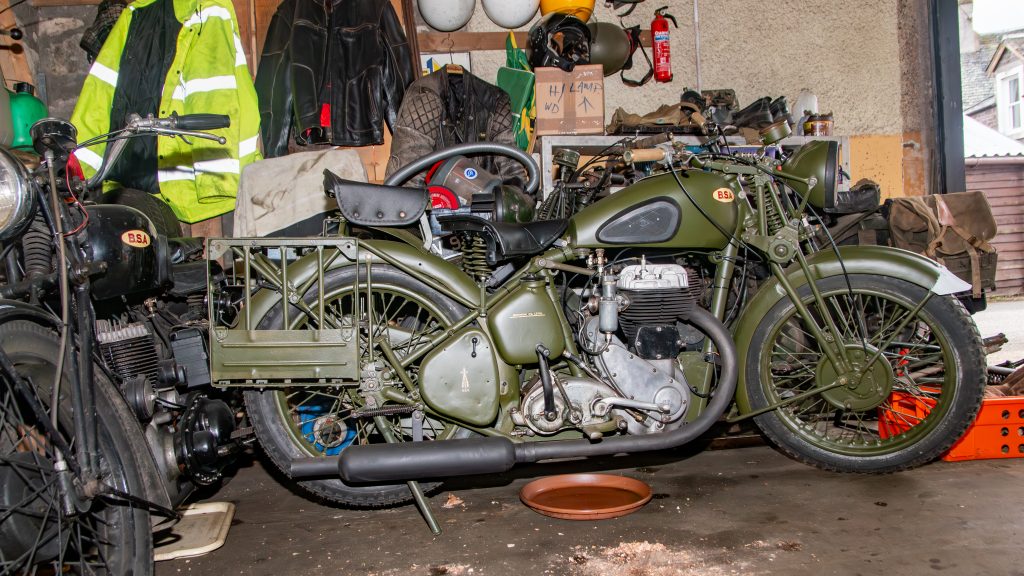
Harry bought his first vintage bike, a 1942 BSA M20, in 1984. He still has it to this day and continues to ride it. It was the first of many vintage bikes owned by Harry, some of which he kept for his collection, and others which he sold on after restoring: “With a growing family and a mortgage, I found that the only way to pay all the bills and be able to indulge myself in my hobby was to buy bikes, restore them, and then sell some of them to cover my costs. In that way, my hobby became self-funding.”
Having had 13 vintage bikes at one stage, Harry has trimmed his collection a little but still has three BSA M20s from the 1940s (and is planning to restore a fourth one soon), a 1937 BSA B23, a 1939 BSA B21, a 1944 Norton 16H, and a Matchless which is awaiting restoration. Harry’s collection also includes a very interesting pedal bike, a 1944 folding bicycle as used by British Paratroops and Commandos.
As interest in older motorbikes has grown over the years, the price of both bikes and the spare parts needed to restore and keep them running has increased. Spare parts are getting harder to find too – another reason why prices have risen. Fortunately for Harry, he has amassed a good collection of spares over the years, which will not only ensure that his motorbikes keep on running but also, through swaps and sales, help him to acquire and fund whatever additional parts he may need in the future. Harry does most of the restoration work, including painting, himself but leaves specialist tasks to people with the necessary skills and equipment.
But what does his wife make of his hobby? “I’m very lucky, in that I have a very understanding wife. I often joke that she’s a ‘shed widow’ rather than a ‘golf widow’. Of course, it helps that she likes motorbikes as well,” says Harry. “She obtained a motorbike licence nine years ago; she said that she was fed up riding on the pillion! We each have a modern motorbike and we often go out for a day together on our bikes.”
So how does Harry rate vintage motorbikes against their modern equivalents? “They’re very different beasts,” he replies. “Modern motorbikes are very comfortable, with good brakes and supple suspension. The vintage bikes are a bit lacking in these departments. You need to be much more aware of road conditions and other road users, as well as the limitations of your brakes, on an old bike. They’re so much more involving to ride than a modern machine but that only serves to make them hugely enjoyable for experienced riders.”
Bikes aren’t Harry’s sole interest as a collector. “I grew up in a house that was full of antiques, and like most boys of my age I used to read ‘Commando’ books and the like,” he explains. “Many of my older relatives served in the military, and some famous characters from the Second World War – including David Stirling of SAS fame, and Major-General Roy Urquhart, who led the British 1st Airborne Division at Arnhem – either lived in or had strong links with this area. These things led to me becoming interested in military history and, later, in collecting militaria.”
Harry’s two interests intersect, in that most of his motorbikes are from the Second World War period and are types that were extensively used by the military. And as he is quick to point out, they might be British bikes but the German military used them too: “In 1940, the British Expeditionary Force left much of its equipment behind in France. The roads to Dunkirk were strewn with abandoned vehicles, including hundreds of motorbikes. After they fell into German hands, they were repaired, repainted in German military colours, and used in both Europe and North Africa.”
Harry’s collection isn’t just limited to militaria; he also owns a wooden chair which, according to an inscription set into a plaque on the seat, belonged to that well-known Scottish folk hero from the 17th and 18th centuries, Rob Roy MacGregor. Harry, who knows a thing or two about antiques, reckons that the chair is of the right age to have been owned by Rob Roy. But did he actually own it? There are, as Harry observes, two possibilities: either the inscription is right and Rob Roy really did own the chair or someone might have added the inscription in the hope of bumping up the chair’s value. Either way, it’s a lovely thing – a well-preserved remnant from a troubled age in which Scot fought against Scot.
Before we take our leave of Harry, we think it right to share the tale of how he became almost certainly the only person ever to appear in these pages who can claim to have hit John Cleese with a vegetable! This feat occurred when Harry, then aged 14, found himself working on Monty Python and the Holy Grail. As the man himself explains: “An advert inviting pupils to apply to become extras in a film being shot at Doune Castle was placed on the school noticeboard. I applied but nothing came of it. When filming started, some friends and I went up to Doune Castle to watch. We were noticed by members of the production team, who asked if we fancied helping out. Needless to say, we did. I soon found myself in a cherry-picker with another boy, our task being to lob fruit and vegetables at the actors from up on high – health and safety wasn’t a thing in those days! I managed to hit John Cleese with a cabbage but that shot didn’t make it into the film.
“Anyway, one thing led to another and I ended up appearing in a few scenes in the film. In particular, I was one of the victims of the Killer Rabbit of Caerbannog. I also dressed as Eric Idle’s character, Sir Robin, in a couple of battle scenes, and I was one of the peasants in the mud-gathering scene. Appearing as an extra meant being issued with a costume and given a quick once-over by the make-up team before filming started. The costume department worked out of a building at the castle but sometimes left before filming ended for the day. When that happened, I would get changed, go home for dinner and then take the costume I’d been wearing to the hotel where the film crew and actors were staying. Inevitably, they’d all be in the bar, and just as inevitably I’d be invited to join them. I was given several glasses of, ahem, ‘apple juice’ and got to chat to several of the Pythons. They were a nice, pleasant, funny, and very down to earth bunch. And in case you’re wondering, John Cleese never did pull me up for clobbering him with a cabbage.”