Dumfries House



Ayrshire’s Georgian Masterpiece Brought Back to Life
When you step onto the grounds of Dumfries House, it’s hard not to feel as if you’ve slipped back in time. This elegant Palladian country house, set within 2,000 acres of Ayrshire countryside, was built between 1754 and 1759 by the famed Adam brothers for the 5th Earl of Dumfries. One of the very few stately homes in Britain still housing its original collection of Chippendale furniture, many pieces were commissioned specifically for this estate.
In 2007, Dumfries House came perilously close to dispersal—the interiors were due to be auctioned off. What followed was a dramatic rescue led by the then Prince of Wales (now King Charles III), who guaranteed a £20 million loan and headed a consortium to save the property for the nation. It opened to the public in 2008 under The King’s Foundation and quickly became a pioneering example of heritage-led regeneration.
Today, visitors explore the beautifully preserved interior on guided tours: from the concise 60‑minute “House Tour” to the more immersive “Grand,” “Chippendale,” “Clock” and “Art” tours. The rooms feel lived-in, not staged, with original carpets, clocks, tapestries, and furniture breathing life into 18th-century daily routines. Not to be missed are the Rosewood Bookcase in the Blue Drawing Room—among Chippendale’s finest—and the cedar-panelled Tapestry Room, illuminated by Gobelin tapestries.
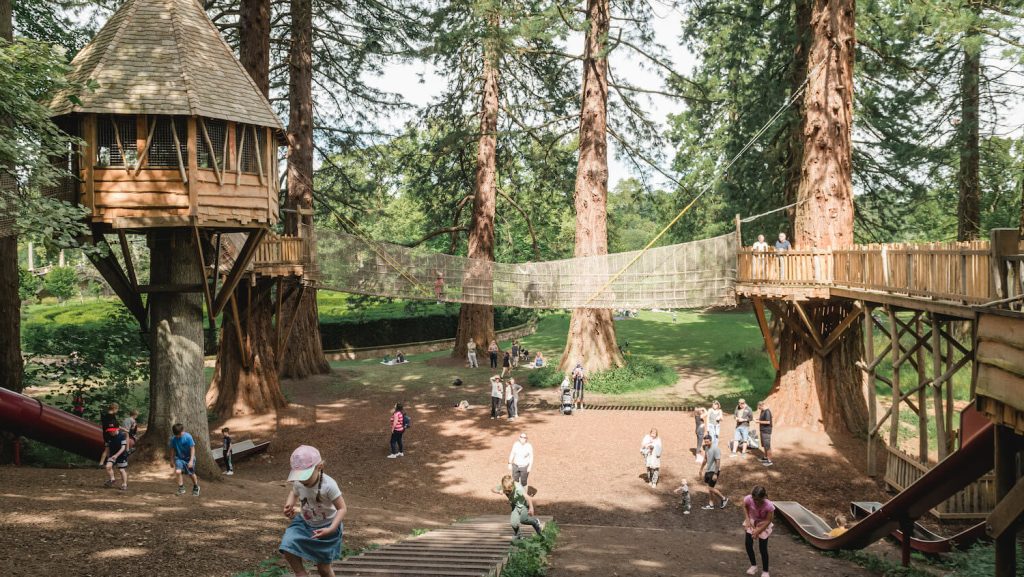
Dumfries House’s architectural elegance extends well beyond its walls. Stroll through Rothesay Woodland, cross the Chinese Bridge over Lugar Water, and lose yourself in the Queen Elizabeth Walled Garden. Children and families delight in the Adventure Playground and educational farm, while seasonal trails—lined with bluebells in spring—offer moments of serene reflection. Entry to the estate is free, and it welcomes visitors every day of the year (although, parking charges were introduced from 1st September this year).
Adding to an already vibrant programme, recent seasons have introduced events like the Dumfries House Fun Dog Show, monthly craft and food markets, and even an outdoor Adventure Cinema screening classics such as Grease and Pretty Woman. These community-driven events underscore the estate’s role as a welcoming cultural hub, bringing together families, foodies, film buffs, and pet-lovers alike.
The estate is also known for exceptional dining. Its 18th‑Century Dining Experience in the lavish Pink Dining Room—often personally favoured by King Charles—offers a candlelit, butler-served feast under a Murano glass chandelier. Think poached salmon, roasted venison, syllabub; menus rooted in Georgian tradition, priced from £375 per head, with proceeds supporting educational initiatives. Alternatively, the Coach House Café and Woodlands Restaurant serve seasonal, locally sourced fare in relaxed, family-friendly settings.
But Dumfries House is far more than a beautifully restored country retreat—it is a centre for learning, skills development, and sustainable innovation. The estate houses Future Textiles, STEM education, and traditional crafts workshops offered through The King’s Foundation. “Make It Mondays” invite the community to learn stone carving, felting, baking, gardening and more, while tens of thousands of school children attend programmes each year.
New initiatives in the pipeline reflect the estate’s commitment to conservation and sustainability. Plans approved last year include a purpose-built bridal pavilion to host luxury weddings for up to 200 guests, designed to generate revenue for maintenance and programming—but only after securing bat-friendly measures such as roost boxes and habitat protection.
These developments speak to a careful balance between heritage and future-proofing—ensuring Dumfries House continues to thrive both as a cultural landmark and community asset. Its listing as a Category A building and place on Scotland’s Inventory of Designed Landscapes underscores its historical and environmental significance.
Employment at the estate exceeds 140 local staff, while an impressive 170,000 visitors engage each year with its offerings—checking in for garden walks, soaking up Georgian design, bringing picnic blankets for cinema by moonlight, or picking up hand-crafted goods at the bustling Sunday market. Dumfries House has become a vibrant hub for local commerce and pride, generating significant economic benefits while preserving Ayrshire’s cherished cultural legacy and historic identity.
Yet, at its heart, Dumfries House remains a story of resurrection: rooms opened up for learning, furniture restored to its rightful home, and a community remade through skill-sharing, creativity and enterprise. From candlelit dining and educational workshops to film nights under the stars, the House presents history not as distant, but as lived experience—experienced and embraced, by individuals, families, visitors and scholars alike.
Whether you’re drawn by Georgian grandeur, artisan activities, conservation successes or a seasonal screening in the grounds, Dumfries House delivers something for everyone. It’s not merely a museum of grandeur, it’s a living, evolving testament to how heritage, vision and community can converge to create something truly enduring, endlessly inspiring and uniquely Ayrshire.