COMMUNITY ROOTS GARDEN



Promoting Community Kindness in West Kilbride
Gill Sherry
There’s something about Fi Thorburn that instantly makes me smile. She’s a colourful character who greets me with a warmth not dissimilar to that of the winter sun that casts its spell over West Kilbride’s Community Roots Garden on this otherwise chilly Wednesday morning.
Because this is, indeed, a magical place.
What started off as West Kilbride Community Support Group, became Community Roots Garden as a direct result of the pandemic.
“We were fighting to get food support in the village,” Fi tells me as we find ourselves a wee sunny spot to sit down. “We were working with a lot of people that were already struggling before the pandemic, financially and socially. And then, because of the pandemic, there were other people needing support as well. This allowed us to tap into support that wasn’t there before.”
Although much of West Kilbride is considered affluent, there is a pocket, Fi confirms, of real depravation within the village which, pre-Covid, was unheard and unnoticed.
“The trustees and myself had always been really focused on the environment, food security, and sustainability, and wanted to build something that would last. We wanted to stand out, and Community Roots was what we landed on. It feels like it belongs to the community… we’re all together in this.”
Fortuitously, land became available for which the charity now has an informal lease. From what Fi tells me, it looks a lot different now than it did then.
“We had to climb up to see it. It was wild and on a camber… beautiful in its own way but not really that workable.”
In the absence of anything else, Fi agreed to take it on and West Kilbride’s Community Roots Garden was born. Since then, the land has been transformed into a thriving garden, the main aim of which is to support the community in which it sits.
“We try and grow a bit of everything,” says Fi. “Broccoli, cauliflower, potatoes, onions… We work with the Village Larder which offers a dignified approach to food security. We gift them vegetables for their shelves.”
Fi is, however, aware of the need to diversify.
“We’re looking into diverse planting… things that will feed the soil and things that are not necessarily a staple in the larder. We’ve researched no-dig methods, where you feed the soil every year and try not to disturb it, so it builds its own eco-system. We’re also interested in things like permaculture, incorporating some perennials. This year we’ve got strawberries going in amongst the spinach and the brassicas. We’ve got violas growing in our salad beds… they’re edible flowers but they’re pretty to look at as well. And we’re looking at putting in things to encourage pollinators.”
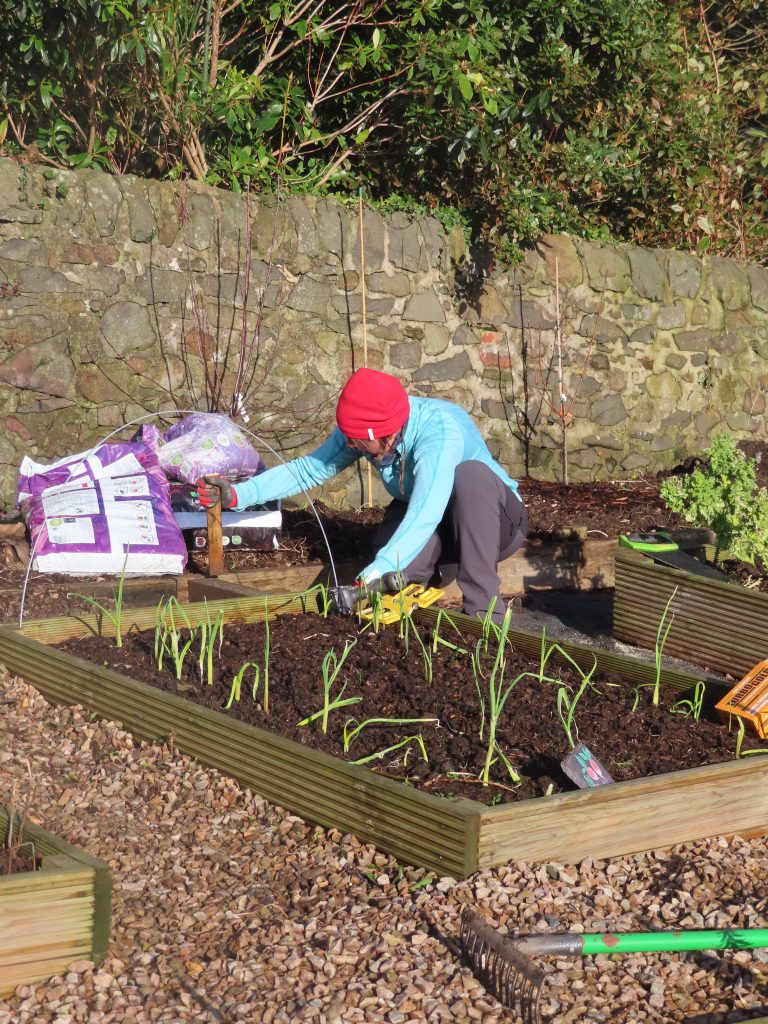
In addition, they have researched food forestry, so as well as traditional fruit trees such as apple and pear, they would have scrambling fruits like raspberries and blackberries, plus espalier trees which grow up against a wall, thus allowing more planting space for ground cover and the likes.
You’d be forgiven for thinking that Fi, Garden Co-ordinator, was a professional horticulturist, but her knowledge is self-taught.
“We’re learning together. I learn from videos, I’m a YouTuber. And I learn from watching people or doing it myself. Barbara is one our trustees and she’s a reader. She reads about permaculture and other things, and she’ll come and talk to us about what she’s read. She’s got a real love for nature and the environment. Gordon goes to another group and brings back ideas.”
And of course, the garden simply wouldn’t survive without the volunteers who tend to it, some of whom I’ve already had the pleasure to meet. I’m told there are currently ten volunteers aged from 25 up to mid-70s.
“Including myself,” Fi confirms, “there are three or four people with diagnoses of ADHD and other neurodiversity. I think I speak for everyone that’s in the group, whether they’re neurodiverse or not, when I say that we all prefer to socialise with a function. We like to be side by side doing things rather than face-to-face. It’s much easier to have a tool in your hand, digging the ground, while you chat to someone openly about stuff. It’s still socialising, but it’s just like having another social tool. For people with neurodiversity, it’s essential to have a practical aspect to what you’re doing.”
In addition to the mental wellbeing and social benefits, gardening also brings physical advantages. Working outdoors can be strenuous but also extremely rewarding. Right on cue, it begins to rain, reminding us that it also has its challenges.
Fi and I are forced to take shelter in the shed. However, there isn’t room for everyone, so the volunteers are getting wet. This prompts Fi to tell me about their crowdfunding exercise for a new garden room. Whilst some funding has been secured from the National Lottery Community Fund, further funds are required to purchase solar panels and to futureproof the enterprise.
Such futureproofing, however, goes way beyond gardening. Fi has plans for a garden haven which will offer free complementary therapy, plus community workshops relating to permaculture, the environment, food and wellbeing.
“I’m trained in lifestyle and stress management. I’ve also done some mental health courses, so there are resources that we can tap into to do workshops and things. One of the reasons I didn’t become a complementary therapist and start a clinic up is because I’m really annoyed that it costs people so much money to access therapies.”
At one time, Fi was off work and unwell with her mental and physical health for 13 years. Not once during that time was she offered low cost or free complementary therapy.
“Why is this not accessible? I’m really interested in giving accessible, free therapies as part of what we do.”
Plans for the haven, I’m told, also include a kitchen.
“It means we can start cooking things together and sit out and eat together as a community.”
I must admit, the thought of wrapping my fingers around a mug of hot soup, made from the vegetables in the garden where we stand, is a very nice thought indeed. What would make that thought even nicer, was if there was somewhere warm and dry to sit.
“This is a legacy that we’re building here rather than just a short-term project. It might not look like much to have a few small fruit trees just now but give it five or ten years and it’s going to be a thriving multi-layered food growing area.”
I don’t doubt it for one minute. Fi’s passion for the project is obvious, and the volunteers appear equally committed.
“We do believe in the permaculture principles – care, fair share – it’s about everybody having what they need and sharing it, including giving the planet what it needs as well.”
Earth Care, People Care, and Fair Share is all about prioritising the health of the planet, the well-being of its people, and the fair distribution of resources. That’s certainly evident in this magical wee corner of West Kilbride.
If you’re interested in volunteering at Community Roots (they meet every Wednesday 10am – 1pm), you can contact Fi via the group’s Facebook page (www.facebook.com/SHEDWestK). And if you’d like to donate to the crowdfunding exercise, please visit: www.crowdfunder.co.uk/p/community-roots-051963