Portencross Castle and the Lost King of Scotland



Suzy A. Kelly
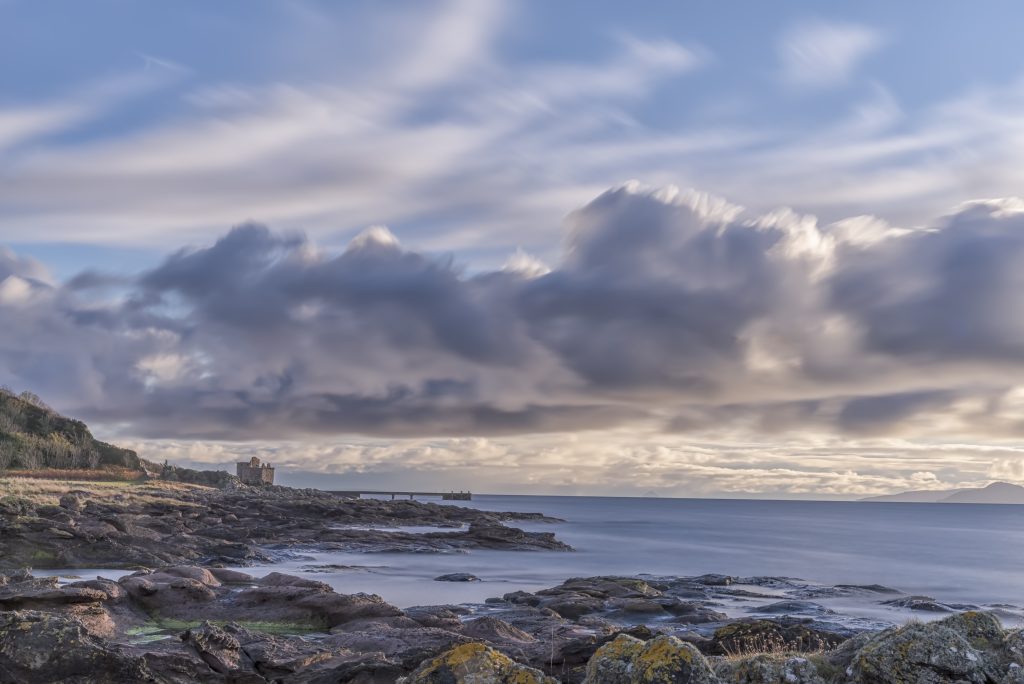
Portencross Castle is two rôst west of West Kilbride. This was the final stop on the mainland before the currach rowed my kind to their eternal resting ground at Reilig Odhrain on Iona. This tradition occurred since the time of Malcolm the Gael, son of Alpin, the one they called An Ferbasach (‘The Conqueror’) until the soil stored the bones of sixty kings.
I am neither Pict nor Gael but from the Northlands where the bite of winter and the night dark lasts longer than those of Pictland, Alba, or Scotland. The long-dead monks never rowed me to rest. I am ‘heathen’ and ‘unfitting’ of a Christian burial and so the death worms rotted my corpse here. The skalds considered me unworthy of mention in your histories and my sagas until my name and lineage went unsung. Thus, have I lingered here in bitterness, trapped in this hel with righteous anger as my only salve. Since you are here, I will guide you through these halls of Portencross. For my restless spirit has borne witness to countless changes throughout the eons, from the defeat of my people at Largs in 1263, the sinking of a tall Spanish galleon off the coast, to the destruction and restoration of Portencross Castle.
Before they drove my body here without feasting or ceremony, a wooden fort sat further along at Auldhame, replaced in time by a stone fortress. A year after the Bruce’s great victory at Bannockburn in 1314, the Scottish crown gifted these lands in the Barony of Ardneil to the Boyds of Kilmarnock in reward for their loyal service.
As my earthly flesh deteriorated, Robert, grandson of the first Robert Boyd, built another home by the rocky headland. A clever strategy, for this is a cunning place from which to trade and monitor vessels sailing the wide channel. I stood at Robert’s shoulder as he raised a hall house on mist-blanketed shores. This rectangular, two-level home had a main hall entered by a separate stair from the windowless basement below. The builders did not intend for this abode to withstand an invading force as powerful as my own but created earthen banks with wooden palisades on top from which they could repel the battle-blooded.
From this same hall at Portencross, Boyd created a sleek fortified tower house reaching high towards the storm clouds. See the refined corbels built into the battlements? He finished the outside with mortar and white lime and created an entrance on the ground floor. Instead of keeping the solar and garderobe behind the Lord’s Dais in the common hall, he transferred these to the floor above to afford the Boyd jarls greater safety. Proof that the house of Boyd’s good fortune was increasing.
Robert II, son of Robert and first Stewart king of Scotland, sat his haunches in a humble wooden chair by the fireside whenever he passed through. He stopped at Portencross with his retinue when journeying to and from his seat at Dundonald. Overlooking storm-tossed kelp-land, he signed Royal charters with the dignitaries of his court gathered in the vaulted hall. I watched him from the window seat, in the corner where candles failed to banish the shadows, as he signed the charter allowing his daughter, Margaret, to marry Iain, son of Aonghus Óg, also known as Lord of the Isles.
In 1588, Philip II of Spain dared assault Elizabeth of England in her own waters with a fleet of ships numbering one-hundred-and-thirty. Elizabeth’s forces split the armada and routed the ships north, including twenty-two galleons. Many men, like me, never returned to their homeland. The fates turned against one ship as it retreated to the cold Scottish waters by Portencross. With the rough peaks of Arran observing in the distance, and gulls circling nearby cliffs, the galleon became stranded on a sandbank and sank ten fathoms deep. I paced atop the Three Sisters, keening for the perished souls alongside the buzzards and the jackdaws. Later authorities sent a diving machine after the wreckage in the late 1700s. The proud diver discovered a large chest still sitting upon the deck. The naval ghosts wept as they witnessed the looting of the chest and the ship’s canons from their graveside. You may have heard tales of removing brass canon and leaving iron ones by the wayside. I swore to the Spanish ghosts before they moved on to the Sea Lord’s palace that I would never reveal the whereabouts of the missing sixteen-pound gun to the living. This solemn oath have I kept.
Sailors, and other recent dead, have relieved my loneliness over the long years since my drowning. These days, I accept time has vanquished the memory of my name. It is Odin’s wish. His ravens will not speak my name for I have infused the south-westerly winds with my ire. Yet, I am loathe to continue doing so. One night, I felt my spiritual injustices so keenly that I tore the roof from Portencross. I believed this to be the ruination of Boyd’s home. It was not. The surrounding fisherfolk took over the ruin and kept the hearth fires burning. Thus, did they save the long-suffering tower house once more and then save the people of Glasgow. By sharing their crop of ‘earlies’ when the city’s own potato crop storage failed in 1917, the fisherfolk of Portencross helped to avoid widespread hunger.
It happened that the Friends of Portencross gathered their hard-won resources and bought the castle’s remains from the Scottish Government. Restoration works began in 2007. South-westerly gales and salt-bitter waves, driven by my vengeance, battered and lashed the exposed stonework of Portencross over centuries. So outraged was I, that I did not let up until I eroded the white lime and exposed the dark stone beneath. The Friends brought in masons who mended the stone I damaged. They fixed the roof I destroyed and fitted webcams for those unable to navigate the spiral stairs to the roof. The Friends added touchscreens too, so that you may better understand the history of this scheduled ancient monument.
Who am I? A long-dead warrior with no name, no kin, and no grave goods to bequeath. Yet, this sharing of memories has done me well. No longer will I possess the body of the Tattie Bogles at Samhain and throw turnips at scream-filled visitors. Thus, have I earned my penance.
Odin’s birds speak my name now. Their master opens his mead hall to me at last. Need not I the damp soil of Iona, but the camaraderie of old friends. In Asgard’s highest halls, we will shout, ‘Skål’ and toast our lives with heart-song and ale. There, shall I share how my langskip blew across the Firth of Clyde on my way to fight the Scots. I shall tell them how I learned endurance and how I discovered unexpected joy and community in this place. Such bonds are evident in the very stones of Portencross Castle, and I am a better man for having known it.
Portencross Castle is open daily over the Easter holidays, weekends from April to July, and daily from July to September. Entry is free.