Golfing Heritage of Ayrshire



Exploring Historic Courses in the Cumnock District and Beyond
Harry Ward
Continuing our journey into the historic golf courses of Ayrshire, the landscape morphs from the wind-swept coastal dunes to the rolling fields and wooded estates of the county’s interior. Moving eastwards toward the Cumnock district, the history of golf unfolds in unexpected corners, testament to a game that captured the imagination of communities both large and small at the turn of the twentieth century.
It is perhaps surprising to modern sensibilities that golf once flourished in places seemingly far removed from the traditional seaside links. In 1898, the village of Ochiltree was the subject of a proposal to establish a golf course – a bold idea for a rural settlement more accustomed to agricultural rhythms than golfing pursuits. However, negotiations with the local farmer ultimately proved fruitless, and the project was never realised. Yet, even in this unfulfilled dream, we see clear evidence of the sport’s growing appeal and the collective enthusiasm that swept Ayrshire at the dawn of the new century.
While some communities saw their golfing aspirations fade, others found success and satisfaction in their endeavours. In June 1896, Lugar emerged as a beacon for local golfers. The newly established course was described by The Post with evident pride: “The course, which is over the high fields of Craigston, is a nine-hole one, and after a month or two, with improved greens, promises to be a model one.” Unfortunately, the club and course would not survive The First World War and closed in 1917.
The town of Cumnock itself holds a unique place in Ayrshire’s golfing chronicle. Unlike many clubs that remained rooted to a single location, Cumnock’s golf club migrated across different sites throughout its history, each incarnation shaped by the needs and fortunes of the time. The first attempt at bringing golf to the town was in 1894 when a Mr Munn of the Dumfries Arms Hotel offered the new club a lease on his ground, but negotiations fell through. Their next attempt was more successful as The Cumnock Express described at the time in October 1894:
“On Saturday afternoon, in fine weather, the new golf course was formally opened. Mrs Galbraith of Holmside struck off the first ball amidst the cheers of a big crowd. Afterwards a large number of players engaged in the game. The course is beautifully situated on Mr Wardrop’s farm of Bankend, and although the grass at present is a little rough it will with a little labour be made a fine course, the bunkers and hazards being numerous. The length of the holes range from 150 up to 300 yards.”
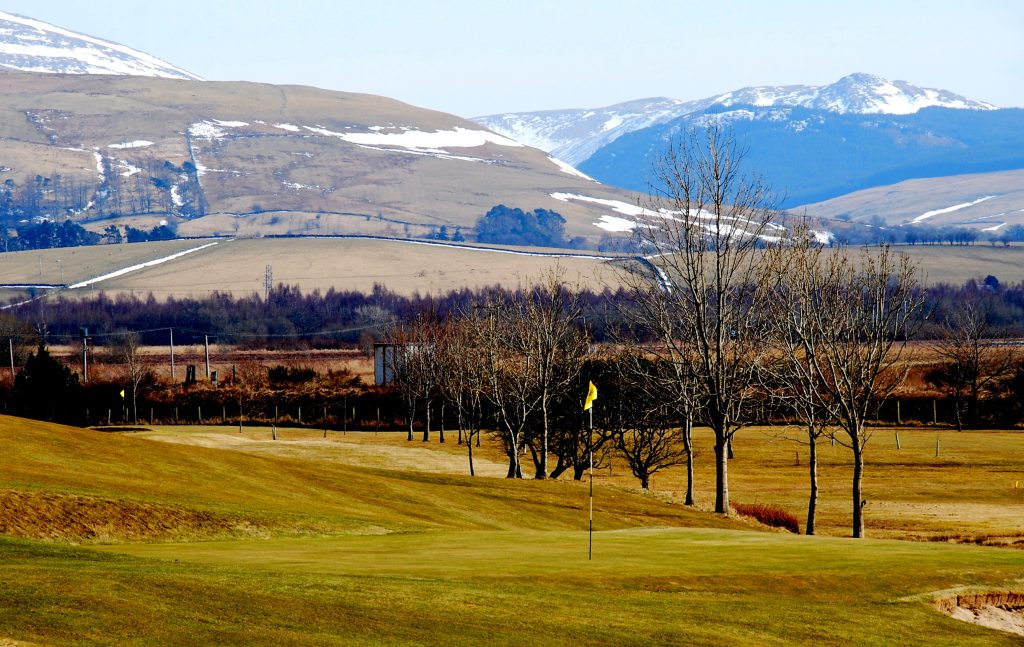
This course, however, was also short lived when Mr Wardrope, the farmer, demanded an increase in rent which the club was not prepared to pay. In May 1895 the club secured a lease on the farm of Netherthird but once again fell foul to demands for more rent and the course lasted only a year. Their next venture was at Blackstone Farm where they opened a course in June 1896, this time surviving at the same location for a mighty three years until 1899. The town’s penultimate course was a return to Netherthird Farm in June 1899 where they would remain for over 20 years. The club’s final course was opened at Drumbrochan Farm in 1922.
Within the wider Cumnock district, the passion for golf extended well beyond public courses. Private six-hole layouts were established at Dumfries House and Glaisnock House, each set within the picturesque and carefully maintained grounds of these grand estates. Here, the game was played in relative seclusion, offering a privileged few the unique opportunity to enjoy golf within the tranquillity of landscaped gardens and ancient parkland.
Beyond Cumnock and its private estate courses, the neighbouring villages and hamlets of Ayrshire became home to their own golf clubs, each with its own story of ambition, community, and sometimes adversity. Among these was Bogwood Farm in Mauchline, where the transformation of agricultural land into a sporting venue was emblematic of a wider trend and the course was opened in May 1909. However, this course would be given up five years later when the club’s second course was opened at Templebogwood less than a mile away in 1914. Sorn Castle saw its fields adapted for golf, providing yet another local attraction in 1912.
The existing club of New Cumnock had its first course high up on the adjacent hillside to the present course in 1896 at Lochill Farm. This club was the early home of Jim McAlister, one of Ayrshire’s legendry professionals.
Pyet Ha in Catrine, Galston, and Loudon Hill were further nodes in this network of rural golf, each nurturing a club that served as both a sporting institution and a social hub. At Pyet Ha, the course sat atop a gentle rise, its holes laid out to make the most of the natural contours of the land. Galston’s course, meanwhile, drew players from across the valley, its greens maintained by a devoted band of volunteers. Loudon Hill, its ancient summit a witness to centuries of history, provided a dramatic backdrop for rounds played in the shadow of legend.
A course and club briefly existed at Auchinleck from 1915 to the 1920s but for some strange reason the game simply did not interest the local community. The first course was at Back Rogerton which was opened in April 1915 but closed during the war, re-opening again in 1920. A new course was opened at Fore Rogerton in 1922 but survived less than a year. Auchinleck’s final course was laid out by the Barrassie professional, Butchart, in July 1923 at Blackstone Farm but despite several fund-raising campaigns the end was nigh and The Cumnock Express reported the following:
The local golf club is disbanded. Failure to enlist a sufficiently large number of members made the closure of the club’s activities inevitable. At a meeting on Monday night the club’s affairs were definitely wound up.”