

a walk at loudoun kirk and ladyton
Linda Brown
It’s December 2024. One of those lazy festive days between Christmas and New Year when time blurs, the days of the week lose all meaning (is it Monday… or Sunday?), and I can’t quite remember when I last left the house… or ate something that didn’t involve turkey.
Outside there’s been a hard frost – my car, dripping with icicles, looks like an abandoned ice sculpture. It’s going to take a bit of defrosting. The temptation to coorie up on the sofa with a fleecy blanket, a mug of hot chocolate and a selection box is strong – after all The Great Escape is on the telly… and I’ve only seen it at least a dozen times. Still, a breath of fresh air and a brisk walk to counterbalance my Christmas pudding overindulgence is called for. Thermals on, wrap up warm, and out I go.
I decide to visit one of my favourite places – Loudoun Kirk just outside Galston. The quiet kirkyard is a haven, even in winter, for birdlife. I’ve brought a bag filled with bird food –sunflower seeds, peanuts, millet and tasty dried mealworm – because I suspect my feathered friends might be struggling to find food in this icy weather.
At the kirkyard, the frozen grass, crisp with frost, crunches under my walking boots, startling a puffed-up robin resting on top of an old headstone. He scoots off to hide in the foliage of a yew tree although I’m sure he’ll make a reappearance once he realises mealworm is on the menu.
Not far from the bench along the kirkyard’s back wall lies a weathered moss-covered slab of sandstone, the broken remains of an old memorial plinth. It makes an excellent makeshift feeding table. Having scattered their belated Christmas banquet across the stone, I step back to wait.
Two great tits are first on the scene, zooming into a nearby holly bush. They flit from branch to branch, chattering noisily, broadcasting the news to their friends and neighbours that brunch is served. They take turns to pop down to the stone, take a sunflower seed, then return to perch in the bush. A blue tit flies in and nabs a small nut – he skedaddles when a nuthatch shows up. And just as I’d guessed, the robin hops in to claim a mealworm. I try to stay quiet and unobtrusive while snapping a few shots with my camera.
I’ve just captured a cracking image of a great tit arriving for second helpings when chaos erupts. Hungry birds swoop in from all directions – everything from tiny coal tits to burly blackbirds – all eager for their share of the feast. There’s so much frantic activity, my camera struggles to stay focused on any one bird. It doesn’t take them long to demolish the spread. Within ten minutes there’s barely a husk left – the birdie equivalent of licking the plate clean.
Feeding birds during the winter – whether at garden bird feeders, or like me, carrying a bag of seed to share on my rambles – offers vital support when natural food is difficult to source. It helps birds build up their essential fat reserves, giving them energy to stay warm, and increasing their chances of survival in harsh conditions. In turn, I feel I’ve played a small role in supporting the bird populations – so often reported as dwindling – through the toughest months of the year.
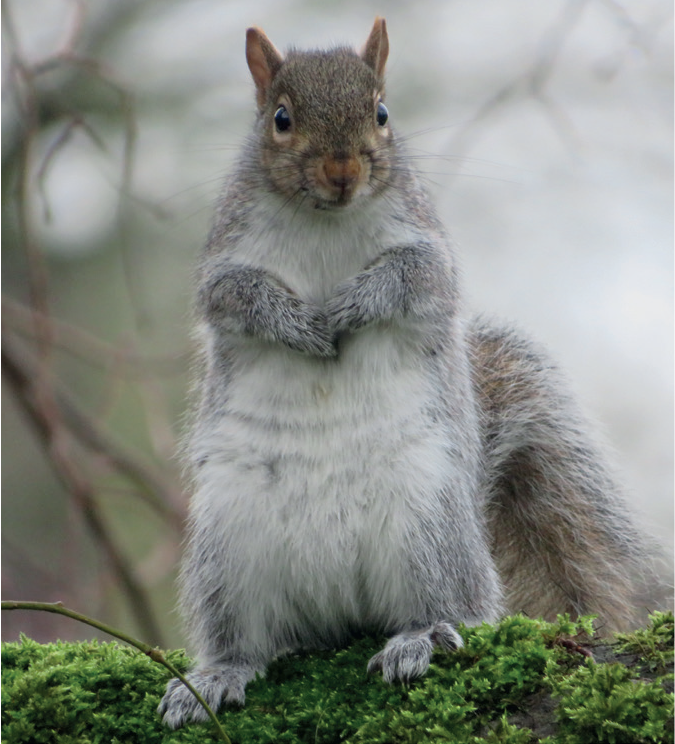
I empty the last of my bird food onto the stone. Round two begins. One cheeky, but canny nuthatch manages to cram two nuts into his beak and zips off. He’ll probably stash them in a tree crevice for later. My attention is caught by a nosy grey squirrel, curious thanks to all the commotion, sneaking along the kirkyard wall. She stops and stares; looking right at me as if to say, “OK, where’s the grub for us puir squirrels?”
It’s too chilly to hang around much longer, so I stamp off along the road toward the large pond known locally as Ladyton Loch. I’m astonished to discover it’s completely frozen over. The weak winter sunshine shimmers faintly on the ice, but there’s no sign of the little family of mute swans – cob, pen and one growing cygnet – who live there.
Usually they’re found gliding serenely across the water, then ducking under, tails and bottoms tipped skyward, to reach their favourite food – pondweed. I wonder where they have taken refuge? Then I spot movement among the tall, brittle reedmace fringing the pond and a long white neck cranes out – the female and her bairn are sheltering there, the cygnet huddling close to its mother for warmth. But where is the cob? Keeping my eyes peeled, I walk on for a few yards – and there he is. He has ventured onto the frozen surface and is now waddling across the ice. His large webbed feet, perfect for paddling underwater, are not meant for skating. He struggles to keep from sliding over. I stand and watch his attempt to traverse the pond – it’s an odd blend of Swan Lake and Dancing on Ice. I reckon he’s searching for a break in the ice to find something to eat, and feel a pang of guilt that I couldn’t bring the swans any food. But, thankfully, while I’m watching, a woman appears from the opposite direction. Her car is parked further along the road, and she’s carrying bags filled with chopped veg especially for the swans. It’s heartening to know that, during this bitter cold spell, someone is looking out for the big birds too.
As the cob turns back towards the bank, and the pen and cygnet emerge from the rushes, hopeful for a good feed, I decide it’s time I made my way home — after all, there’s a repeat of Happy Feet on the telly this afternoon, and I rather fancy watching it – with a mug of creamy hot chocolate and that tempting big selection box, of course.