BROON FRAE TROON



a Scottish Rugby Legend Who Never Forgot His Hometown
Chris Palmer
In the half century or more that I have been following Scottish rugby, a good number of ‘gentle giants’ have played the game at the highest level. Lock forwards with a fierce, uncompromising and physically imposing attitude when they pulled on the blue jersey, but full of warmth, generosity and self-effacing humour off the pitch. A name that seems to me to encapsulate this type of Scottish rugby forward is the late Gordon Brown, invariably known as Gordon Broon of Troon.
A short distance from the centre of Troon, just past where the library stood, opposite the municipal carpark, there is a sign directing passers-by to ‘The Gordon Brown Memorial Garden’. It took me by surprise the first time I encountered it. How many rugby players have a garden created by their hometown in their honour? My enquiries, though not exhaustive, suggest it’s unique. It is a peaceful and well-maintained oasis of calm, such a contrast to the hurly-burly atmosphere of international rugby in front of, say, sixty thousand spectators at Murrayfield roaring on their team. The garden is colourful and welcoming, like Brown himself. The imposing carved sculpture of a lion is remarkably appropriate for his international record.
The facts of his career bear repeating. From a prominent Ayrshire sporting background (his father, for example, was an international goalkeeper), showing prowess from his teenage years at Marr college, and then at West of Scotland, he first played for Scotland, as a lock forward, in 1969. Standing six foot five inches and around seventeen stone, he was a member of a notable Scottish pack of forwards. He won thirty caps for Scotland. This might seem a modest number. In amateur times there were far less internationals than the crowded, television dominated schedule of the professional era.
It is his Lions record that stands out. He toured three times, the most notable being the tour to South Africa in 1974. Beating the Springboks and remaining invincible was a remarkable achievement. Brown scored eight tries on the tour, a world record for a forward. He also was a member of the successful tour to New Zealand in 1971. Though missing from the Scottish team in the Five Nations tournament in 1977, he was still selected for his third tour. This was the unsuccessful tour of New Zealand. He had reached his peak. He did not play for Scotland again and retired from international rugby at the age of 28.
I had a look at Brown’s 1983 biography. He acknowledges that he played far better and more consistently for the Lions than for Scotland, for whom he never scored a try. This appears to have been a criticism directed at him by some rugby followers in his home country. He admits he relished the full-time nature of rugby tours whereas at home in Scotland, he was never able to discipline himself to training every day. The other factor that stands out from his book is how aggressive and violent rugby could be in the era that he played. Mass punch-ups were not unusual. His memoir does not shirk from this part of rugby culture which has been largely eradicated in the professional era.
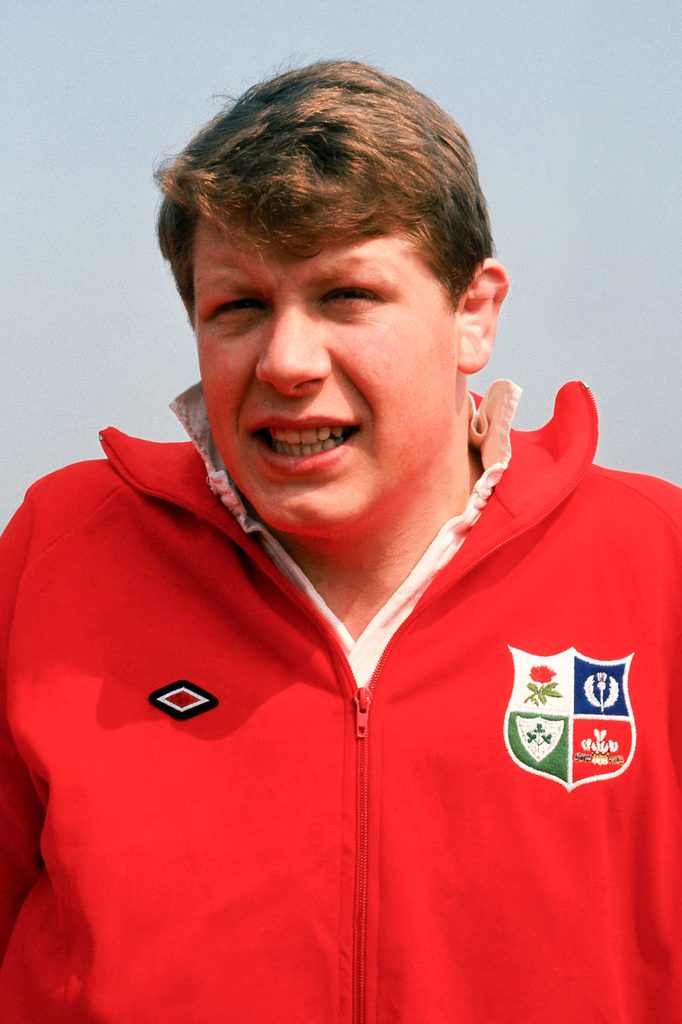
Quite possibly, his life after retirement from rugby is as well-known as his playing career. Initially he continued his employment in a local building society. One imagines him being reluctant to turn down requests for a mortgage from anyone with an interest in, or having an active role, in rugby! He became an enthusiastic fund-raiser for both local and national charities. He wrote three books and dabbled in both journalism and television punditry on international rugby. A keen golfer, he was a member at Royal Troon.
It was, however, his prowess as an after-dinner speaker that he is best remembered for. I wish I had been in an audience when he was the guest speaker. Though his playing career was relatively short it was sufficient to produce many amusing anecdotes which he was able to relate with the skill and timing of a born raconteur.
Though extremely ill with cancer he was still speaking to a large audience weeks before his death. In this fund-raising dinner he was confronted by a Springbok forward who had flown all the way from South Africa to make a surprise appearance just as Brown was recounting a famous story from a notorious Lions Test match. It brought the house down. Sadly, a few weeks later on 19th March 2001, he died, at the age of 53.
The funeral service in Troon for Brown was huge. Red and yellow, the colours of West of Scotland were worn rather than black. A quarter of a century after his death he is still fondly remembered in his hometown.