Royal Troon


Where Dreams Were Won and Lost
Harry Ward
On the Ayrshire coast, Royal Troon remains one of golf’s great theatres, a place where ambition, nerve and history meet in the wind.
Few championship venues capture golf’s fine margins quite like Royal Troon. With the Firth of Clyde close by and the weather never far from the conversation, Troon is a classic Scottish seaside links golf course in every sense. Its identity is shaped by rumpled fairways, native grasses, sand dunes, revetted bunkers and the ever-present influence of the sea. It has built its reputation on a compelling contradiction: it is a course where dreams can be realised, but rarely without first being tested to the limit.
Founded in 1878, with the help of a group of Kilmarnock businessmen, Troon Golf Club developed from modest beginnings into one of the game’s most respected links. It first staged The Open Championship in 1923, won by Aurthur Havers with the American Walter Hagen a shot behind, and has since become a familiar proving ground for the world’s best players. Royal status followed in 1978, confirming its place among the sport’s most distinguished clubs.
Its challenge is rooted in the traditional demands of links golf: firm-running fairways, deep bunkers, changeable coastal winds and a routing that can shift from inviting to intimidating in a matter of minutes. Troon does not simply reward power. It asks for judgement, patience and control under pressure. A round can look secure one moment and begin to unravel the next.
Like the finest links, Troon is not defined by spectacle alone but by the questions it asks. The ball must be flighted beneath the breeze, worked along the ground and placed on the correct side of fairways that seem generous until the wind turns. Its seaside setting gives the course its character, but also its unpredictability. A calm morning can invite scoring; an afternoon squall can turn the same holes into a survival exercise.
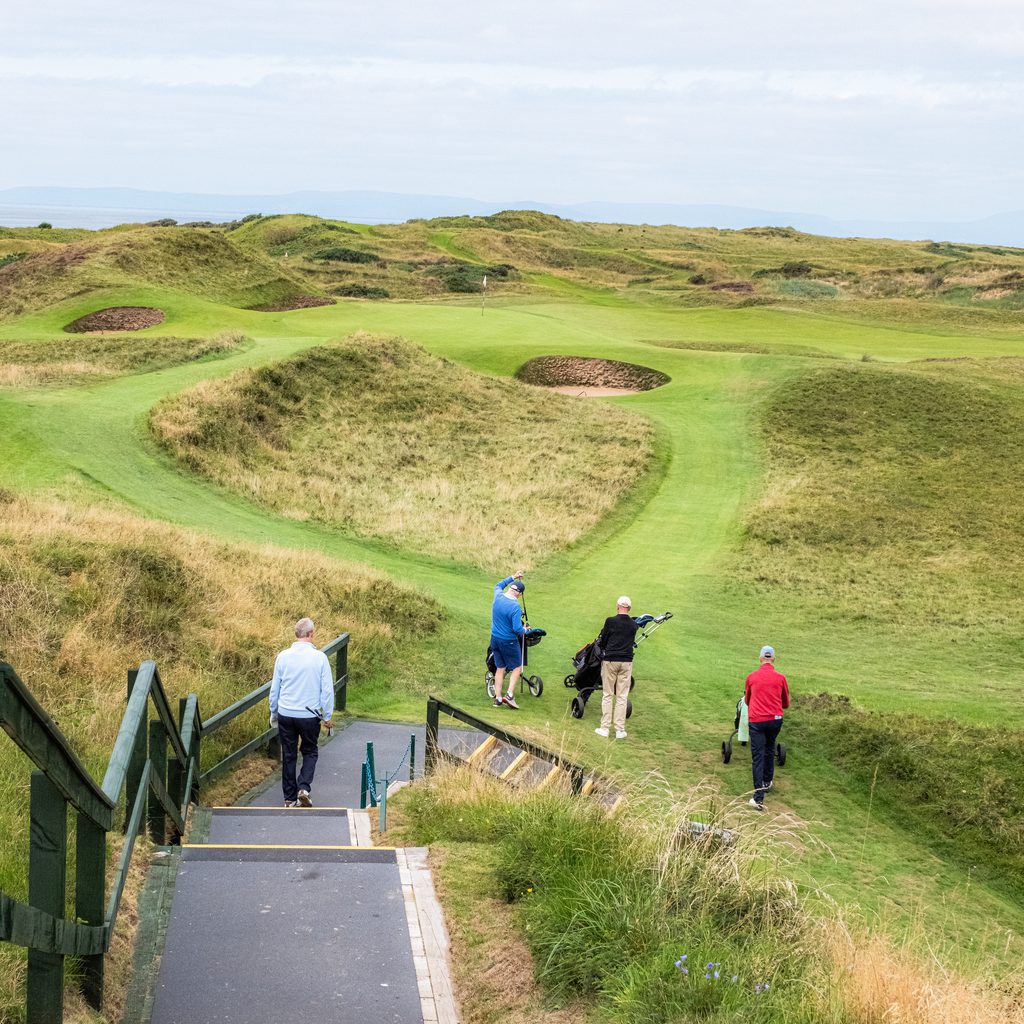
That tension is most clearly expressed at the 8th hole, the celebrated Postage Stamp. Measuring just 123 yards, it is the shortest hole in championship golf, yet few par threes carry such weight. The target is small, the surrounds are severe, and the bunkers punish even slight miscalculations. The Coffin, the most famously named of them, needs little explanation.
The Postage Stamp is Troon in miniature. It appears simple: one short iron, one precise swing, one chance to set up birdie. But beneath that simplicity lies danger. A marginal error can leave a player fighting from sand, rough or an awkward lie, transforming opportunity into damage in the space of a single shot.
For some, Troon has provided the kind of moments that enter golfing folklore. In 1973, Gene Sarazen, one of the game’s enduring figures, made a hole-in-one at the Postage Stamp. In 2004, Ernie Els did the same, on a hole designed to expose hesitation, both found perfection with a single swing. A dream coming true for both players, especially for Sarazan, who at the age of 71, was making his farewell appearance, having played at Troon in 1923.
But Troon’s romance is inseparable from its capacity for ruin. Its bunkers have swallowed title hopes, its winds have unsettled the assured, and its closing stretch has tested players who believed they had done the hard work. The course does not need to overpower; it only has to ask the right question at the wrong time.
That is the essence of Royal Troon’s appeal. It is more than a historic venue or a stretch of classic Scottish linksland. It is a place of consequence, where every decision carries weight and every shot seems to belong to a larger story. Players arrive with ambition; Troon decides how much of it will survive.
That is why its memories endure: the clean strike that brings an ace, the costly visit to a bunker, the roar that follows a champion’s response to pressure. At Troon, triumph and disappointment are separated by the narrowest of margins — sometimes by no more than the width of the Postage Stamp green.
Dreams do come true at Royal Troon, but never cheaply. They are earned against the wind, the bunkers and the pressure of history. And for every dream fulfilled on this famous Ayrshire links, another is left behind in the sand. And speaking of dreams, our very own Ayrshire Scottish Amateur champion, Alan Thomson, fulfilled his dreams by qualifying for the 1982 Open Championship at Troon when his playing partner for the day was Bruce Lietzke, the American who won 13 PGA events in his career.