Historical Troon



Dane Love
Troon is one of Ayrshire’s most prosperous towns, but it is also one of the newest. It wasn’t until 1805 that William Fullarton of that Ilk, who owned Fullarton estate, started selling feus along the shore to people keen to live near the sea. There had been a few fishermen’s cottages here beforehand, but little in the way of a village. Fullarton was in financial difficulties, and had to sell Fullarton in 1805 to the Marquis of Titchfield, later the 4th Duke of Portland. The Duke already had extensive estates around Kilmarnock, where he made a fortune from coal mining, and he regarded the purchase of Troon as a means of getting coal to the shore for export to Ireland. Accordingly, he created a new harbour at ‘The Troon’, as the headland was called, and laid one of Scotland’s first railways from Kilmarnock to the port. His initial plan, however, had been to dig a canal, but this idea was changed.
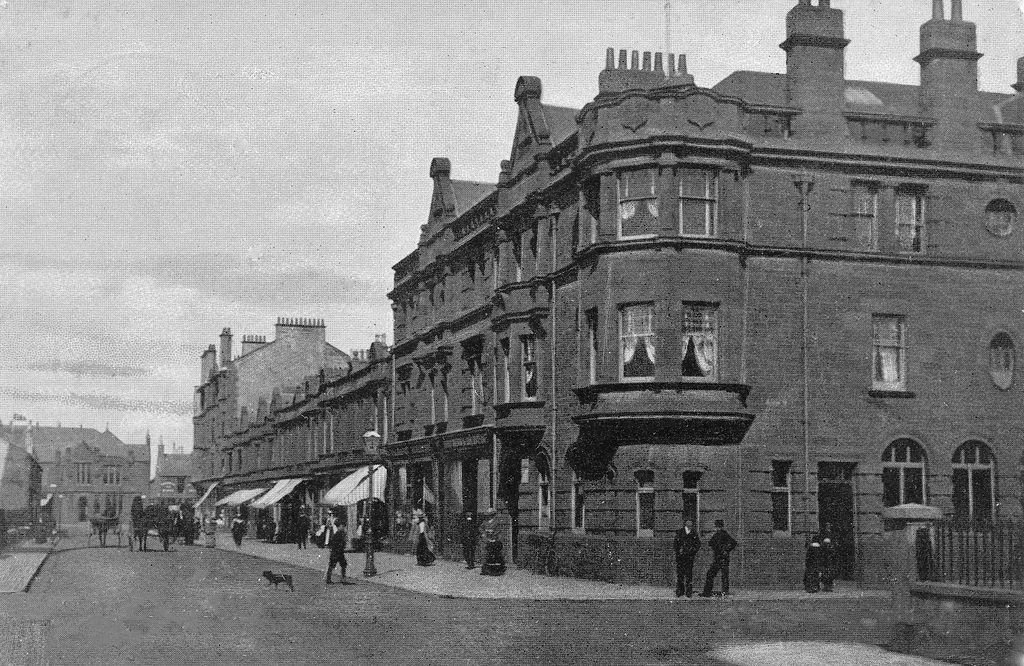
The Duke established a new town at Troon, laying out curving streets that followed the shoreline, with a regular grid pattern inland. Large villas were erected, and in the centre of town tall commercial blocks were built. Street names often reflected the landowner, such as Portland Street, Welbeck Crescent and Bentinck Drive.
With the arrival of Royal Troon Golf Club in 1878 and Kilmarnock Barassie in 1887, the town’s place as a seaside resort was cemented. Other golf courses were laid out by the council, such as Lochgreen, Darley and Fullarton. The internation golf Open has been held at Royal Troon on ten occasions. With the fresh air available at Troon, away from Glasgow’s smoky streets, many large houses were erected around the town by city businessmen. Piersland was erected by Sir Alexander Walker, chairman of Johnnie Walker and keen golfer. Crosbie Tower was erected in South Beach around 1883 for Alexander Walker, his father, and Portland Villa, erected around 1840 and owned by the Duke of Portland but for many years leased by James Wood, Troon’s harbour master, and then John Wood, coalmaster. The larger villas were later to be augmented with the small country houses in South Wood.
The Duke of Portland had Fullarton House as his Scottish retreat, a classical mansion built to the east of the town. This had been erected in 1745 for William Fullarton before the Duke acquired it in 1805 and made extensions to it. Today, only the former stable block, now converted into housing, and some decorative piers mark where the house once stood. It was demolished in 1966.
Troon harbour was constructed for the coal industry but soon developed other trades. It was given parliamentary assent in 1808 and took around ten years to build. From 1886 until 1986 the Ailsa Shipbuilding Company was based there, constructing sizeable vessels. The largest steamer constructed was of 2,500 tons, launched in 1904 for J. T. Duncan of Cardiff.
Fishing also takes place from the harbour, although not on so large a scale as it once was. Timber is imported and along the southern side of the harbour there is still the large sawmills of Alexander’s, now part of Glennon Group.
To the north of Troon the suburb of Barassie was originally established as New Kilmarnock around 1835. The first houses were nine villas in a line overlooking the beach, but these were soon joined by a variety of holiday homes and the former Tower Hotel. In 1911 a new ‘garden suburb’ was planned, but it did not come to fruition due to the outbreak of war.
Holidaymakers and daytrippers still flock to Troon. On a warm day the beach is busy. Walkers like to make their way long the esplanade, as well as along the top of the Ballast Bank, a green mound that protects the town from some western winds. The bank was created from ballast, which ships returning with no cargo used to steady themselves in the water. The earth and stones used was dumped here.
At the head of South Beach the Walker Halls were erected in 1932, where concerts and exhibitions take place. Doubling originally as Troon Town Hall, the building was financed by Sir Alexander Walker, of whisky fame. On the shore side of the hall is Troon’s magnificent war memorial, a statue of Britannia sculpted by Walter Gilbert.
Troon has a good selection of ecclesiastical buildings. The original parish church still stands in Ayr Street, erected in 1838. Next door is the later Old Parish Church of 1895. Other denominations erected their own places of worship, including the Seagate Church in 1843, St Meddan’s in 1889, with its tall spire, Our Lady of the Assumption in 1911, with its bulky castle-like tower, St Ninian’s in 1913, and Portland Church in 1914.
Visitors to Troon have much to enjoy, and there is plenty to discover in the terraces and promenades of the seaside resort.
Dane Love has written extensively on Ayrshire’s local history. Troon appears in his Ayrshire Coast and A Look Back at Ayrshire Harbours. You can find out more at www.dane-love.co.uk