


The Rise and Fall of the Maybole Tacketties
Chris Palmer
On 16th April 1894, Thomas Aitken Gray, aged 41, married, and a father of seven children, bought a rail ticket for the over-night sleeper from Glasgow to London. He also purchased copies of two popular magazines, Tit-Bits and To-Day. To encourage new readers, commuters benefitted from travel insurance if they carried a copy of the magazine on their person whilst travelling. The value was not inconsiderable – a pay-out of £100 from carrying Tit-Bits and £1,000 from carrying To-Day – should they be found in the possession of a deceased traveller. The magazines were a vital component of Thomas Gray’s travel plans that day as he intended to kill himself on his forthcoming journey.
Gray was an imposing figure in both local and national industry. He was the proprietor of The Lorne Boot and Shoe Factory in Maybole, one of the largest Scottish industries in terms of both output and employees. Gray was at the pinnacle of his success, seemingly the epitome of Victorian business enterprise. He was a member of Maybole Town Council, a police commissioner and an elected county councillor. In contemporary terms, it is as if Sir Richard Branson or Sir James Dyson were to suddenly and inexplicably take their own lives. Why then did Gray, clutching his two magazines, throw himself off the London train that evening soon after 9.45pm? For the answer we need to dip a toe into the history of the humble working boot in Scotland.
In 1838, Thomas Gray’s father, John Gray, opened a factory producing hand-sewn footwear using the skills of local outworkers to stitch pre-cut soles to uppers. In cottages throughout Maybole, in the early years of the shoe-making industry, families would cut and sew by candlelight, being paid by the dozen. In 1853, a machine was patented that attached the sole to the upper using metal rivets. The industry was transformed. In Maybole, a singular boot had an extraordinary impact.
Construction and factory workers, as well as agricultural labourers, need reliable, strong and durable footwear. Maybole’s signature boot was sturdy, heavy, ankle-high with great studded soles and heels formed from the rows of metal tackets. They were advertised as being resistant to farmyard manure and acid. Immensely popular, for a few decades in the late nineteenth century, they proved to be as ubiquitous in the working life of farms and factories as the training shoe became popular in late twentieth century leisure life. By 1891 there were ten boot and shoe factories, employing 1,500 workers and producing one million pairs of shoes a year. Tall factory chimneys dominated the Maybole skyline. The Maybole Shoe Shop became a feature of towns throughout the United Kingdom and abroad. One was opened as far away as Manitoba. Sixty-five were established by 1890.
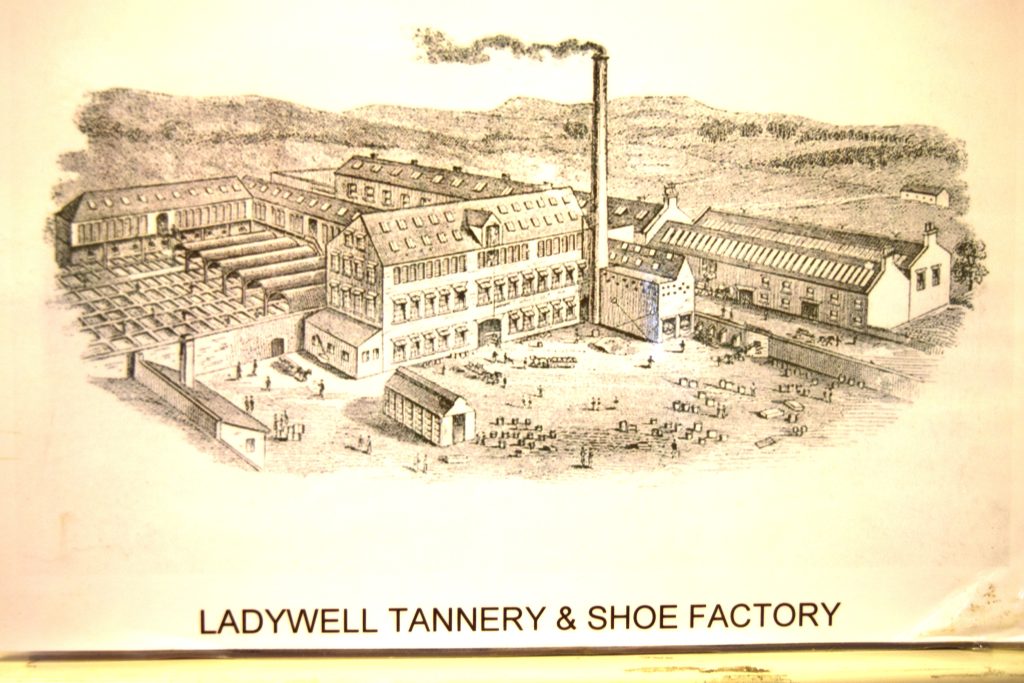
The success of the Maybole industry was encapsulated in the verse:
Go where you will through Scotia’ land
You’ll see our boots on every hand
It’s Maybole on which Scotsman stand
This auld toon o’ Maybole
The town itself became vibrant and prosperous. A new railway line linking Glasgow in the north and Stranraer in the south enabled the boots and shoes to be despatched both abroad and to the industrial heartland of Scotland. Residents of Maybole were known as ‘Tacketties’ and Maybole became known as Auld Tackettie.
Why then are the Maybole Tacketties not as famous as the Paisley Shawl, Harris Tweed and the Glengarry Bonnet? Why did Thomas Gray hurl himself, on that April evening in 1894, from the London sleeper, mere minutes after his departure from Glasgow? The simple truth appears to be that the tackettie proved to lack the staying power of the shawl and the tweed jacket. The industry as a whole proved to be built on frail and flimsy foundations in contrast to the durability of the tacketties that it manufactured.
In 1883, the Co-operative Wholesale Society opened a boot and shoe factory in Glasgow. Very soon, the factory was producing 14,500 boots and shoes a week. Competition had arrived. Comparable mass production offered impressive challenges. In addition, lighter but equally durable boots became available. Wellington boots became more popular for farm workers. Some of the Maybole factories began to suffer through their lack of diversification.
In the light of static demand, Thomas Gray took a commercial gamble comparable to many that successful entrepreneurs have made in recent years. Borrowing extensively, despite being already deep in debt, he signed a contract with the Egyptian Government to supply its army with new boots. He appears to have miscalculated. Gray may have, ultimately, lacked the nerve and chutzpah to see through the deal. Crippling late delivery penalties and an inability to fulfil the punitive terms of the contract caused a financial crisis that he could not withstand.
The details of Thomas Gray’s death are set out in detail in the local paper, the Ayr Advertiser, The Advertiser’s correspondent injects a strong personal, but also prophetic, element into his piece describing the frantic efforts of the entrepreneur to keep his business afloat –“Only a fortnight ago he told me, at his own fireside, of his having left Maybole the week before by the last train for Belfast, thence on to Dublin, thence back to Glasgow, home again for a few hours, and then off to London… I cautioned him against the high pressure way he went about his business, saying it would wear him out before the time; but he simply laughed.”
The sudden death of the town’s largest employer had a profound impact on Maybole. In the first instance it was of course a shocking event. The Advertiser reflected this – “The body of Mr Gray arrived by the 6.15pm train from Glasgow. A tremendous crowd of people were at the railway station awaiting the arrival of the train. The coffin was conveyed in a hearse to the deceased gentleman’s residence, Cargillan House.” It was also a pivotal moment in the story of the Maybole Tackettie.
The decline of the industry was steady and irresistible. The most significant milestone was the closure of the largest factory in 1907. A measure of the impact that this event had on the town was the emigration of approximately 2,000 workers and their families to Canada. So distinct was this North American diaspora that to this day a district in Ontario is known as ‘Wee Maybole’. Short-lived increases in demand during both world wars ensured that the decline was not terminal for several decades. The last small factory, which diversified into general leather goods and survived, closed in 1969.
In recent years the local council has put up a useful heritage plaque giving a summary of the history of the industry. The local library has an informative display cabinet with examples of the boots and photographs of the factories and advertising material. It feels, though, that the town acknowledges rather than celebrates the industry. Though disappointing, it is perhaps not surprising that there is no shoe shop in the town that once produced a million pairs of shoes in a year.