


Linda Brown
Now that autumn is almost behind us and the short dark days of December are around the corner, I wonder how many walks I will manage this winter. Will the weather be wet and wild, or will we have snow and a white Christmas? Not that one or two snowflakes prevents me from heading out for a walk. In fact, I recall a wintery walk I enjoyed in December a few years ago.
Overnight flurries of snow had blanketed the ground, transforming the woods into a winter wonderland. By mid-morning, the temperature still hovered below zero, preserving their pristine beauty.
Cocooned in my thick padded jacket and woolly hat, I trudged carefully, along the Strath Path, which follows the stretch of the River Irvine between Newmilns and Galston. Beneath my snow-booted feet, the path was treacherous in places. A sneaky patch of black ice had already caused me to ‘slip up.’ Fortunately, despite skidding in slow motion like a drunken Bambi, then executing a clumsy double axel, I somehow managed to stay on my feet and avoided landing on my bum with a bump. Thank God, no-one was around to see me!
The Strath Path was unusually quiet. Although a few hardy, wellie clad dog-walkers had passed by, it seemed that with more snow forecast, most sensible folk had stayed cosy at home.
A staccato tapping noise overhead stopped me in my tracks. I looked up. Around me, frosted trees shimmered in the pale morning sunshine, their bare branches dusted with ice crystals. Then I heard the sharp call of a great spotted woodpecker; its repetitive ‘kik kik kik’ reminded me of the sound of a squeaky toy. There was a flutter of white, black and red plumage as the bird (the scarlet patch on the back of his head identified him as being male) moved from one tree to another. Clinging to its bark with his strong claws, he inched his way up the trunk, then along the underside of a branch, all while tap-tap-tapping, searching for tasty insects hidden beneath the icy surface. During winter, the great spotted woodpecker’s favourite food of beetle larvae, spiders and caterpillars is harder to find, so I’m never surprised to see these beautiful birds visit my garden bird feeders. They are very fond of peanuts and suet balls.
Speaking of bird food, I had a small bag of mixed seeds and nuts (black sunflower seeds, maize, millet, peanuts and more) shoved in my pocket, as is my habit during the colder, dreicher months. I like helping the wild birds by leaving small piles of food at several regular locations along the path.
I made my way to the first ‘feeding station’ on my route – a wooden fence post. Blue tits, great tits and chaffinches had already gathered on the branches of the tree growing behind it. I was convinced these little birds recognised me and followed me to this spot. They hopped expectantly from branch to branch, their keen eyes watching my every move. The blue tits, their tiny bodies fluffed up against the cold, steeled themselves to compete against the other bigger birds for their brunch.
I tipped a handful of my special mix onto the top of the post, then stood well back. Two great tits swooped down in unison, each nabbing a nut or a seed, to take back to a branch. There they held their prize in their feet and chiselled away at it with their sharp beaks. A chaffinch followed suit and snatched a sunflower seed. I whipped out my camera to fire off some shots as, one by one, the waiting birds, including the brave blue tits, took their turn at the feast.
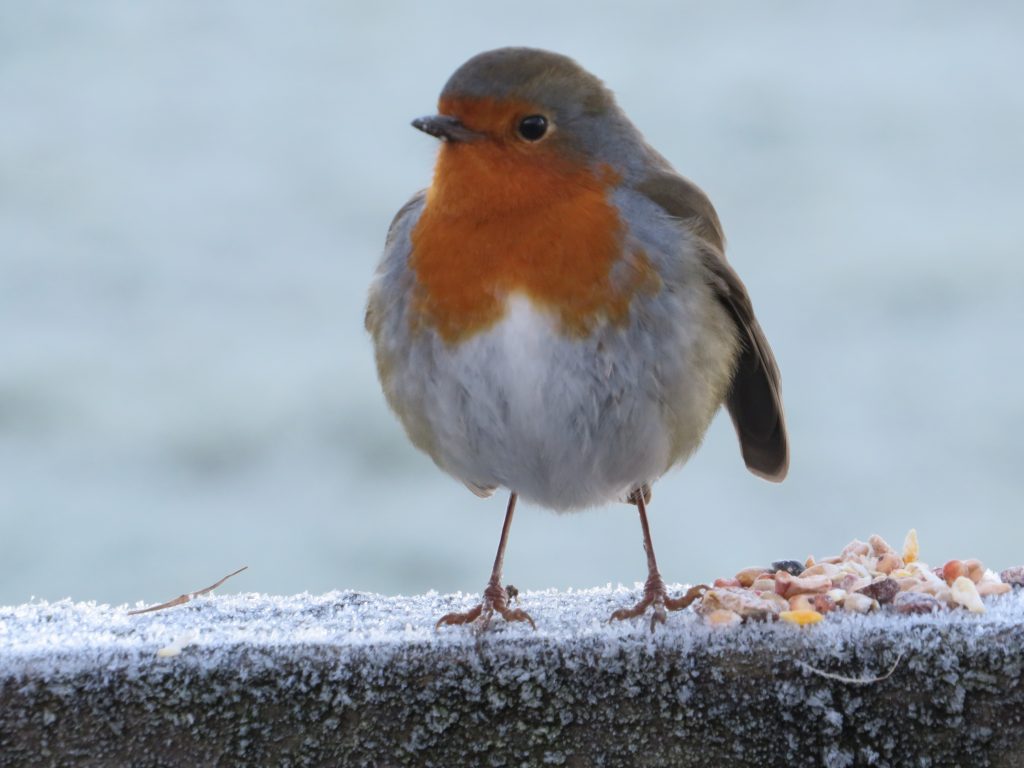
Then a robin showed up. Robins enjoy the reputation of being cute, however, they can also be very territorial and bossy. This feisty wee fellow pecked at oat flakes I’d included in the mix (who knew robins love porridge?), then decided to guard the post, fending off any would-be diners. But the determined squad of hungry great tits proved too much for him to battle, dive bombing him until he flew off.
Meanwhile, a grey squirrel, lurking high in a nearby tree, observed the proceedings, and probably hoped to dart down and pinch some nuts as soon as I’d moved on. Indeed, it was far too cold to hang about for long, so I headed off along the path to leave another handful of food on the trunk of a fallen tree.
Wintery conditions suited the Irvine. Picturesque and photogenic, the river’s shallow waters, moving downstream at a sluggish pace, reflected the muted light of an overcast sky. More snow had to be on the way. Along the river’s edges, ice had formed, creating delicate and intricate lacy patterns. I inhaled deeply and savoured the fresh scent of frost. The air, crisp and still, amplified the tranquil beauty of my surroundings. Snapping more photographs, I became aware of a kerfuffle on a nearby tree. A twist of chattering siskins had descended on an alder. These bonny wee birds, with cheery yellow streaked plumage, showed off their acrobatic prowess, hanging upside down at all angles while plundering the alder’s cones for seeds. They fed for several minutes, flitting and twittering around the branches, swapping positions and cones, before they abruptly took flight, swarming across the river to carry on the party in another tree.
Suddenly, my ears caught an unexpected sound – a high-pitched, piping call which reminded me of a dog whistle. A kingfisher? A blink-and-you’d-miss-it flash of blue zipped upstream. I was astonished. I was used to seeing these gorgeous birds whizz up and down the river in spring and summer, but rarely glimpsed them over autumn and winter.
Then I realised the kingfisher had landed and was perching on a narrow branch overhanging the river. I zoomed in with my camera to capture some images. I identified the bird as female – male kingfishers have black beaks, but females, like this one, have beaks with an orange/red base. Tilting slightly forward, she sat, her gaze fixed on the water. Her teal blue and amber feathers appeared faded as if the winter light and icy temperatures had drained them of their usual vibrant colours. With a spurt of energy, the kingfisher plunged from the branch and entered the water like a missile. Seconds later, she re-emerged with an empty beak. After reassessing the river from her perch, the kingfisher called it quits, and shot off like a bullet, continuing her upstream journey. Freezing conditions are a challenge for these small birds. Kingfishers are vulnerable during harsh winters and many, sadly, don’t survive.
Tiny wisps of snow began to drift through the air. Within moments, larger flakes were swirling. The predicted snow shower had arrived.
I pulled my hood over my bunnet and started to retrace my steps. By the time I was halfway home, I felt like I’d stepped through a wardrobe and landed in Narnia. A puffed-up robin watched me from a snowy fence post. I promised him I’d return the next day with more oats.
I wonder if the robins will be looking for porridge oats this winter? You bet they will!