


An Irvine Valley Walk
Linda Brown
It was early one October morning last year when I set off, not long after first light, for a walk around Lanfine Estate.
Overnight there’s been a light touch of frost, and the sky is a delicate pale blue, the sun bright but weak. Summer swallows and house martins have disappeared, already winging their way across Europe to Africa for the winter. Autumn has officially arrived.
I puff uphill for half a mile along the stony, muddy track that was once the estate’s west drive, listening to the excited chatter of siskins and long tailed tits as they zip between the trees enjoying breakfast. At the top, I choose the path that skirts behind the ‘big hoose’ (Lanfine House), and then it’s downhill all the way, past the peacocks and the piggies – wild boar, actually, kept safely behind tall fences – following the tree lined east drive towards Darvel.
Around me, the trees are dressed in amber and russet, their leaves spiralling slowly in the breeze before drifting to the ground like nature’s confetti. It feels like I’m on one of those idyllic autumn walks straight from the pages of a cheesy romance novel, the kind where a loved-up couple wanders hand-in-hand, crunching through crisp golden leaves, before returning home to warm up with steaming mugs of hot chocolate. Except I’m crunching solo – Mr B is at work. And anyway, he hates hot chocolate.
At last, I slip through the estate gates onto Brown’s Road; the narrow rural road that traces the course of the River Irvine between Darvel and Newmilns. It takes its name from John Brown, the wealthy Glasgow textile manufacturer and banker, who purchased Lanfine estate and built the mansion house back in the 1770s.
When I was just a wean, Brown’s Road was still open to traffic, but a landslip caused by heavy rain and riverbank erosion forced its closure. These days it’s used for access only, and forms part of the Irvine Valley Walking Trails, providing a quiet scenic route to be enjoyed by walkers, cyclists and horse riders.
My plan is to hoof it back to Newmilns, but first, I pause for a wee breather on Randoldcoup Bridge. Gazing down on the water below, I keep a sharp eye out for otters. Ramblers and dog walkers often tell me they’ve been spotted on this stretch, particularly around the nearby dam upstream. But no luck today. After what seems like an eternity (all right, fifteen minutes at least), I’m otterly scunnered. Time to move on. Maybe if I stop looking for these shy creatures, I might eventually, accidentally, bump into one. Keep your fingers crossed.
Meanwhile, the grey squirrels are on a mission. It’s that time of year when they quite literally ‘go nuts’. All along the path, squirrels scuttle and scamper among the trees, gathering winter supplies – acorns, beech mast, seeds and other tree nuts – before burying their stash randomly in shallow holes on the woodland floor. Although they remember where most of their hoard is hidden, some nuts are inevitably forgotten. This results in unintentional tree planting, helping to grow our oak, beech and hazel populations.
One daredevil darts across the road right in front of my boots, then bounds up the trunk of an oak tree. He settles on a low branch and peers down at me, an acorn the size of a gobstopper jammed between his jaws. His curious expression seems to say, ‘I’d like tae introduce masel, but ma mammy always telt me no tae speak wi ma mooth full.’ I snap a few photos of this cheeky character, then he leaps into the next tree and is swallowed by foliage.
Grey squirrels, of course, are divisive. Like Marmite, folk either love ‘em or hate ‘em. They get a bad rap for good reason; as a non-native species deliberately introduced to Scotland in the late 19th century, they have had a devastating impact on our own red squirrel population. Sadly, these days, you won’t see a red squirrel in most of Ayrshire, although you might be lucky enough to spot one in more rural areas around the South Ayrshire-Dumfries and Galloway border.
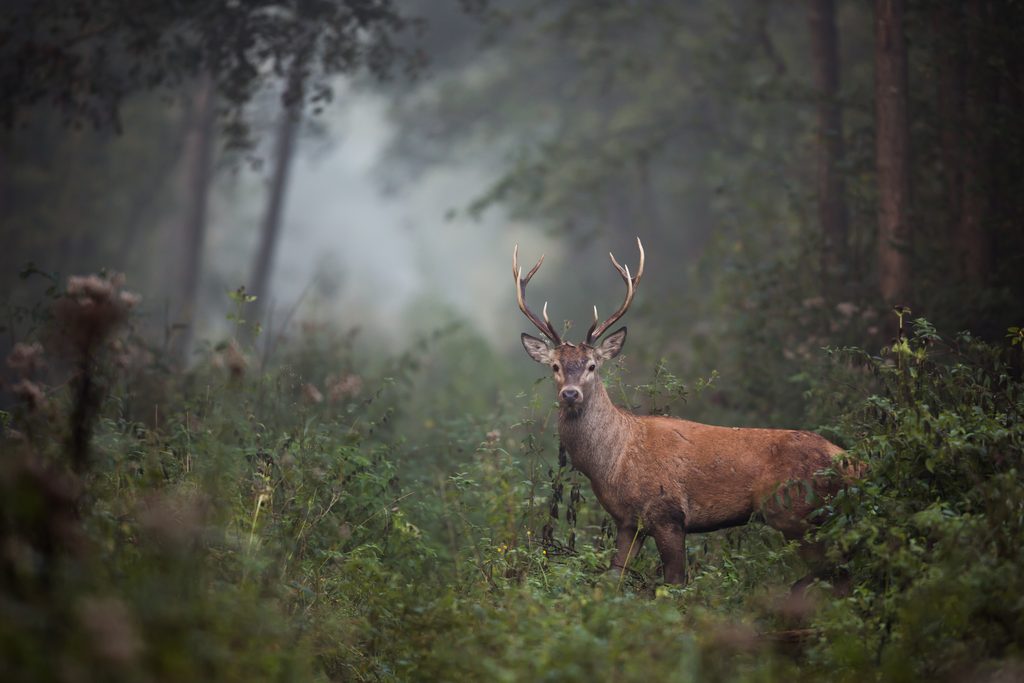
Further along the road, near the area known as ‘The Staners’ – an opening down to the river’s edge with, yes, you’ve guessed it, a stony beach, I hear several deep guttural grunts followed by a loud bellow. It sends woodpigeons flapping from the treetops into the air. What on earth was that? I stop in my tracks and listen. There it is again – a raw, primeval roar that chills my bones, echoing through the trees from the adjoining fields. Ah-ha, of course. It’s rutting season, and a red deer stag on Lanfine is making his macho presence known. He’s not only making a statement about his strength and virility, warning any rival males that he is boss, he’s also hoping to woo the hinds. I clamber up the small banking at the side of the road, trying not to get my feet caught in trailing brambles, and make my way to the fence. The stag grunts and bellows again. I peer in the direction of the noise and finally spot the herd on the hillside in one of the far fields – little brown smudges clustered along the treeline. I focus my camera on them, hoping to get some decent shots, but even with my zoom lens, they’re simply too far away to be anything more than blurry blobs. Never mind. At least I’ve heard him. He bellows again, longingly, and I wonder if his harem is impressed, or rolling their eyes, muttering, Aye, whatever.
Trudging on, my footsteps start to flag. I’ve walked over five miles and I’m ready for a break. The stag’s romantic overtures return my thoughts to those perfect autumnal strolls in chick-lit novels. Today, I may have been crunching leaves all on my own, but, at my local coffee shop, a slice of gingerbread and a pumpkin-spiced latte…no, a marshmallow-and-cream-topped hot chocolate… beckons. Yum! Now, that’s my idea of a happy-ever-after ending.