Covenanters, Coal And The Covies



A Historical Jaunt Around The Irvine Valley
Linda Brown
East Ayrshire’s Irvine Valley is steeped in fascinating history. Let’s take a whistle-stop tour through the three Valley touns – Galston, Newmilns and Darvel – and explore just a few historical places and stories from the Valley’s past.
Gawston – By Work and By Confidence (town motto)
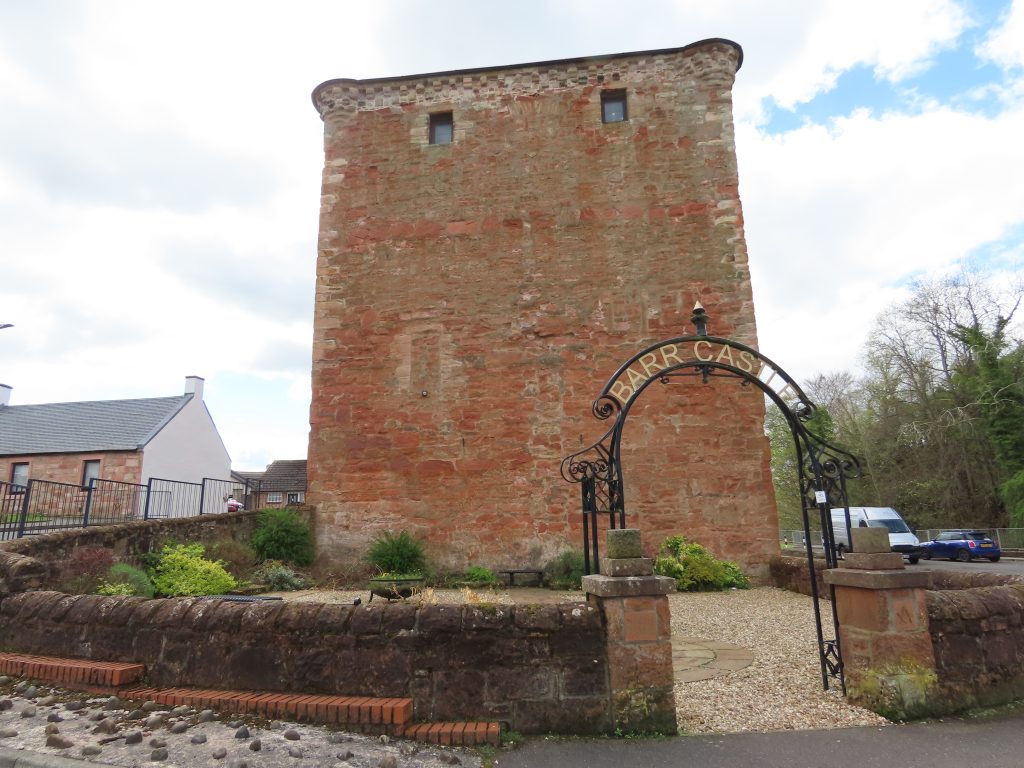
Our first stop is Barr Castle – a robust late medieval tower house, dating from the 15th century, that once was a stronghold for the Lockharts, a prominent and influential family in the area. Built for defence and not ornamentation, the castle was at the centre of Ayrshire’s political and religious activity. During the 16th century, George Wishart and John Knox, both Protestant reformers and key figures during the Scottish Reformation, preached their fiery, authority-challenging sermons in Barr Castle after being banned from entering Galston’s church. Today the tower is used by the Masonic Lodge and also houses a small collection of local artefacts.
Ever heard of the game Handba’? This unique Galston sport was played by generations of townsfolk using their clenched fists to smash a hard ball off Barr Castle’s wall – think squash, but without the racquets and with only one wall. According to legend, ‘braveheart’ William Wallace devised this game to help keep his men fit. If true, however, since Wallace lived and battled in the 13th century, they must have played off an earlier castle wall. My great-uncles, young miners, played handba’ in the 1920s. The last official handba’ game was in 1939.
Historically, one of Galston’s main industries was mining. Around the end of the 19th century, there were as many as 15 mines, including Streetheid, Maxwood and Gauchalland Pits in and around Galston, employing around 1,000 men. The aptly named Streetheid Pit was located at the top of Henrietta Street, very close to miners’ homes, (Keir Hardie Crescent was later constructed on the old pit’s site). Imagine living with the relentless noise and coal dust on your doorstep. During the early 20th century, one by one, the pits closed. Mining in Galston ceased in 1933 with the closure of the last working pit, Maxwood Colliery. Over the years, pit accidents had maimed and taken the lives of many local men and young boys, some only twelve and thirteen years old. A memorial cairn dedicated to the deceased miners was unveiled in 2009 across from Barr Castle.

Galston is home to two imposing churches, each with its own remarkable history. St Sophia’s Church, built in 1885 in the Byzantine-style, was modelled on the iconic Hagia Sophia in Istanbul. Galston Parish Church, erected in 1808, stands on a site where Christians have worshiped for over 750 years. The Rev.
Robert Stirling, the church’s minister from 1824 until his death in 1878, was also a pioneering engineer who invented the Stirling Engine – an innovative, efficient heat engine powered by hot air. Remarkably, Stirling’s trailblazing technology is still relevant today.
Heading out of Galston towards Newmilns along the A71, the ruined remains of Loudoun Castle, once the ancestral home of the Campbells of Loudoun, are visible through the trees. The impressive castle was built circa 1808 on the site of earlier structures and gained the nickname, ‘The Windsor of the North’. Sadly, Loudoun Castle was destroyed by fire in 1941. In more recent times, a popular theme park operated inside the castle grounds attracting visitors from all over Scotland until its closure in 2010. Just a short putt away lies Loudoun Gowf Club, the world’s only gowf club. Amazingly, gowf – the ancient Scottish word for golf – has been played on this land for over 400 years. Part of the modern 18-hole course has been developed from the original ‘Gowf Field of Loudoun.
Newmulls – Weave Truth With Trust (town motto)
Newmilns was established as a Free Burgh of Barony on 9th January 1490, making it Ayrshire’s oldest inland burgh. This privilege, bestowed by King James 1V to George Campbell of Loudoun, allowed Newmilns to control its own economy, elect local Baillies and hold weekly markets and annual fairs.
Still standing on the town’s Castle Street, Newmilns Keep, dating back to the 15th century, was part of the Campbell family’s original fortified residence. Both Newmilns and the Keep have strong connections to the Covenanters – ardent supporters of the 17th century political and religious movement that championed Presbyterianism while fiercely resisting King Charles I’s interference in Scotland’s religious affairs. In 1685, Captain Inglis, a government officer, and his soldiers attacked a clandestine Covenanter prayer meeting at Little Blackwood, Kilmarnock. During the violent raid, Covenanter James White was shot and killed, while eight others, including John Law, were captured then imprisoned at Newmilns Keep. Inglis decapitated the deceased White and used his severed head to play a grisly game of fitba with his men. Fellow Covenanters attempted to free Inglis’ prisoners. In the ensuing skirmish between Covenanters and government soldiers, John Law was shot dead. A memorial stone embedded in a wall near the Keep commemorates the martyr’s sacrifice.
The Nisbet family of Hardhill Farm in Newmilns were also staunch Covenanter supporters. Over a century earlier, their ancestor, Murdoch Nisbet, defied Church authorities by secretly translating the New Testament into Scots – one of earliest bibles written in our language – with the aim of making the Bible accessible to ordinary folk. This monumental task took 20 years. Possessing a layman’s copy of the Bible was punishable by imprisonment or death. Despite these risks, Nisbet hid his manuscript in a vault beneath his home. After his death in 1559, it passed down through generations of his descendants until acquired by Sir Alexander Boswell, the famous biographer, of Auchinleck House. Today Murdoch Nisbet’s original Scots Bible is preserved in The British Library in London.
Traditionally, Newmilns has been synonymous with lace weaving, a skill introduced by Flemish refugees, who settled in the Valley in the late 16th century. For over 200 years, the town’s cottage industry of handloom weaving thrived. The arrival of revolutionary power looms and industrial lace looms in the 1860s and 70s led to the construction of the mills. By the early 20th century, Newmilns boasted 20 mills employing over 2,000 people, earning the town worldwide renown for fine quality lace curtains and tablecloths, (today only one lace mill survives.) Football played a significant role in the community, with teams formed by lace workers. Incredibly, Newmilns’ lace workers promoted the development of football in Barcelona and Gothenburg during the late 19th century. Sent to both cities to help establish lace mills, the workers shared their footballing talent and were instrumental in the creation of FC Barcelona and Sweden’s first football club, Örgryte IS. Notable footballers from Newmilns include George Girvan (1878-1968) who played for FC Barcelona in 1900, and Hugh ‘Lalty’ Wilson (my great-great uncle, 1869-1940), Captain of Sunderland AFC and capped for Scotland four times.
Before leaving Newmilns and heading up ‘The Cut’ to Darvel, let’s pay homage to an iconic place from Newmilns’ more recent history – The Covenanters Hotel. Did you ever strut your stuff to Earth, Wind and Fire at the famous ‘Covies’ disco? Maybe meet ‘yer ither hauf’ boogieing to The Bee Gees? During its 1970s and 80s heyday, the ‘Covies’ was the place to be for young folk from Ayrshire and beyond. Coachloads even travelled from across Lanarkshire to visit this vibrant Newmilns hotspot. Sadly, The Covenanters closed in the 90s, the original building is now private flats. The discotheque annex is long demolished – but happy memories live on.
Derval – Not For Ourselves, But For Others (town motto)
Darvel, the baby of the three Valley towns, evolved from a cluster of cottages on land owned by the Campbells of Loudoun, to a small town in 1754. The expansion was driven by John Campbell, 4th Earl of Loudoun, who aimed to provide his estate with a source of steady income while offering employment and homes to displaced families affected by agricultural changes. Darvel’s long, straight main road earned it the nickname ‘The Lang Toun.’
Perched above the road, just before entering Darvel, stands Gowanbank House. Built in 1892, this was the home of Alexander Morton (1844-1923), an entrepreneur and lace manufacturer who shaped Darvel’s identity as a lace town. Born into humble circumstances, Morton found work as a weaving agent. During his business travels around England, he recognised the huge potential of lace-weaving machines. Along with a family consortium he raised the necessary funds to bring the first lace power loom to Darvel in 1875. Within a decade, his company, Alexander Morton & Co, had a factory operating 24 lace looms non-stop. In 1892, Morton generously gifted the Morton Park, situated alongside the River Irvine, to the town, providing Darvel folk with a valuable space for recreation and leisure to this day.
Let’s stop at Hasting Square and check out the mysterious Dagon Stone. Purportedly a prehistoric standing stone, this rough olivine monolith, is believed by some to have been used in ancient rituals, (the stone ball on top, fixed by an iron rod, was added at a much later date). Local records show that the Dagon Stone has been a feature around Darvel for over 200 years. According to Valley folklore, pre-19th century, newlywed couples and their wedding guests would walk around the stone for good luck and, possibly, to boost fertility. Does it work? I’ve never chanced it.
Looking out across the square towards the Dagon Stone is the bronze bust of world-renowned physician and microbiologist, Sir Alexander Fleming – Darvel’s memorial to its favourite and most famous son. Born in 1881 at Lochfield Farm, just outside town, Fleming was the son of a local farmer. His education began at the one-classroom Loudoun Moor School, continued at Darvel School, and then Kilmarnock Academy where he excelled as a scholarship pupil. Fleming progressed to study medicine at St. Mary’s Hospital Medical School, Imperial College London. Graduating in 1906, he later specialised in bacteriology. His groundbreaking discoveries began in 1922 with lysozyme, an enzyme with antibacterial properties found in bodily fluids like saliva and tears. Fleming’s most significant contribution to science took place in 1928 – the discovery of penicillin, the world’s first widely effective antibiotic. Penicillin revolutionised medicine and has saved countless lives. Knighted in 1944 and awarded the Nobel Prize in Physiology or Medicine in 1945 for his outstanding work, Sir Alexander Fleming’s legacy continues to impact modern healthcare.
Further along the road at ‘the Corner’, Darvel has recently honoured Sir Alexander Fleming with a second tribute – a wonderful mural depicting the inspirational and pioneering scientist examining penicillin mold in a petri dish. The artwork is spectacular.
I can’t conclude Darvel’s story without a nod to its football team. On 23rd January 2023, Darvel FC, a semi-professional, sixth-tier team, defeated Premiership team Aberdeen 1-0 in the fourth round of the Scottish Cup at the town’s Recreation Park. A huge shock for Scottish football, a tough blow for Aberdeen, but what a victory for the ‘Vale’ – that night will go down in Darvel’s history.
Our historical jaunt through the Irvine Valley has come to an end, and, sadly, we never got to hear about blankets, Lace Queens, Lanfine, tinned haggis, Lady Flora Hastings, yashmaghs, Robert Burns, silver bands, poet Allan Ramsay, and the S.A.S. All those Valley stories and more will need to wait until another time.