


Linda Brown
I’ve laced my walking boots tight, tucked a chilled water bottle into my backpack and slung my camera bag securely across my body. Sorted. It’s a mild and bright May morning – the perfect day for a good walk. My destination? The Pit Brae, a quiet back road branching off the A71 just before the fire station and primary school on the outskirts of my hometown, Newmilns. The nickname ‘Pit Brae’ is a leftover legacy from almost a century ago, when Loudoun Colliery was active at this site.
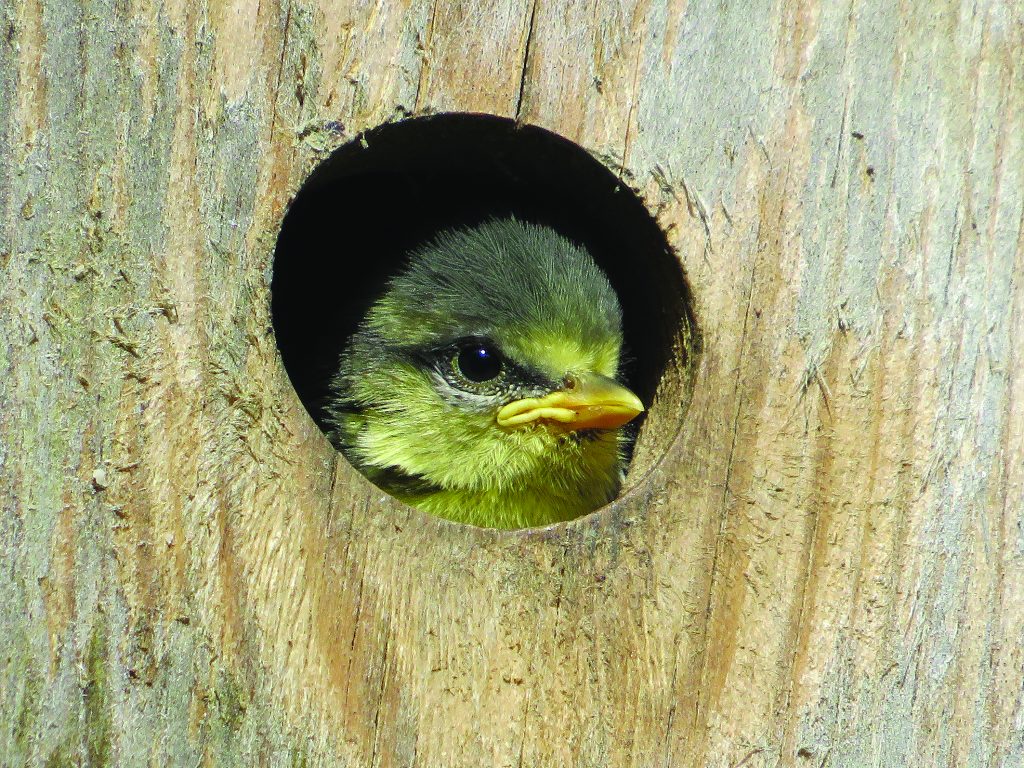
But just as I’m locking up my back door, ready to head off, a flicker of movement at the bird nesting box fixed to our garage catches my eye. I pause, then turn slowly to take a closer look. At first there’s nothing to see – no activity at the box. Then, suddenly, up it pops – a blue tit chick, its crabbit wee face scowling from the entrance hole. From the branches of a nearby silver birch, its parents call encouragement, coaxing the chick to take its first brave flying leap into the outside world.
Now, it seems their family is preparing to fledge. At least two fledglings are already huddled in amongst the beech’s foliage. Plucking up courage, the chick in the nesting box pulls itself through the hole, its muted blue and yellow downy plumage ruffling in the light breeze. With a frantic flutter of virgin wings it launches itself into the air and manages to flap the short flight to join its parents and siblings on the branch. What an amazing moment. I feel quite emotional.
When I finally set off on my walk, I can’t help but wonder if my blue tit lodgers will have moved on by the time I return.
I’ve arrived at the foot of The Pit Brae, but before tackling the steep climb – walks in the Irvine Valley almost always include hills – I decide to take a detour. A path leads into wooded area that stretches alongside and behind both the fire station and the school. This spot, now designated a local nature site, was brought to life thanks to a Newmilns Community Council initiative several years ago. The project’s aim was to promote and encourage wildlife on the redeveloped land next to the old pit bing. Judging by the diversity of birdsong around me, it’s safe to say that aim has been achieved. Despite the constant rumble of traffic whizzing past on the nearby main route through the Valley, these woods are alive with birds. Great tits, chaffinches and song thrushes vie to out-sing one another. Chiffchaffs announce their own names in rhythmical chants – ‘chiff chaff, chiff chaff’ – from the treetops, while their almost identical cousins, the willow warblers, sing a more soulful tune. Bullfinches dart from tree to tree, dining on buds and seeds. I hope to snap photographs but these notoriously shy birds keep themselves well hidden among thick greenery. Instead I shift my attention to a flutter of orange-tip butterflies ducking and diving among wildflowers gathering nectar – these spring pollinators transfer pollen between flowers as they forage which helps plants reproduce. Above me, a very vocal male blackcap begins to sing. I spot him, perched on a slim branch behind a tangle of twigs. He’s a true performer, singing his heart out. I’ve captured a few cracking images when his aria is interrupted by the harsh ringing of a bell – it’s morning break at the primary school. Eardrum piercing shrieks, yells and laughter echo through the woods as exuberant children flood the playground. The cacophony threatens to drown out the birdsong. However, the blackcap and his feathered friends are unperturbed by their noisy young neighbours and keep singing on.
Marvelling at wildlife’s ability to thrive so close to such a noisy environment, I reluctantly leave the nature site and begin the steady tramp up The Pit Brae road.
At the top of the Brae, I take a right turn and follow the road until I reach the metal gate that opens onto a narrow belt of mature woodland known as Clearmount Strip. From April to mid-May, the Strip’s woodland floor is covered with bluebells, their vibrant violet bells gleaming in the spring sunshine. Today, however, bluebell season is almost at an end. Most of the flowers have withered away though a few resilient clusters still flourish in sheltered spots along the path. Naturally, over the next couple of days, they too will fade away and, like the others, retreat underground where their bulbs will lie dormant until next April’s showers and sunshine summon the bonny bluebells back again.
Last winter’s storms, especially infamous Storm Éowyn, wreaked havoc across Ayrshire’s woodlands. Several of Clearmount Strip’s trees did not survive the battering from the ferocious winds. Some have toppled and lean uneasily at precarious angles, propped up by their sturdier surviving neighbours. Others were entirely uprooted, crashing to the ground and their trunks and branches now block the path. While I manage to step over most of these casualties and carry on, one particularly old and broad tree proves to be too much of a challenge for my short legs. Och, if I just plunk myself down on the trunk, and swing each leg over one at a time, I’ll be able to sprauchle o’er and continue on my way… nae bother! I’m halfway through this manoeuvre, trying to haul – er, spritely raise – my second leg across, when I get the uncanny feeling I’m being watched. I look over my shoulder and scan the path behind me, but no-one is there. Then twisting my head, I check the winding path ahead… and freeze. Just a few yards away, just off the track, a fox stands motionless, his russet coat dappled with sunlight filtering through the tree. Tilting his sharp face, his intelligent amber eyes lock with mine. He’s staring at me as if he’s never seen a female human straddling a tree trunk before – which to be fair, he probably hasn’t. Gingerly, I pull my left leg over the bark and swivel to face forward. The fox watches me intently. Could I lift my camera for a photograph without startling him? Before I can decide, the moment is gone. The fox turns, jogs into the cover of thick undergrowth, and vanishes as quietly as he appeared. I sigh, slide off the trunk, and head off along the path.
Later, when I return home, I hover beside the silver birch, hoping for a glimpse of my blue tit family – but there is no sign of them. The nesting box is silent. Fingers crossed, new lodgers take up residence next year.