ARRAN WHISKY SOCIETY



Enjoying Community Spirit
Martin Stewart
When Peter Black was retiring, there was only ever going to be one destination.
“We lived in Leeds, but we’ve always holidayed on Arran – and our family’s connection to the island goes back even further. We knew that if we were going to retire anywhere, this was where it was going to be.”
Peter and his wife, Janet, received a warm welcome in Kildonan and, while researching their new home on the island’s southernmost point, the couple discovered a fascinating nugget of local history.
“It turned out that a couple of hundred years ago, there had been a thriving trade in illegal distillation on the island. This had provided employment to much of the population, and most of the distilleries had been within a five-mile radius of our village!”
Illegal eighteenth-century distillation conjures images of bathtubs and moonshine – white spirit strong enough to strip the enamel from the drinker’s teeth. Is that Arran’s whisky heritage?
“Far from it,” says Peter. “The whisky they produced was widely sold on the mainland and was considered second only to the Glenlivet in terms of quality. Arran whisky was renowned.”
And smuggled?
“Absolutely! They’d load it on to boats bound for the mainland, or Campbeltown, or even Ireland – always with the excisemen on their tail! It’s a fascinating story, and one that’s very close to home.”
Much has changed since the days of poteen and smuggling. Arran now has two modern distilleries at Lochranza and Lagg, producing award-winning, internationally recognised malt. With such excellent – and legal – production now taking place on the island, Peter was surprised that some form of whisky appreciation group didn’t already exist. This realisation was the perfect spark for the long-time dram enthusiast to form the Arran Whisky Society in early 2024.
“It felt particularly appropriate,” says Peter, “that we started the society here.”
He began with a few quiet enquiries of his neighbours and was delighted by the enthusiastic response. The first AWS meeting was held in a living room, where the sharing of a dram with good company established the format that continues today under the guidance of its board.
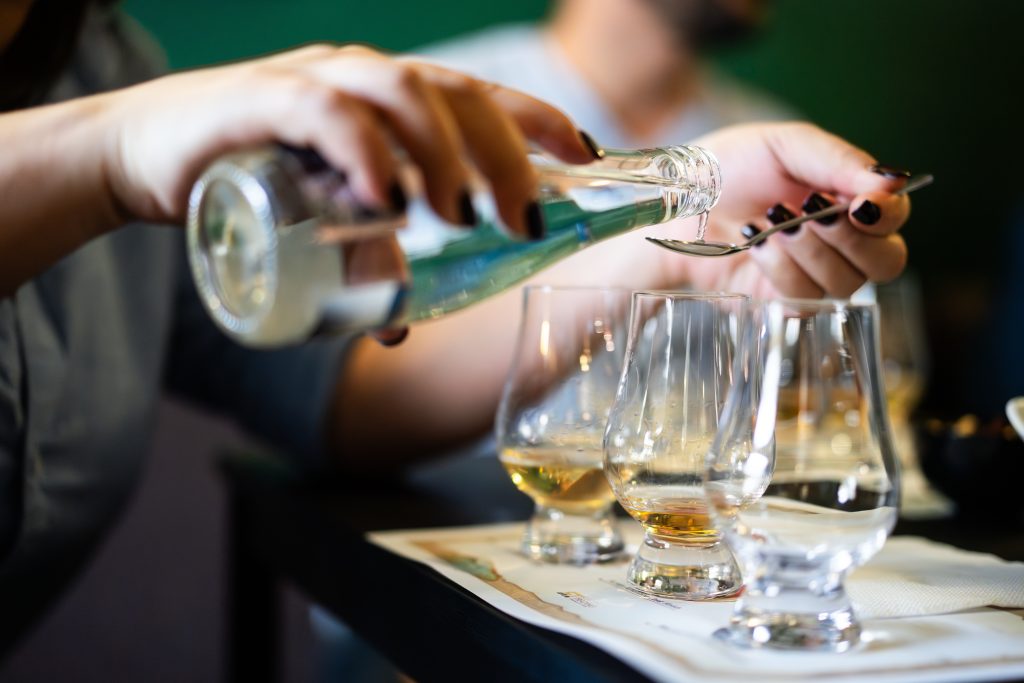
Scotland’s whisky embodies the tension between old and new, representing both the nation’s traditional heritage and its contemporary, outward-looking future, its global industry driven by science and innovation. Whisky is, all at once, past and future, craft and science: who we were, who we are, and who we will be. In this way, the national drink is not simply one thing, for one type of person, it is for everyone – something Peter is keen to stress.
“Our society is designed to be different to more traditional whisky societies. There’s no need, for example, for a certain type of dress. That is the exact opposite of our philosophy. We are totally inclusive and determined not to become a stuffy gentlemen’s club filled with whisky snobs – we mainly drink single malt, but have tried some terrific blends, too. Many of our members are women, and anyone is welcome – provided they’re over eighteen years of age!” It’s not even mandatory to throw yourself into the world of the uisge beathe. “Often people come along who’d rather have a gin and tonic, or even a cup of tea. And they’re more than welcome to sit down for a blether.”
‘Blether’ is an important word for Peter Black. If the Arran Whisky Society has an animating spirit, it’s that essence of informality and friendship, of easy company and community.
But that’s not to say the other spirit doesn’t feature during their monthly meetings.
“In whisky terms, the point of the society is to open people’s horizons. We’ve tried all sorts over the course of the dozen or so meetings we’ve held so far.” He puts the number of different whiskies sampled by the group at “between fifty and sixty”, many of which have come from beyond Scotland’s borders. “Our members bring bottles to share at our meetings. We’ve had whiskies from all over the world: Finland, Japan, Denmark, Spain… one of our members even visited Bhutan, and tried to bring us back a bottle from there. Unfortunately, it was confiscated by customs in India – but we’re still hoping it’ll make its way to us for a future meeting!”
There’s even been, whisper it, a whisky from England.
“But don’t print that,” he says, laughing.
This communal, shared enjoyment – and shared expense – opens the possibility of sampling whiskies that might otherwise be too expensive for the casual enthusiast.
“We call them Superdrams! If you were buying a bottle by yourself, these might be out of your price range. But by pooling our resources, we’re able to sample older, rarer, more complex whiskies, which is a great thrill.”
So, what’s next for the Arran Whisky Society?
“Now that the better weather has arrived, we’re looking to organise some excursions as a group. We’d like to go to the mainland to visit some distilleries. One of our members has a boat, and there’s been talk of taking that over to Campbeltown, to visit the incredible sites there. Hopefully, we’ll have some guest speakers join us at our meetings, too. We’d love to hear about specific whiskies, about production methods, or about the history of whisky on Arran. It’s such an endlessly rich topic, and our members are passionate about all of it.”
The island’s population swells in the summer months, as tourists flock to enjoy ‘Scotland in Miniature’. Are non-islanders welcome at AWS meetings?
“Not only are visitors to the island welcome to come, they’re encouraged. We’ve had people from all over the place coming for a chat and a dram, and to exchange stories. It’s been one of the best parts of the experience since we started.”
Something magical happens when people come together under the banner of a shared interest.
The Arran Whisky Society’s purpose isn’t limited to its narrow specialism. Those tumblers are not microscopes focused on small detail; they’re the lenses through which the members look at their history, their community, and each other. This is about making connections, and if a single word could define them, it wouldn’t be malt, still, cask, or any of the other technical jargon that hems in the world of whisky.
It would be blether.