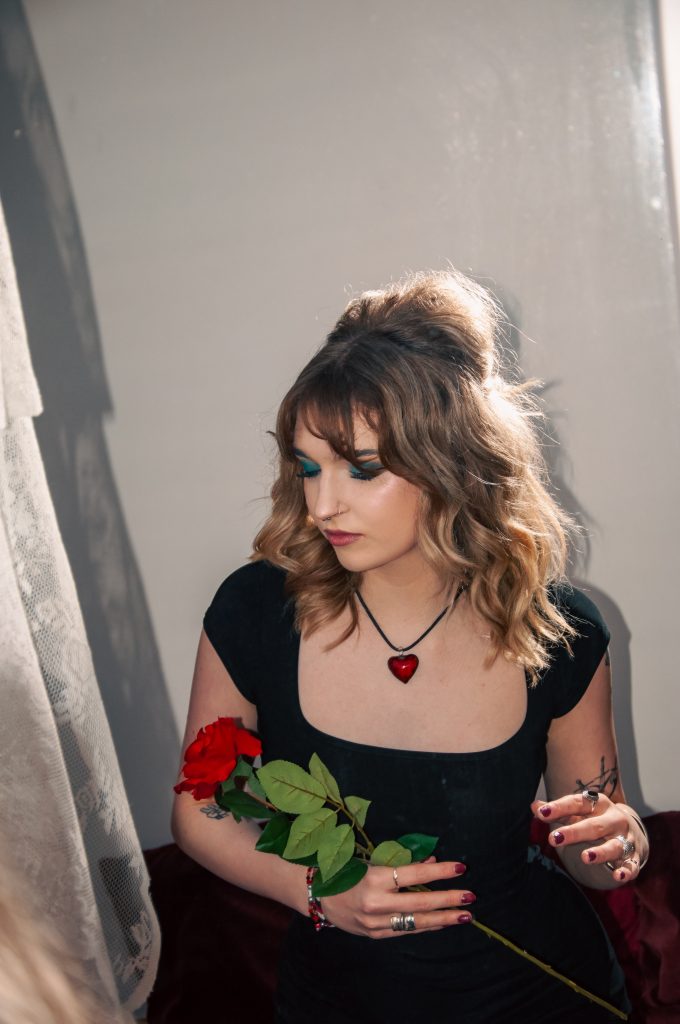
Mica Hill: Spellbound



Claire Gillespie
Mica Hill’s photography journey started before she even realised that’s what it was.
“When I was around 13, I’d walk around local parks and beaches with my phone, snapping a few shots,” she says. “It wasn’t until one of my cousins messaged me and said she really liked my photos that something clicked in my head.”
Mica went on to do Higher Photography, where she fell in love with the work of Mick Ross, Ross Halfin and Robert Mapplethorpe and decided to leave school and pursue her passion for photography at Ayrshire College.
“I knew I wanted to create images that shocked people but also had a story behind them,” says Mica, who is now 18. When she was asked to work with Police Scotland in November 2022 to create an image about coercive control, she grabbed the opportunity. This became the seed of her Spellbound project, which is exhibiting at Ayr’s Narture Studios from 12th July to 12th August.
“The Spellbound story is a dark, twisted one,” Mica reveals. “The main character is a very beautiful, messed-up fairy. In the images she wears gorgeous dresses and is shown on weird yet endearing sets. She’s a little naive and portrays a character of a younger age.”
As Mica explains, the first three images provide the viewer a look inside the fairy’s world. “It’s all a little dramatic, she’s extremely unwell and vulnerable and believes that she needs someone to save her. This is where ‘the fox’ comes in — a sly, cunning predator. He’s also very wise — hinting at the idea of him being older. He takes everything from the fairy, which is visually represented with a very graphic image using a real heart.”
Mica hopes viewers of the exhibition will have an emotional experience that will be enhanced by an accompanying documentary that explains the narrative of the images but also tells Mica’s own story of abuse at the hands of her ex-boyfriend.
“I want other young women in similar situations to know they’re not alone,” she says. “I want them to know that it’s not okay to be treated this way. I hope that by spreading awareness of coercive control, other people will pick up the signs that I didn’t.”
Although Spellbound stems from Mica’s personal experience, she hopes viewers will focus on the gravity of the impact of coercive control in general.
“It’s a trauma that can be prevented,” she explains.
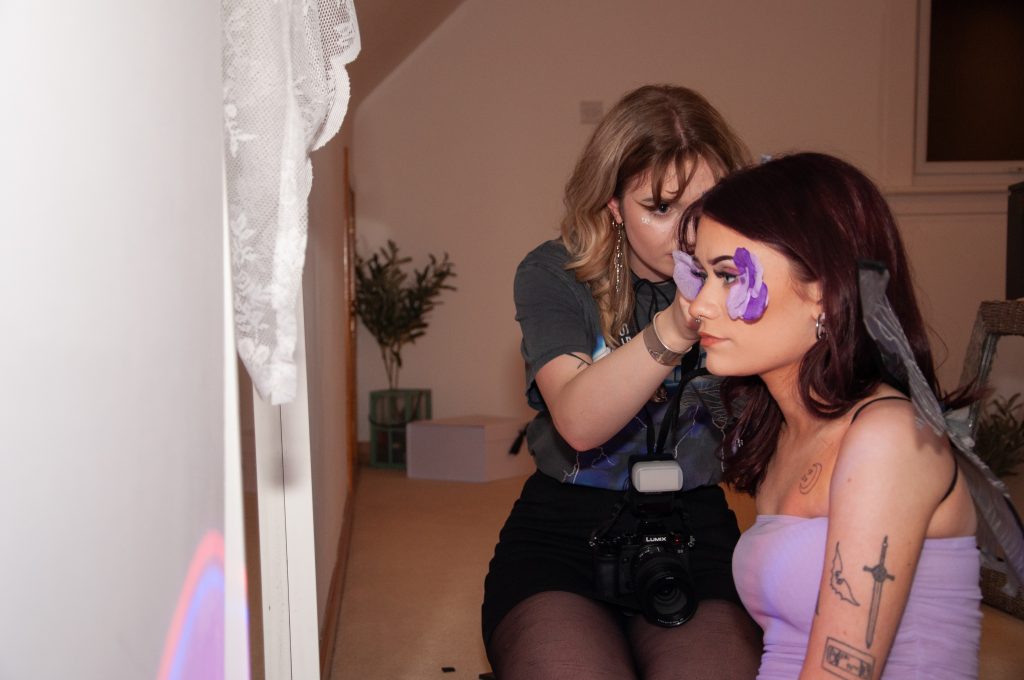
It was crucial for Mica to involve a women’s charity with her project, and that’s where South Ayrshire Women’s Aid (SAMA) stepped in.
“It takes courage for any survivor to speak openly about their own personal experience of domestic abuse,” says SAMA training worker, Niamh Connolly. “Mica has shown courage with the creation of the Spellbound project and her commitment to providing an opportunity to share information about coercive control is something that has resonated with us as an organisation.”
The term “coercive control” was coined by the late Evan Stark, a sociologist, forensic social worker and award-winning researcher.
“Stark brought awareness to the reality that domestic abuse is not only physical violence but includes the patterns of behaviour that someone will use in relationships to remove away someone’s sense of self and safety through controlling behaviours,” Niamh explains. “The person directing the harm will use various tactics such as intimidation, manipulation and isolation among others to enforce power and control. For the person who is being harmed, it can often feel like their life has been hijacked.”
Many young people are in relationships where someone is using coercive control and trying to control who their partner can speak to and spend time with. Niamh adds: “They might be forced into sharing their location, harassed with constant messages and texts, or pressured into any sexual activity, including sending sexual images.”
Coercive control is a criminal offence in Scotland under the Domestic Abuse (Scotland) Act 2018. In Scotland. Niamh points out a harrowing statistic: each year an average of over 60,000 cases of domestic abuse are reported in Scotland. Nobody knows exactly how many victims of domestic abuse never report it, which can be due to a number of reasons.
“Because coercive control isn’t always recognised as a young person’s issue, a young person might not recognise the behaviour as a domestic abuse harm and might not think anyone will believe them,” says Niamh. “Sometimes, they might be very worried and scared about what might happen if they do disclose or report it.”
This makes raising awareness hugely important, and Mica’s Spellbound project shows that this can be done in many different ways.
“This is a project that supports young people with information about their rights in their relationships as well as creates the awareness that there is always help and support available,” says Niamh.
Mica wanted Spellbound to be something that would help women in different ways — not just in terms of being able to relate to the content but to connect them to resources they could use for help.
“A lot of young people don’t have parents or an appropriate adult they can go to, and even if they do, it can be scary,” she says, revealing that she was scared to ask for help when she was the victim of domestic abuse. “I’ve had such an amazing response working with Women’s Aid and having their reassurance and support has really given me the confidence to power through with Spellbound.”
Spellbound is at Narture Studios, Newmarket Street, Ayr, from 12th July to 12th August. You can connect with Mica on Instagram: @micaelliehill.photography. South Ayrshire Women’s Aid provides confidential support and service to women, children and young people who are living with and being affected by domestic abuse in their relationships and families. They can be contacted at 01292 266482. They also offer a confidential, gender-inclusive young people’s support service (13 to 18 years) on 01292 67067. If you are ever in an emergency, South Ayrshire Women’s Aid encourages you to call 999.