RUSSELL WALLIS

The art of car design
David Milloy
Designing cars sounds like a very glamorous job, but as Russell Wallis, who holds a degree in Automotive and Transport Design from Coventry University, tells us, getting a job in vehicle design isn’t quite as simple as firing off a few drawings and a covering letter to the car manufacturer of your choice.
So, Russell, where did the road that led you to study automotive design begin?
A love of cars and a love of drawing. I’ve been fascinated with cars since a very young age. My interest in drawing came a bit later, after I realised that there was a limit to what you could build with Lego but pretty much no limit to what you could draw.
Where did your interest in cars come from?
It’s always been a part of me. I don’t really know where it’s come from and what sparked it.
What made you decide that you’d like to become a car designer?
When I was about 10 or 11, Blue Peter ran a competition to design a new Mini. The boy who won it told the presenters that he wanted to be a car designer when he grew up. I hadn’t realised until then that some people were lucky enough to design cars as a job! It was a lightbulb moment for me, and from that moment on I wanted to be a car designer.
And that eventually led you to studying Automotive Design at Coventry University?
That’s right. After completing an art foundation course at Cheltenham Art College, recommended by Coventry University, I was then successful in gaining a place on the course. The interview for a place at Coventry wasn’t what you would call a traditional interview. Instead, you had to take a portfolio of design work and art work with you to show to the course tutors, usually three of them. They wanted to see evidence that you could draw and, just as importantly, had interesting design ideas. On the day I went for my portfolio to be assessed, there were about 20 to 30 applicants there for the same reason. Only three of us gained a place on the course.
How many other people were on the course?
I was one of about 100 students who started the course that year. For every student who got on the course there were four whose applications were rejected.
What did you study during your first year?
There was a design project in the first term, which you had to pass if you wanted to stay on the course. Mostly, though, the first year was about bedding-in to the course, honing your drawing skills and improving your rendering prowess. It also focused on getting an understanding about how cars are designed and who really designs them.
What do you mean when you say, “who really designs them?”
The chief or lead designer may get the headlines but is always supported by exterior and interior design teams who do much of the work but get little or no public recognition. Most designers work on relatively unexciting but important components. For example, one designer might be responsible for the interior lights and another might design the cup holders.
Did any noted car designers act as tutors on the course or otherwise interact with students?
Quite a few. Our main tutors had all worked in industry at Ford, British Leyland, Jaguar, and Honda. We used to have a lecture every Wednesday afternoon with a guest lecturer from industry, such as Anthony Grade from Renault and the Head of Design of the (then) new Rolls Royce Phantom. Some gave talks and others played a more hands-on role. One very well-known designer who spent quite a lot of time helping out on the course was Harris Mann. He was a really nice person and superb at clay modelling. I was first introduced to him in my first year. To my shame, I didn’t know who he was. I don’t think I was alone in that, though. I didn’t find out until after the project was completed that he’d been the Chief Designer at British Leyland and was responsible for the Allegro, Princess, and TR7!
What challenges did you face in second year?
In second year, we were introduced to ergonomics – how to make a vehicle suitable for use by its intended end users – which is an incredibly important aspect of vehicle design. We worked in groups to simulate working in design teams. My group’s brief was to take a small vehicle and optimise it for use by a mother and children. So we went out and interviewed mothers with cars and asked them to tell us if there was anything about their car that wasn’t best suited to their needs. We then produced a research report and designed a small car, based on the Smart car dimensions, that solved these problems through good design. It was an interesting but difficult project. We we also introduced to Alias, a computer modelling software package which professional automotive designers use. This gave us the chance to dive into the world of digital 3D modelling. It isn’t for everyone!
Did the course ramp up in intensity in third year?
Absolutely, third year started with an exciting project run as a competition in association with the Canadian Auto Show. It was open to all the automotive design schools around the world. The brief for students was to create a new version of an iconic car from their country of origin, to be ready for launch in ten years’ time. Ultimately, two students from each design school would be chosen to display their respective designs at the Show. My design – a modern take on the Morris Minor Traveller – was very well received by the tutors but I didn’t win a trip to Canada.
In the second term we worked on a ‘live industry’ project with Prodrive, the company which ran the Subaru World Rally Team and the BAR F1 Team. The project was to style a radical city car concept called Naro, which was only about 2.5 metres long, about as wide as a motorbike, and leaned into corners. Initially, we were working by ourselves producing ideas that were then chosen by Prodrive to be developed in teams of five students put together by our tutors. We had to produce a clay model and present our final design to Prodrive.
Did the Naro ever make it into production?
Sadly not. A prototype was built and was tested but that’s as far as it got.
Were students ever given placements with design studios as part of the course?
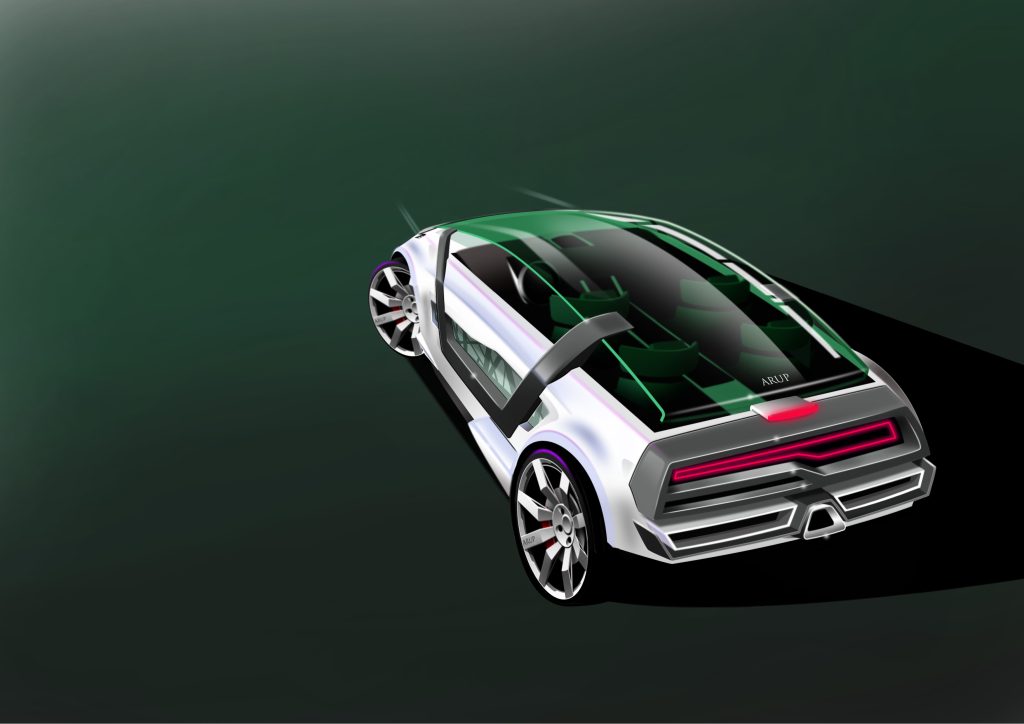
Yes. In our last term in third year, we were placed with various companies, who selected which students they wanted after reviewing their portfolios. Along with some other students, I was placed with Arup, a civil engineering company which had a small car consultancy. Our brief was to design a car which was representative of Arup as a company. It was quite a challenging project but I thoroughly enjoyed working with Arup’s designers. I learned a lot from them, both from direct advice and from simply watching how they worked.
What did the course focus on in your final year?
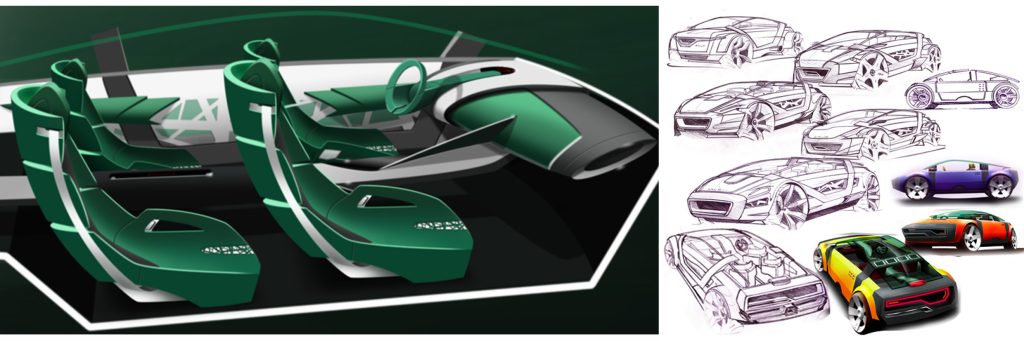
Each student was tasked with designing a vehicle of their choice. The idea being that this would showcase everything you had learned on the course as well as identifying your own particular design interests. It would also form a large part of the portfolio that you would pitch to potential employers. Your design had to be viable – you had to show that, if built, it would be both accessible and useable as a road vehicle. So you had to think of things like the vehicle’s packaging, ergonomics, running gear, and interior dimensions as well as its styling.
What did you design?
A new Lancia luxury car with an interior inspired by the design philosophy of Bang & Olufsen, the Danish hi-fi and consumer electronics company. German cars dominated the luxury car market at the time, and I wanted to design something that would be a credible alternative to them. To this day, I still have mixed feelings about my design – I love it one minute and hate it the next. If I could find the time, I’d be tempted to redesign it. I’ve still got the ¼ scale model I built of it as part of the project brief.
What did you do when you graduated?
My dream had been to get a job with Citroën, but it wasn’t to be. Although I graduated with a first-class honours degree, the automotive industry was tightening its belts and very few jobs were available with design studios. Only a handful of people in my year got jobs in the automotive industry. I did think of taking a Master’s degree but a close family member became seriously ill and I stepped away from design for a couple of years. I suppose I could have returned to chasing my dream later on but I had moved on from it, so I decided to set up my own graphic design business. I figured that since I had a degree in design, I might as well put it to good use. After that, it was a question of building up a portfolio and getting my name and work out there. Later on, I discovered that there was a market for car art so I branched into that.
What form does your car art take?
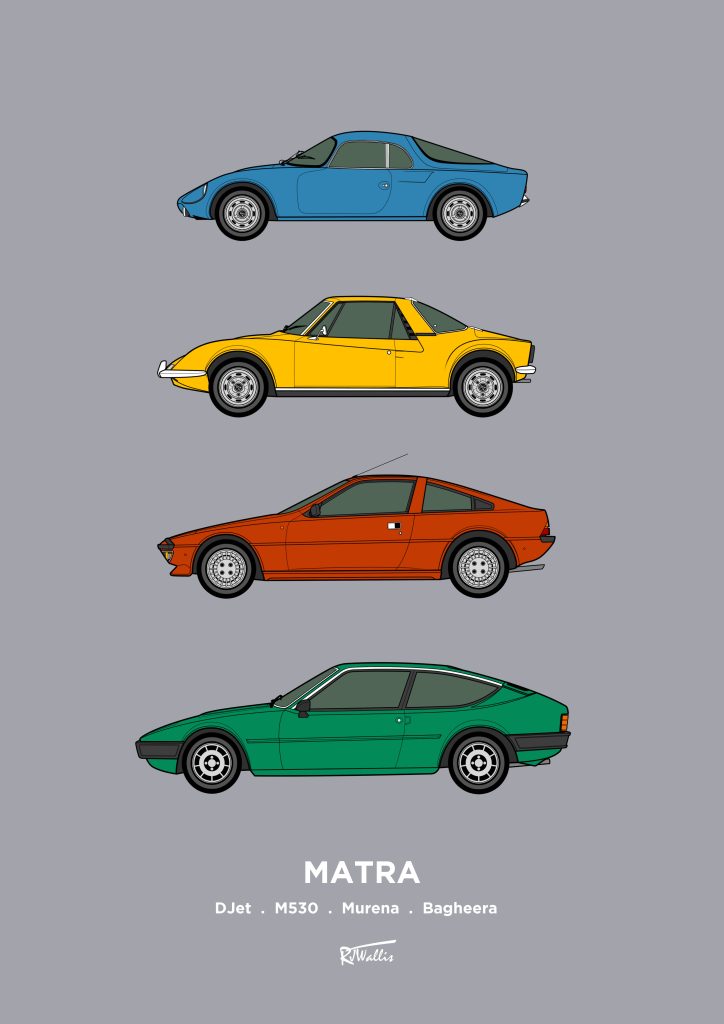
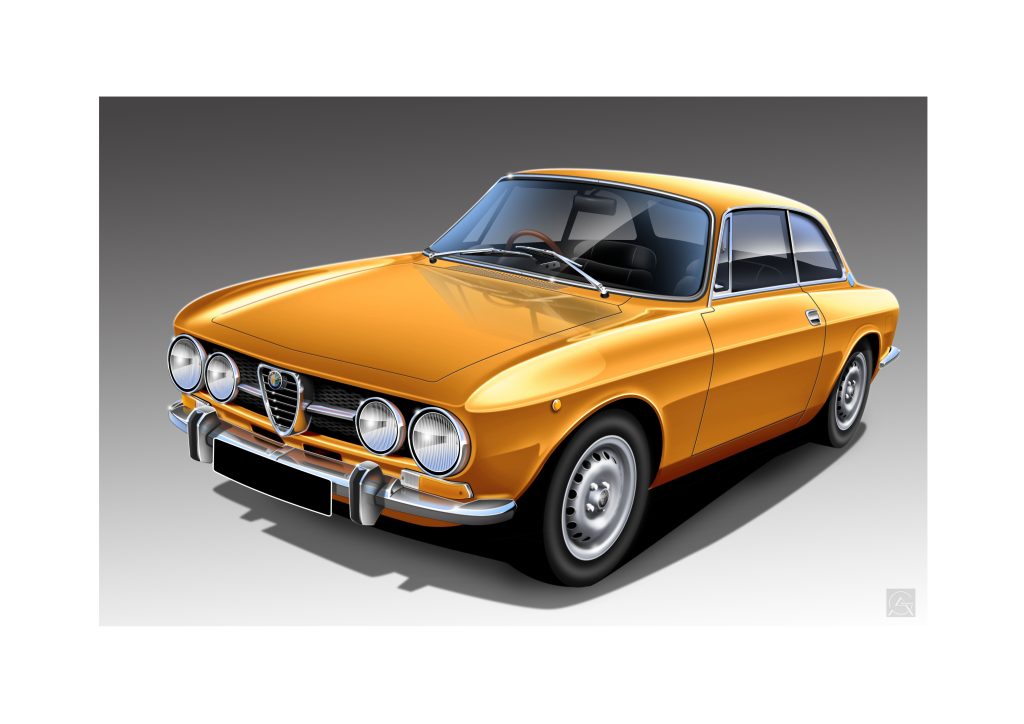
I do all sorts of illustrations of cars, mostly classic cars, ranging from a bespoke illustration of a particular car for a client, to poster-type illustrations of model families, such as 1980s Citroëns or 1990s hot hatchbacks. Many of these general illustrations are available not just as prints but also on T-shirts, mugs, cushions etc.
And these are available online?
Yes, I have a couple of online shops, and people can also contact me directly if they want something bespoke. I’m always happy to accept commissions!
You also illustrate books.
Yes, I’ve both done a number of book covers and interior illustrations. Again, I’m happy to accept commissions for those too!
Do you ever think of what might have been if you’d continued to pursue a career as an automotive designer?
Not with any great sense of loss. I enjoy what I do and I love the feedback I get from clients. It’s very rewarding. I don’t expect that spending years designing, say, a windscreen wiper for a car would be as satisfying. I’ve spoken at length to someone who worked as a designer for one of the big manufacturers. The picture he paints of life as a designer is one that’s full of frustration. That wouldn’t appeal to me.
What do you make of modern car designs?
I’m not a fan. There’s far too much emphasis on SUVs and not enough diversity or originality. I still love older cars, though.
Do you have any classic cars?
I’ve got three Citroëns – an XM, a C5, and a Xantia. I’ve also got a first-generation Ford Ka. I’m a huge fan of its ‘New Edge’ styling and it’s also great fun to drive.
Leaving aside your design skills for a moment, how are you with a spanner?
Not bad. I enjoy working on my cars. I must do because I’ve taken the engine and gearbox out of my XM several times!
Do you have any advice for anyone thinking of pursuing a career as a car designer?
Getting a place on an automotive design course isn’t easy. You need to know a lot about cars and, even more importantly, be adept at drawing them. Practice hard, draw lots of cars and build up a good portfolio. The other bit of advice I’d give to people is to go in with your eyes open. Be aware that statistically you’re unlikely to get a job with a car design studio after you graduate. A few people do but most automotive design graduates end up working in other areas of design. If you can accept that then the course itself is very interesting and gives you a real insight into the world of design.
www.rjwcreativedesign.co.uk
www.redbubble.com/people/RJWautographics/portfolio